


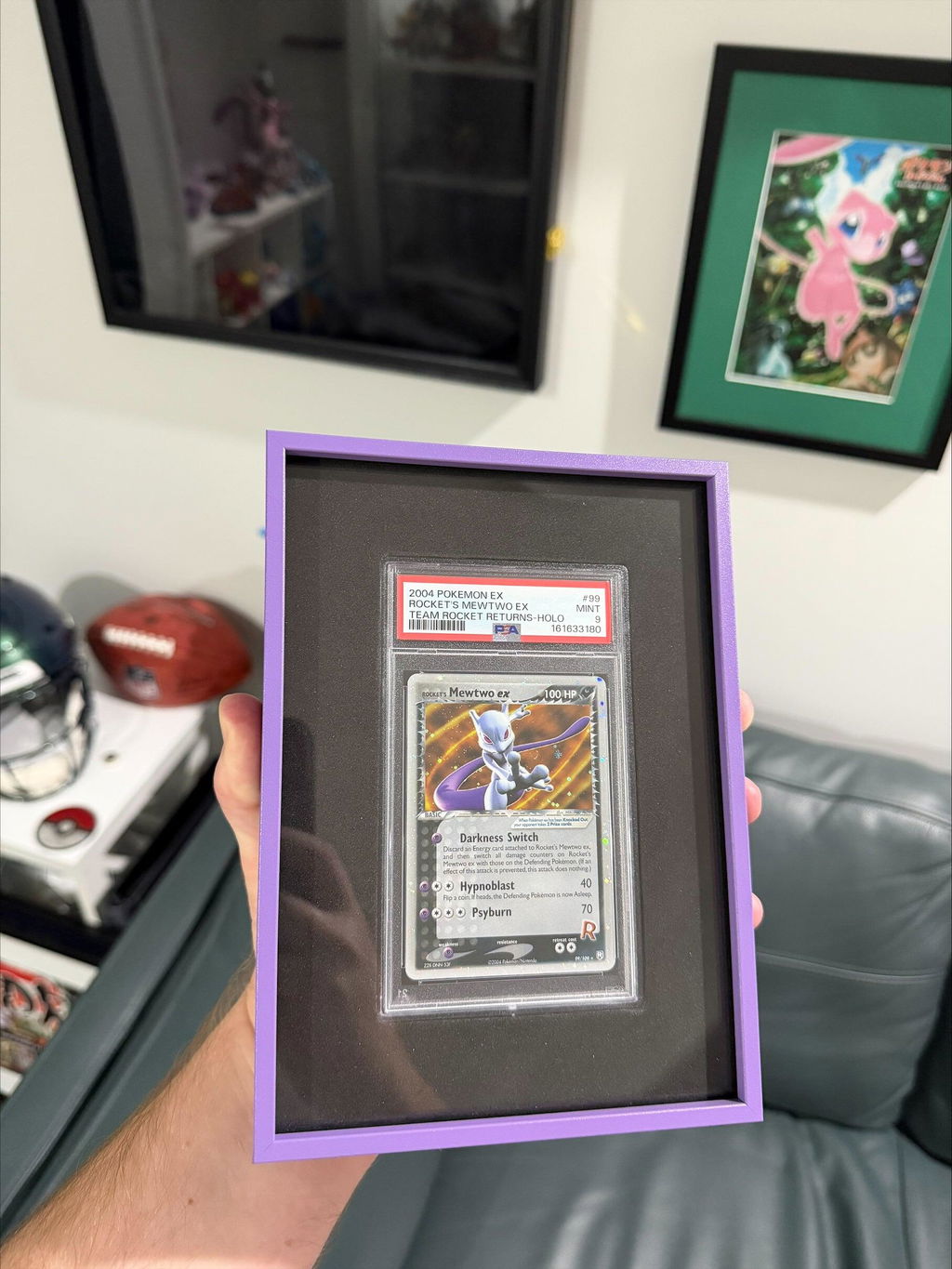
Graded trading cards look simple to display because the holder is already rigid and protective, but the slab introduces new questions about fit, depth, label alignment, weight and access. A good DIY graded display is built around the holder first.
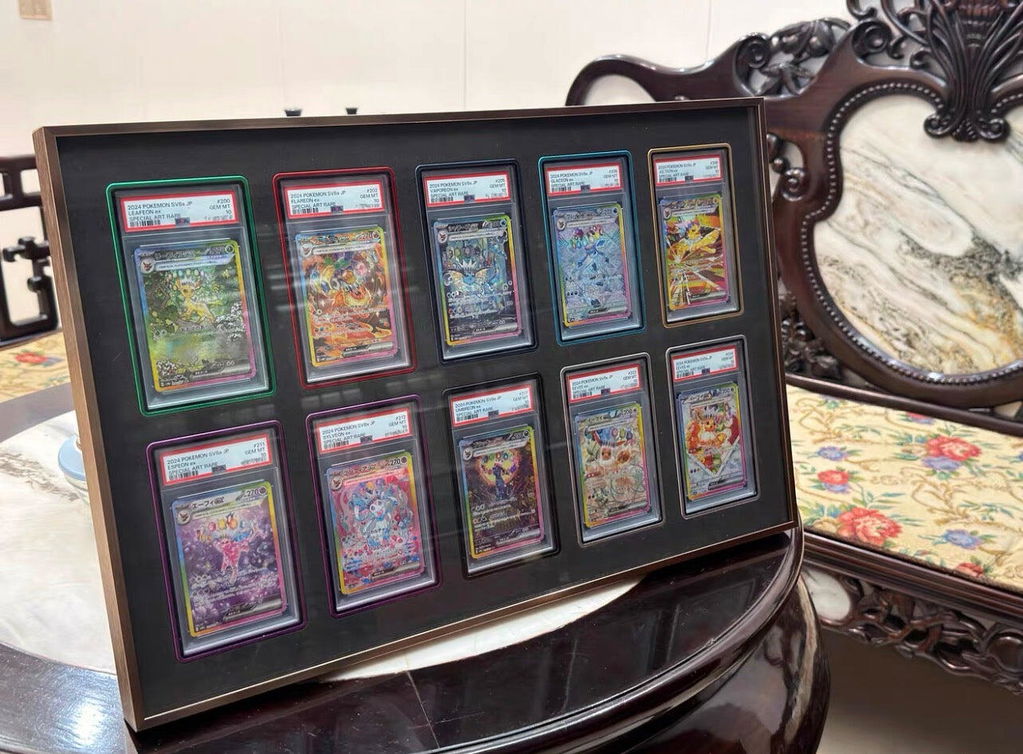
If you are searching for how to make a graded trading card display, a DIY PSA card frame or a homemade slab display, remember that the slab itself is the object the frame has to support.
This guide is specifically about graded trading cards and slab displays. For the broader comparison of raw trading cards, sleeves, magnetic holders and other DIY display approaches, see our complete DIY trading card wall display guide.
A graded trading card display is really a slab display
Once a trading card is graded, the object you are physically building around is the slab. That changes everything from the required depth to the total wall weight.
PSA, CGC, BGS and other grading holders differ in size, thickness, label proportions and edge shape. A DIY builder should never assume a generic “graded trading card” opening will fit every holder correctly.
Choosing a frame material without making the project harder than it needs to be
With graded trading cards, the frame has to carry more weight and more depth than a raw-card display. That makes structure more important from the beginning.
Timber is practical for DIY because deeper profiles are easy to work with. MDF can be used for painted custom frames, although large sections get heavy. Acrylic is useful for keeping the front weight down. Aluminium gives a slim, rigid finish that suits large slab grids particularly well, but accurate fabrication is a more specialised job.
The frame material should also suit the slab labels visually. A clean neutral surround usually works better than a heavily decorative frame when dozens of labels are already creating a repeated pattern.
PSA, CGC, BGS and mixed slab collections
A single-company display is the easiest to keep visually consistent because every slab label sits in roughly the same position. A mixed collection can still work, but the outer holder proportions may create uneven visible faces even when the trading cards themselves are aligned.
Measure actual slabs from the collection and test the insert before cutting the full panel. Manufacturing variations and slab generations can create small differences that matter in a snug foam opening.
The goal is support rather than compression. The slab should sit level without having to be forced into the insert.
Matboard, EVA foam and the part that actually holds the trading cards
Matboard is not usually the first choice for a wall full of slabs because the holders are already thick and visually framed. EVA foam is often more useful because it can support the rigid outside shape while leaving the slab face and label exposed.
Foam density and fit matter. Too soft and the slab can tilt. Too tight and every update becomes difficult. The right opening supports the holder consistently without turning insertion into a force test.
Prototype with real slabs before committing to the full panel, especially when the collection contains different grading companies or holder generations.
Label alignment becomes part of the grid
Raw trading card displays are judged mostly by the artwork openings. Graded displays add another repeated visual element: the grading labels.
When many slabs are shown together, small vertical inconsistencies in label position can become obvious. This is another reason to group similar slab types or use separate modules when the collection is mixed.
Layout planning: where small errors become obvious
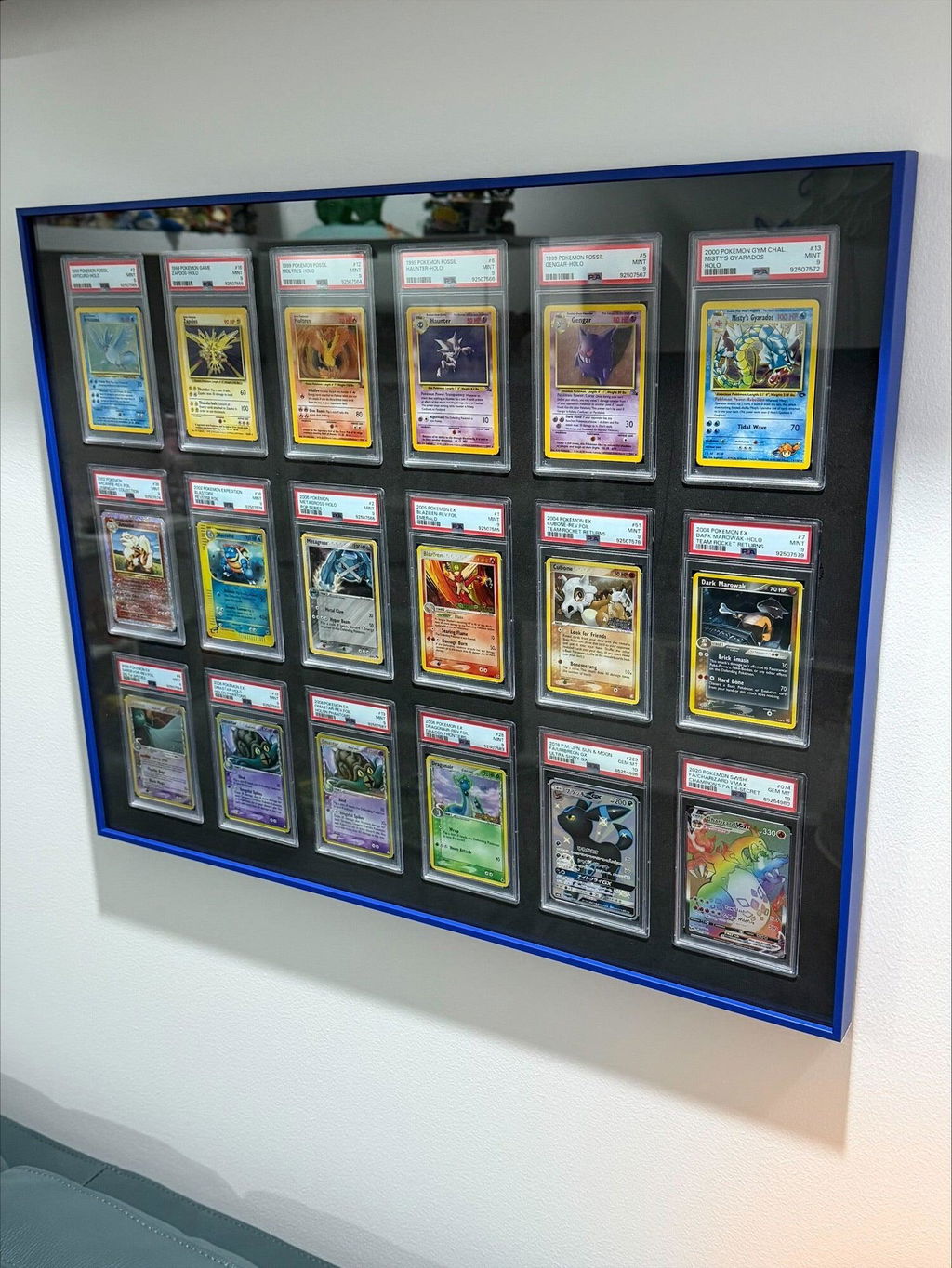
Graded trading card walls expose alignment errors very quickly because the labels create their own grid above the artwork. Even if the trading cards look centred, a drifting label line can make the whole wall feel off.
Single-company displays are easiest to keep uniform. Mixed PSA, CGC, BGS and other slabs can still work, but consider grouping them by row or module so the variation looks intentional.
Mark the total frame size on the wall before cutting the insert. A large slab grid occupies much more visual space than the same number of raw trading cards.
Black and white EVA create very different graded displays
Black EVA tends to make the slab edges disappear, especially with black or dark frames. White EVA creates a brighter, more graphic wall and can make individual slab shapes stand out more clearly.
Neither is better in isolation. The room, frame finish and trading card artwork should decide the direction.
Acrylic, glass and UV protection
Acrylic is often the practical front for a large graded display because it keeps the weight lower and removes the breakage concern associated with a very large sheet of glass. Glass remains useful for smaller frames where scratch resistance matters more.
The slab protects the trading card physically, but it does not make light exposure irrelevant. Keep direct sunlight away from the display and choose UV filtering based on the room and the value of the collection.
Lighting without turning the glazing into a mirror
Graded slabs add another reflective surface behind the glazing, so lighting needs more testing than it does with raw trading cards. A bright LED strip can reflect off the acrylic front, the slab face and the label at the same time.
Soft, diffused lighting usually produces a cleaner result. Test the frame from several positions in the room before fixing a permanent light source.
Weight becomes serious when the slab count rises
A wall of fifty or one hundred graded trading cards carries far more weight than the same number of raw trading cards. The slabs, larger glazing area, insert and stronger backing all contribute.
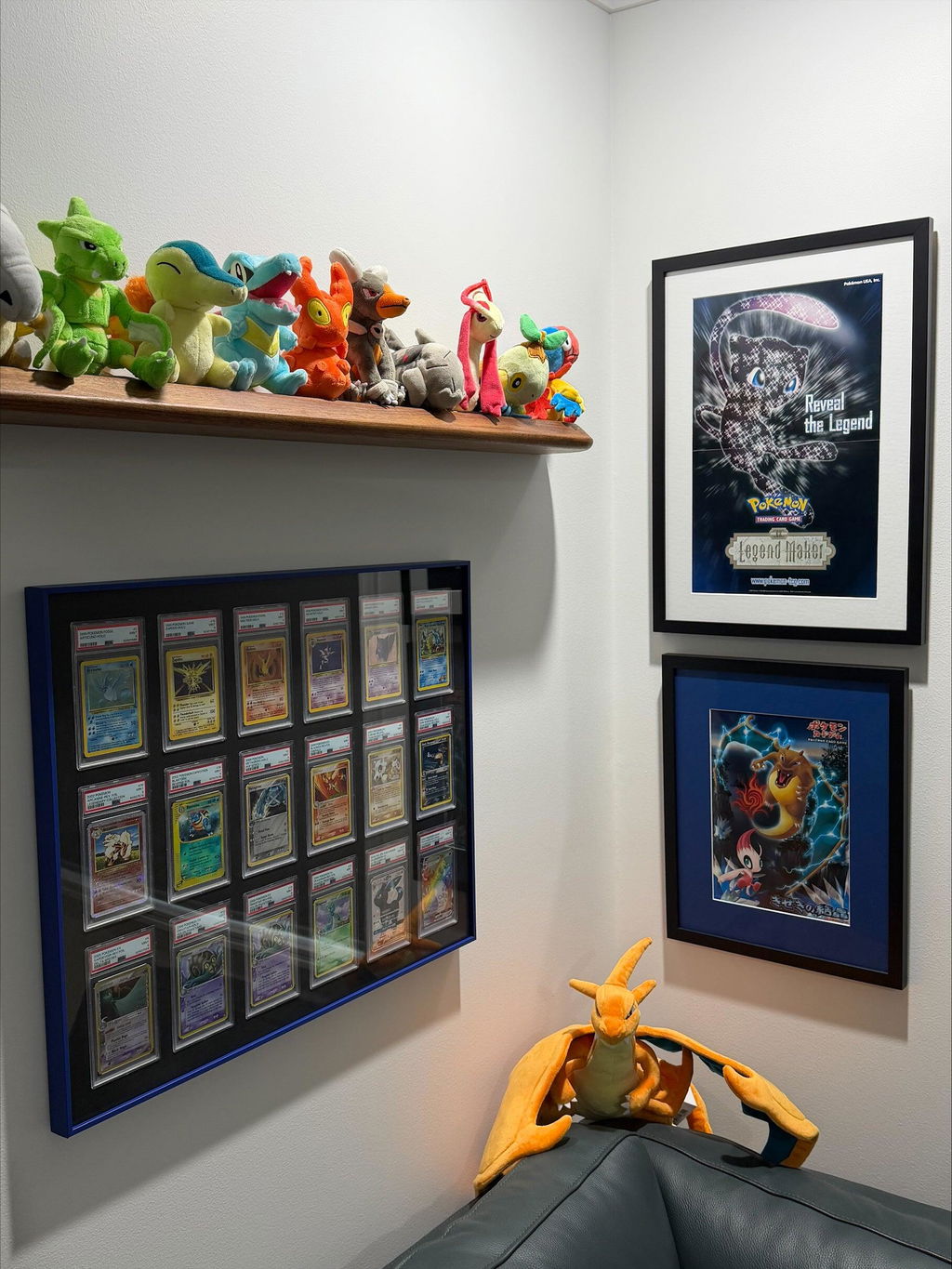
This is where large one-piece displays and modular walls need to be compared honestly. One giant frame creates a strong visual statement, while several smaller frames are easier to lift, mount, move and reopen.
Frame depth, backing and wall mounting
Depth is non-negotiable with slabs. The frame needs room for the glazing, holder, insert and backing without pressing the slab against the front.
The backing becomes part of the structure on a large grid. It should remain flat and support the insert across the centre, not just around the edges.
Weight is the biggest mounting difference. Dozens of slabs, a large panel of acrylic and a rigid backing add up quickly. Use hardware designed for the wall type and final load, and distribute the weight across multiple fixing points when the display is substantial.
Where to source materials for a DIY build
Local foam and plastics suppliers are especially useful for graded displays because EVA and acrylic are often the two materials that need the most precise preparation. Hardware stores cover the outer frame materials and wall mounting, while picture framers can advise on glazing and finishing.
Take a real slab with you when discussing the project. It is easier for a supplier to understand the depth and rigidity requirements when the holder is physically in front of them.
Cheap, mid-range and premium ways to approach the build
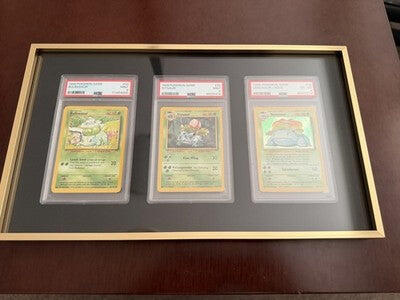
A budget graded display usually starts with a deep ready-made frame or shadow box and a simple custom insert. That can work well for a small group of slabs.
A mid-range build can add custom acrylic, denser foam, stronger backing and a better outer frame. This is where the display starts becoming purpose-built rather than adapted.
Large premium walls may justify aluminium, upgraded glazing and professional mounting. At that scale, consistency and structural confidence matter more than decorative extras.
Why a graded trading card display should remain serviceable
Graded collections change. A higher grade replaces an older slab, one trading card is sold, or the collector changes grading company. A wall display should make those changes possible without damaging the insert or frame.
Removable backing and a tested foam fit are more valuable in the long term than a display that is extremely tight but frustrating to use.
Why slab labels change the visual design
A graded trading card display contains two pieces of information in every opening: the trading card and the label. Once many slabs are shown together, the labels create their own repeated pattern.
This is why mixed grading companies can feel visually busier even when the trading cards themselves are similar. The slab size, label colour and label height can all change the rhythm of a grid.
Single-grading-company displays versus mixed slabs
A single-company slab wall is easier to keep uniform. A mixed wall can still work well, especially if the collection value or history matters more than perfect visual consistency.
If the differences are strong, one option is to group grading companies into separate rows or modules. That turns variation into an intentional design choice rather than a mistake.
Foam compression and long-term fit
EVA foam should support the holder without acting like a clamp. A fit that feels impressively tight during assembly may become annoying every time the collection changes.
Prototype the material with the actual slab and test insertion and removal several times. Look for obvious compression, tearing or permanent deformation around the opening before committing to a full panel.
Large slab walls and cumulative weight
One graded slab does not weigh much. Dozens of them do. Add a large frame, glazing, backing and insert, and the finished wall display can become substantial.
This should influence both the frame material and mounting strategy. A large slab wall may need more than one fixing point and may be easier to install with two people.
Transporting a graded trading card display
If the display ever needs to move, decide whether the slabs should remain inside it during transport. A wall-mounted frame that supports slabs perfectly in a vertical position may experience very different forces when carried flat or tilted.
For valuable collections, removing the slabs and transporting them separately can reduce unnecessary risk. The frame can then be remounted and the collection reinstalled.
Cleaning graded trading card displays
Slabs themselves can attract fingerprints and dust, especially when a frame is reopened. Handle them by the edges where possible and clean the front glazing with an appropriate method before closing the display again.
If acrylic is used, avoid abrasive cleaning materials. Small scratches become much more visible when a large sheet is viewed under strong light.
Common DIY mistakes that are easy to avoid
- Assuming every grading company's slab uses the same outer dimensions.
- Cutting a full foam panel before testing one real slab.
- Making the fit so tight that removing slabs damages the insert.
- Ignoring label alignment across mixed grading companies.
- Choosing glass for a huge frame without considering the added weight.
- Using backing that flexes under a large slab grid.
- Mounting the frame with picture hooks intended for a much lighter object.
- Transporting a loaded display without considering how the slabs are supported when the frame is tilted.
A practical build sequence
- Choose the grading companies and slab types that will be displayed.
- Measure actual examples from the collection.
- Decide whether mixed slabs should share one grid or separate modules.
- Mock up the completed frame size on the wall.
- Select the frame, foam, glazing and backing.
- Prototype one slab opening and test insertion and removal several times.
- Dry-fit the material stack to confirm depth.
- Assemble the grid and check label alignment vertically.
- Mount the completed display using hardware suited to its real weight.
When DIY makes sense and when ready-made starts looking attractive
A small slab display can be a satisfying DIY project, particularly if you are comfortable cutting foam and building a deeper frame.
Large graded walls demand much more precision and structural planning. When the slab count rises, a ready-made system can become attractive simply because it removes a lot of repetitive measuring, cutting and fitting.
Single grading company or mixed slabs?
A wall of one slab type is the easiest route to visual consistency because the holders and labels repeat. A mixed wall can still look excellent, especially when the collection matters more than uniformity, but the differences should be acknowledged in the layout.
Group slab types by row, column or module if the variation is strong. That makes the change look intentional. Trying to hide obvious differences usually draws more attention to them.
Why label alignment matters so much
Graded trading card displays have two grids at once: the artwork and the grading labels. A row can look uneven even when the trading card images are centred if the labels drift vertically.
Check the display while it is standing upright, not only flat on a table. Gravity can reveal movement that is not obvious during assembly.
For mixed grading companies, perfect label alignment may be impossible. In that case, prioritise consistent holder positioning and let the labels vary naturally.
Testing EVA foam before cutting a full panel
A small test piece is one of the cheapest forms of insurance in the project. Cut a single opening, insert the actual slab and remove it several times. Look for tearing, excessive compression or a holder that feels difficult to release.
Also stand the test piece vertically. A fit that seems fine while flat may allow the slab to sag once gravity is involved.
If the collection contains several slab types, test each one independently rather than assuming one fit will transfer to another.
Large graded walls and cumulative weight
The weight of one slab is easy to ignore. Multiply that across a large collection and then add the frame, front acrylic, EVA and rigid backing, and the finished object becomes substantial.
This should influence the outer frame, mounting system and installation plan. It may also influence whether one large frame is sensible at all.
Several smaller modules distribute the wall into easier pieces. One large display gives a cleaner uninterrupted look. The right answer depends on the room and how often the collection is likely to move.
Transporting a loaded slab display
A wall frame is designed primarily to work vertically. Transporting it flat, on its side or at an angle changes the forces acting on the holders and insert.
For a valuable collection, consider removing the slabs before a major move. The empty frame is easier to handle and the trading cards can travel separately in their normal protective storage.
Upgrading grades without rebuilding the frame
One of the reasons to keep a graded display serviceable is that collectors upgrade. A PSA 8 becomes a PSA 9, a raw trading card is submitted for grading, or one grading company is replaced by another.
If the replacement holder has the same general format, a removable backing makes the update easy. If it changes slab type, a modular insert or separate frame can prevent one upgrade from forcing a complete rebuild.
Cleaning slabs and glazing
Fingerprints are particularly visible on slabs because the holder itself is glossy. Handle slabs by the edges when installing them and clean the front surfaces before closing the frame.
Acrylic glazing needs a soft cloth and acrylic-safe cleaner. Fine scratches that seem minor on a small piece can become obvious across a large sheet under strong room lighting.
When to use one large graded display and when to split it up
A single large slab wall creates the cleanest uninterrupted grid, but it also concentrates the weight and makes transport more difficult. Several smaller frames are easier to lift, mount, move and expand.
If the collection is complete and unlikely to move, one large frame can make sense. If the slab count is still growing or the collection may be reorganised, modular displays are usually more practical.
Different slab generations can still matter
Even within one grading company, holder designs can change over time. Small changes in shape or thickness may not matter in loose storage but can matter inside a snug insert.
Measure more than one slab if the collection spans different eras. A test based on one recent holder may not represent every slab on the wall.
Do not let the glazing support the slabs
The insert and backing should carry the holders. The front acrylic or glass should protect the display, not act as the surface that stops slabs from falling forward.
If a slab has to press firmly against the glazing to stay in place, the internal support system needs to be reconsidered.
Check the finished display vertically before mounting
Always stand the completed graded display upright before it goes on the wall. This is when gravity reveals small problems that are easy to miss while the frame is lying flat: a slab that rotates slightly, an insert that moves, or a label row that no longer looks straight.
Fix those issues on the bench rather than after the frame is mounted.
If you plan to add another graded display later, keep a note of the slab types, insert material and outer frame finish used in the first one. Consistency is much easier to reproduce when the original choices are recorded.
Record the mounting method as well. A second large slab display may need the same kind of wall fixing, and knowing what worked previously makes the next installation much easier to plan safely.
How to make your own graded trading card or PSA display frame
A DIY PSA card frame or homemade graded trading card display needs a deeper frame, rigid backing and an insert that supports the slab without excessive pressure. Measure the actual slabs you own and test one opening before cutting the full panel.
A cheap slab display can start with a deep ready-made frame. A premium version may use custom acrylic, denser EVA foam, aluminium or solid timber framing and stronger wall mounting.
Frequently asked questions
Can PSA and BGS slabs be displayed in the same frame?
Yes, but their outside dimensions and thicknesses differ. A mixed slab display should be designed around the actual holders.
How tight should EVA foam fit around a graded slab?
Snug enough to support the slab and stop visible movement, but not so tight that insertion or removal requires excessive force.
Is acrylic suitable for large graded trading card displays?
Yes. Its lower weight compared with glass is especially useful as the display gets larger.
Do graded trading card displays need special wall mounting?
They need mounting hardware appropriate to the finished weight and wall type. Large slab displays can become substantial.
Can graded trading cards be displayed in direct sunlight?
Direct sunlight is best avoided even when UV-resistant glazing is used.
Final thoughts
A graded trading card display succeeds when the slabs are supported consistently, the labels align cleanly and the finished frame remains easy enough to reopen when the collection changes. The more slabs involved, the more important weight, backing and wall mounting become.
Continue Exploring
If you enjoyed this guide, you may also find these collector resources helpful.
📚 Collector Guides
-
Best Trading Cards to Display & Collect
Explore Pokémon, MTG, Yu-Gi-Oh!, Sports Cards, One Piece and Disney Lorcana cards, sets, rarities and collection ideas. -
The Ultimate Trading Card Display Guide
Explore trading card wall displays, frames, shelves, layouts and display solutions for collections of every size. -
How to Display Graded Cards on a Wall
Learn how collectors display PSA, BGS and CGC graded cards using wall-mounted trading card displays.
🛒 Shop Display Collections
-
Aluminium Trading Card Wall Display Frames
Premium aluminium trading card display frames available in a wide range of grid sizes, frame colours and holder formats. -
PSA, CGC & BGS Graded Slab Wall Display Frames
Purpose-built graded trading card display frames for Pokémon, MTG, Yu-Gi-Oh!, One Piece, Sports Cards, Disney Lorcana and other collections. -
One Touch Wall Display Frames
Premium aluminium wall display frames designed for One Touch magnetic trading card holders.

0 comments