


Best Pokémon Card Display Ideas: The Ultimate Guide to Displaying Your Collection
At some point, most Pokémon collectors reach the same stage.
You have a binder or storage box full of cards you have spent months or years collecting, but only a small number of them are ever actually seen.
Some may be valuable. Others might be favourite Pokémon, standout artwork, difficult pulls, completed set highlights or cards you simply enjoy looking at.
That is usually when displaying part of the collection starts to make sense.
A well-planned Pokémon display can turn selected cards into a feature within a gaming room, office or collector space without requiring the entire collection to come out of storage.
The best displays are not necessarily the largest or most expensive. They are usually the ones with a clear theme, enough space around the cards and a layout that suits the collection.
This guide looks at some of the best Pokémon card display ideas, including raw cards, graded slabs, One Touch holders, wall frames, shelves, display cases, lighting, frame sizes and larger collector-room layouts.
Why More Collectors Are Displaying Their Pokémon Cards
Binders and storage boxes still play an important role in protecting and organising Pokémon collections.
But they are designed around storage rather than visibility.
Displaying selected cards gives collectors a way to keep favourite parts of the collection visible without changing how the rest is stored.
Some of the main reasons collectors choose to display cards include:
- Keeping favourite artwork visible.
- Giving important cards a clear place within the room.
- Making better use of wall space.
- Organising smaller themed groups separately from the main collection.
- Creating a collector wall or dedicated display area.
For many people, a smaller group of well-chosen cards is more enjoyable to look at than trying to put everything on display at once.
That does not mean the rest of the collection matters less. It simply means storage and display can serve different purposes.
Start With What You Actually Want to Display
One of the easiest ways to make a Pokémon display feel disorganised is to start with the frame instead of the cards.
A better approach is to choose the group first.
That group might be based around a favourite Pokémon, one evolution line, a particular era, a set, a rarity or simply a selection of personal favourites.
Favourite Pokémon
Many collectors build displays around one Pokémon.
Popular examples include:
- Charizard.
- Pikachu.
- Umbreon.
- Gengar.
- Mew.
- Rayquaza.
- Lugia.
A display focused on one Pokémon can feel more organised than a random group of unrelated cards, even if those cards come from different sets or years.
Evolution Lines
Evolution lines naturally lend themselves to smaller grouped displays.
Examples include:
- The original Kanto starters.
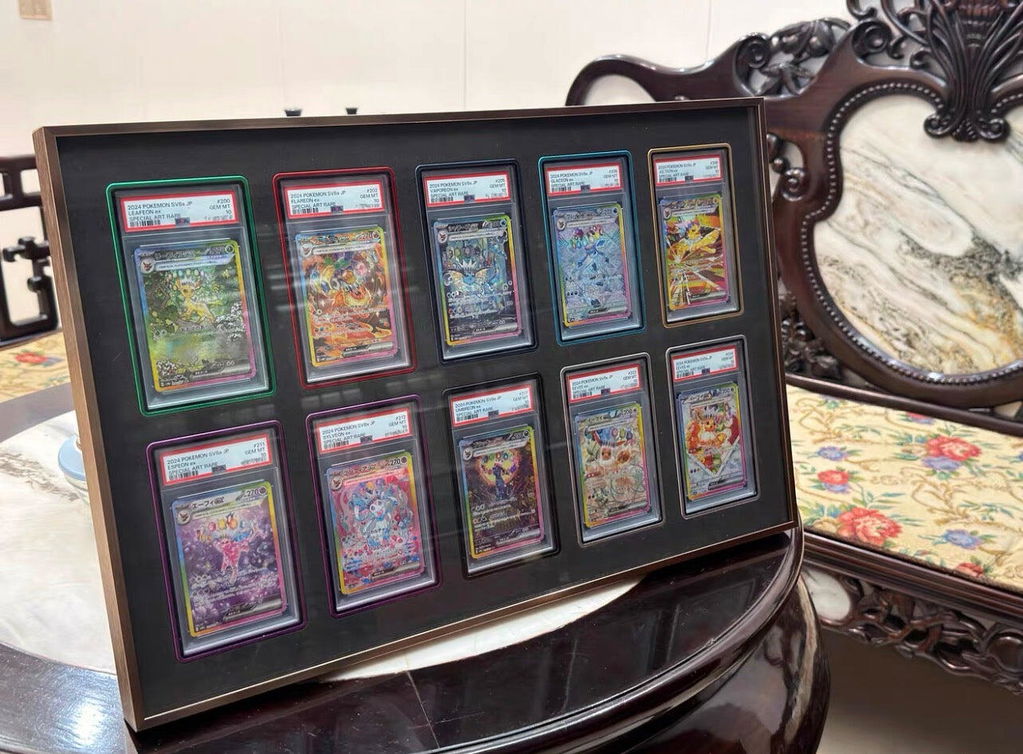
- Eeveelutions.
- Ralts, Kirlia and Gardevoir.
- Dratini, Dragonair and Dragonite.
Three, six and nine-card layouts can work particularly well when the cards already form a natural sequence.
Favourite Artwork
Not every display needs to be based on rarity or value.
Illustration Rares, Special Illustration Rares, alternate arts and other artwork-focused cards can work extremely well together because the visual connection between the cards becomes the main theme.
Master Set Highlights
Displaying an entire master set is not always practical.
Instead, some collectors choose the cards that best represent the set and display those together while keeping the rest organised in storage.
This can create a cleaner result without losing the connection to the complete set.
Raw Cards, Graded Cards or One Touch Holders?
Before choosing a frame or display method, it helps to decide which card format you are actually working with.
Raw cards, graded slabs and One Touch magnetic holders all create different display requirements.
Raw Cards
Raw and sleeved cards are lightweight, compact and easy to organise into larger artwork-focused displays.
They are particularly well suited to:
- Illustration Rare collections.
- Complete or partial sets.
- Favourite Pokémon groups.
- Modern collections that are still changing.
Because the cards take up relatively little space, larger raw-card layouts can stay much more compact than equivalent slab or One Touch displays.
PSA, CGC and BGS Graded Cards
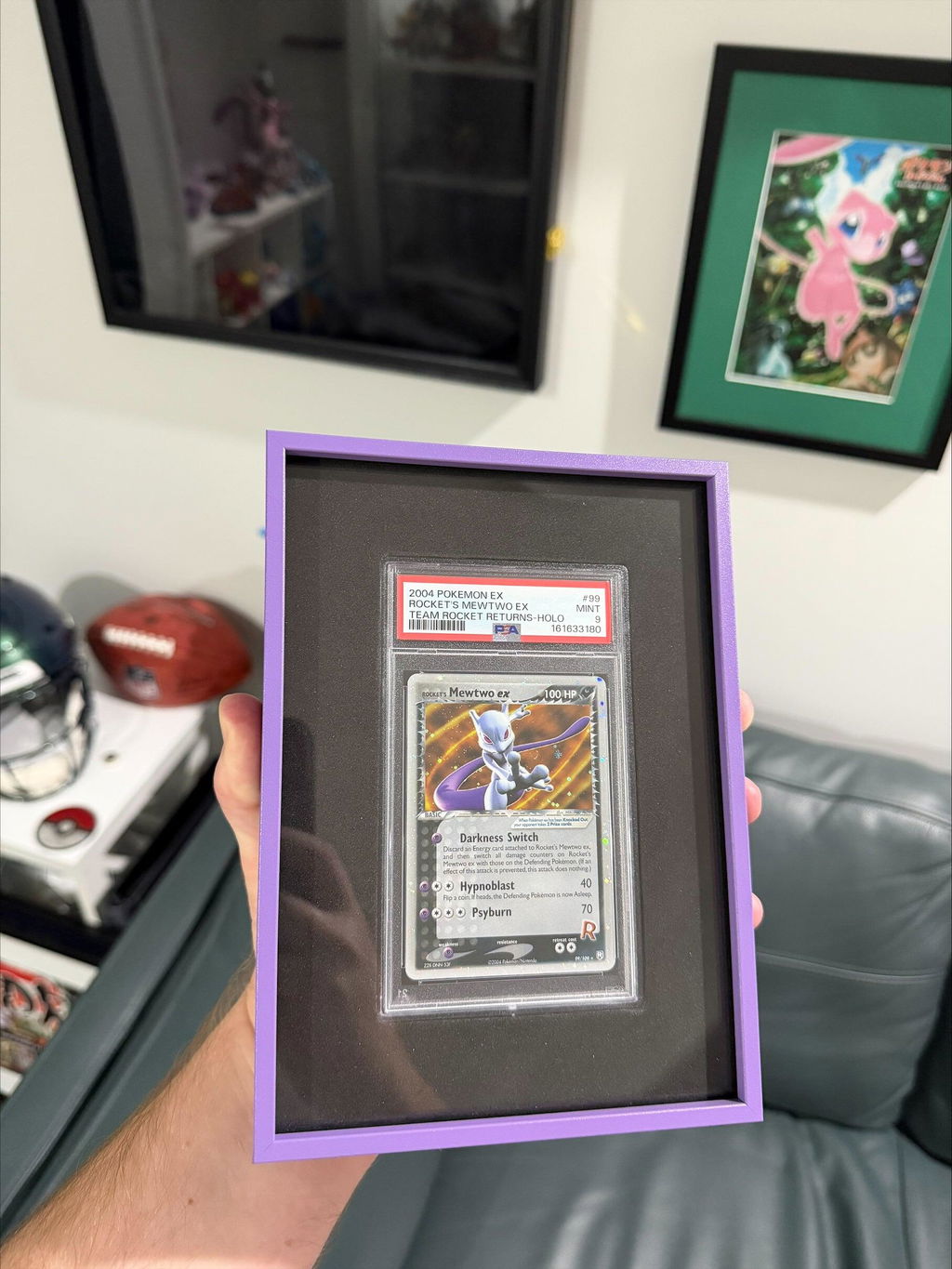
Graded slabs create a more structured display because the holder and grading label become part of the presentation.
They are commonly used for:
- Vintage collections.
- PSA 10 collections.
- Rare cards.
- Trophy cards.
- Cards where the grade itself matters.
PSA, CGC and BGS holders are not identical, so it is worth checking the actual slab format before choosing a frame.
One Touch Magnetic Holders
One Touch holders provide a rigid case around an ungraded card while keeping it removable.
They are a useful option for collectors who want more structure than a sleeve or toploader without adding a grading label to the display.
They work especially well for favourite modern cards, premium pulls and collections that are updated regularly.
The Best Ways to Display Pokémon Cards
There are several practical ways to display Pokémon cards, and each works better for different types of collections.
Wall Display Frames
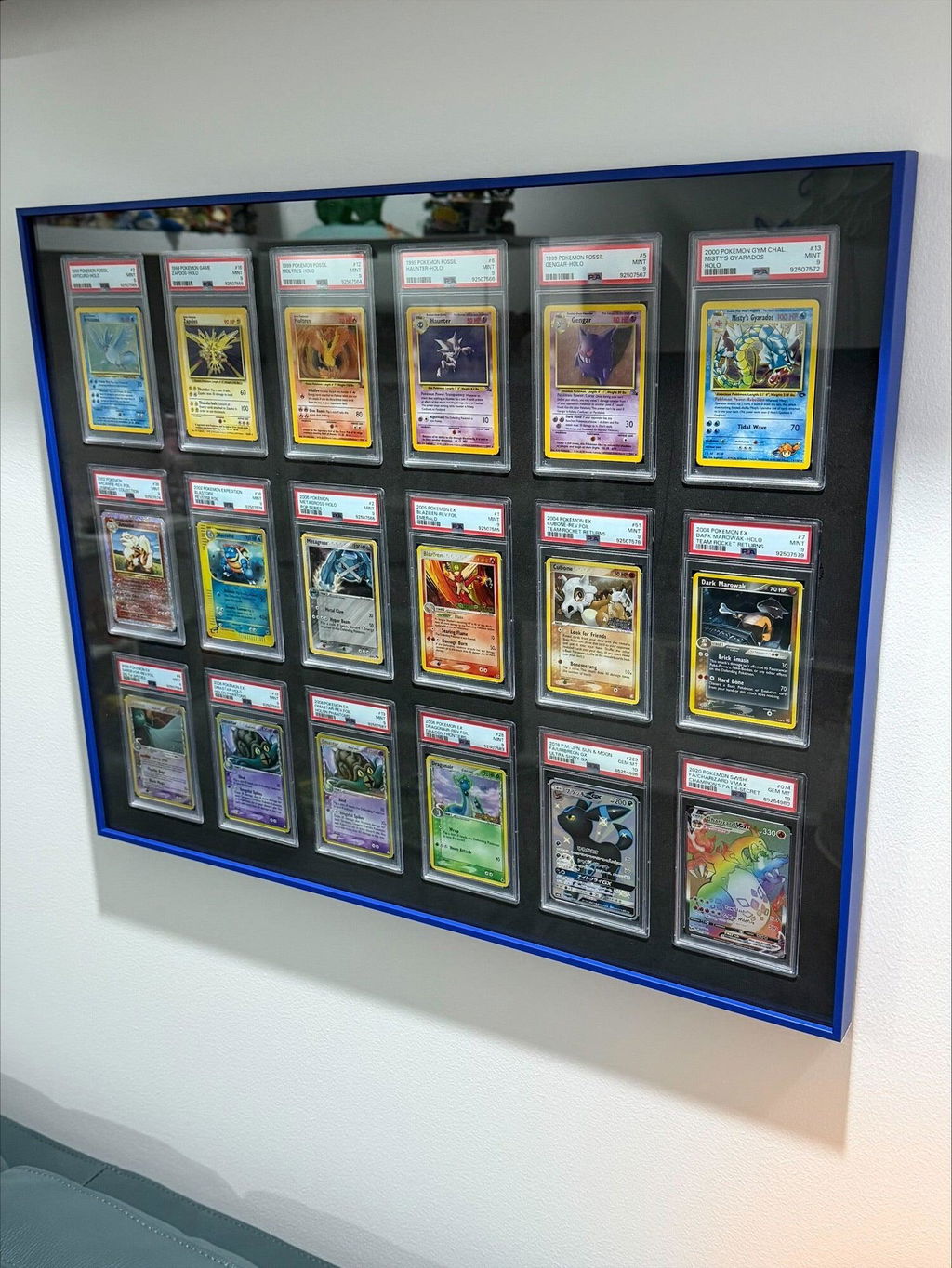
Wall display frames are useful when several cards belong together and you want them presented as one organised group.
They work particularly well for:
- PSA graded collections.
- CGC and BGS slabs.
- One Touch magnetic holders.
- Favourite Pokémon collections.
- Master set highlights.
- Illustration Rare collections.
- Larger trading card walls.
One advantage is that the collection can grow through additional matching frames rather than needing to place every card into one enormous display.
Shelves
Shelves are a flexible option, particularly when cards are being displayed alongside other Pokémon collectibles.
They work well with:
- Elite Trainer Boxes.
- Booster boxes.
- Figures.
- Pokémon Centre merchandise.
- Signed memorabilia.
- Trophies.
- Vintage consoles.
The main limitation is that shelves can become visually busy once too many stands, products and loose items are added.
Some collectors therefore use shelves for sealed products and figures while keeping selected trading cards grouped in frames.
Display Cases
Acrylic or enclosed display cases work especially well for larger collectibles that do not fit naturally into a standard wall frame.
They are useful for:
- Booster boxes.
- Elite Trainer Boxes.
- Vintage sealed products.
- Signed collectibles.
- Trophies.
- Larger feature pieces.
Display cases and wall-mounted card frames can also be used together, giving different types of collectibles their own place within the room.
Why Wall Displays Work Well for Larger Collections
Wall displays make use of space that would otherwise remain empty.
Instead of spreading individual card stands across desks and shelving, several cards can be organised into one larger layout.
This can make the collection easier to view and reduce the amount of surface space being used around the room.
Frames also encourage collectors to think more carefully about which cards belong together.
Because each display has a limited number of positions, the final selection usually becomes more deliberate.
That often creates a cleaner result than trying to display everything at once.
Choosing the Right Display Frame Size
The best frame size depends on the cards you already own and how you want the group to look on the wall.
Bigger is not automatically better.
| Display Size | Best For |
|---|---|
| 1 Card | Favourite cards, trophy cards and individual highlights. |
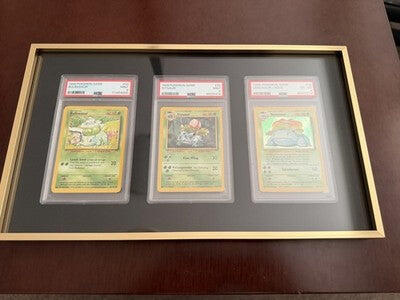
| 3 Card | Starter Pokémon, evolution lines and small themed groups. |
| 6 Card | Compact collections with a clear theme. |
| 9 Card | A versatile size for character, set and graded-card displays. |
| 12 Card | Growing collections that need more space without dominating a wall. |
| 20–25 Card | Master set highlights and larger themed collections. |
| 36–54 Card | Dedicated collector rooms and large wall displays. |
It is usually better to choose a frame that suits the collection now rather than buying something much larger and leaving a large number of empty positions.
A filled, well-organised layout generally looks more complete than an oversized frame waiting for future cards.
Planning a Pokémon Display Wall
If you expect the collection to grow into several frames, it helps to think about the wall as a whole before mounting the first one.
Consider:
- Whether more frames will be added later.
- Whether you prefer a symmetrical or more flexible layout.
- Whether different displays will be grouped by Pokémon, set or era.
- How much empty wall space should remain between frames.
- Whether other trading card games or sports cards may eventually be displayed nearby.
Leaving some room for expansion can make future additions much easier.
It can also prevent the entire wall from needing to be rearranged whenever another display is added.
Display Ideas for Different Types of Collectors
The Favourite Pokémon Collector
If most of your collection revolves around one Pokémon, a dedicated display can work extremely well.
Charizard, Pikachu, Umbreon, Gengar and other character collections can include cards from different eras while still feeling connected because the Pokémon itself provides the theme.
The Vintage Collector
Vintage collections often work well in simple, consistent layouts.
Graded slabs can add structure where authentication and condition are important, while raw vintage cards can also be displayed when a more compact layout is preferred.
The Illustration Rare Collector
Illustration Rares and Special Illustration Rares are particularly well suited to larger artwork-focused displays.
The different artists, scenes and colour palettes can create a strong visual group without relying on one Pokémon or one set.
The Master Set Collector
Instead of putting every card from a set on the wall, a collector can display the main highlights while keeping the rest organised in a binder.
This gives the set a visible presence without turning the wall into storage.
The Competitive Player
Competitive players may prefer to display tournament cards, favourite deck pieces, signed cards or other items connected to playing rather than collecting alone.
Designing a Pokémon Display That Can Change Over Time
Pokémon collections rarely stay exactly the same.
New expansions are released, grading submissions come back, favourite cards change and collection goals move in different directions.
That makes flexibility useful.
Before committing to a large wall layout, think about where the collection might be in a year or two.
You may eventually complete an Eeveelution group, add more PSA slabs or split one large collection into several smaller themed displays.
Planning some flexibility into the wall can make those changes much easier.
Creating a Pokémon Display Room
You do not need a dedicated collector room to create a strong display.
A spare wall in a bedroom, office, gaming room or studio can be enough.
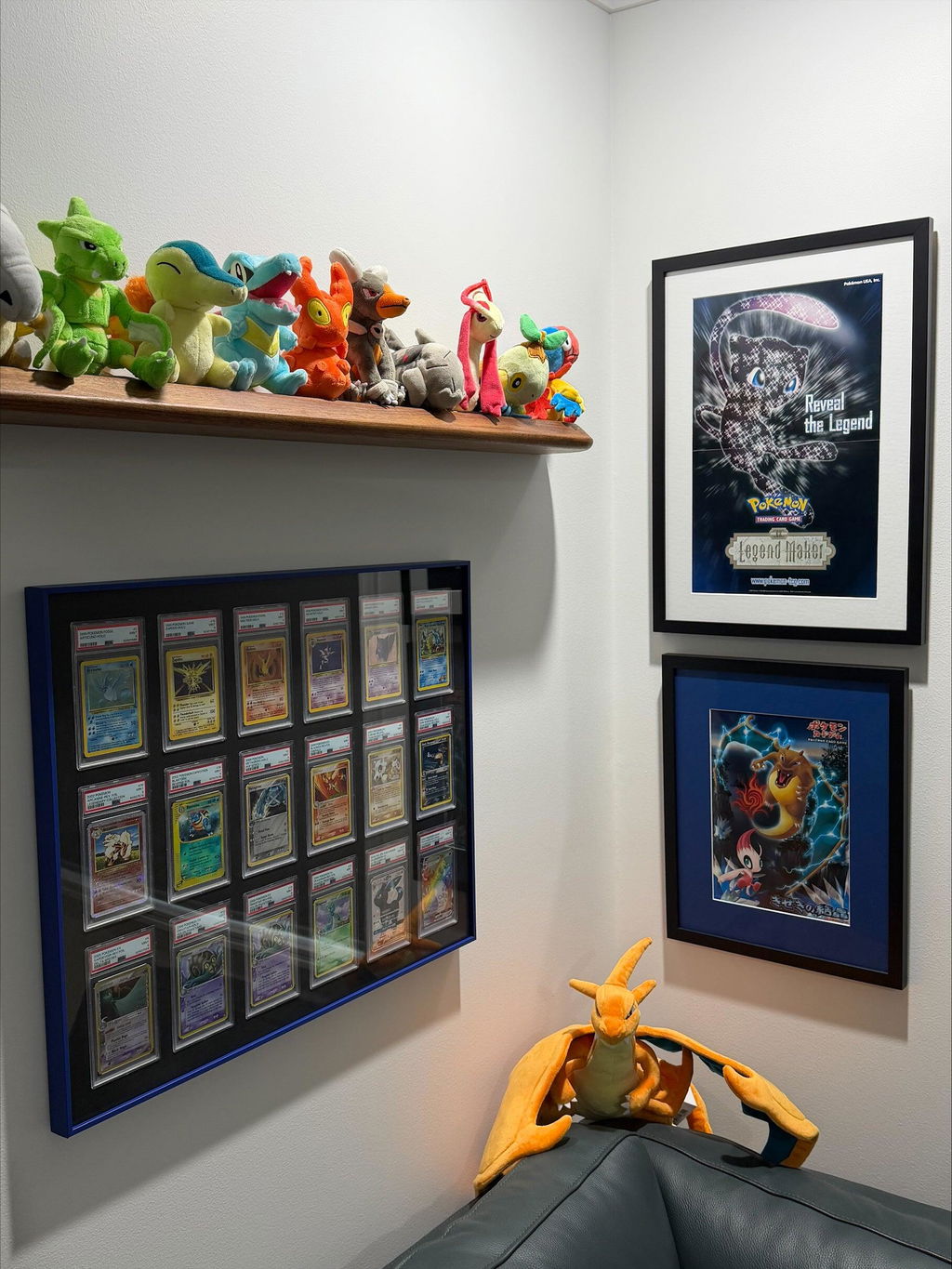
Many collector spaces combine several display methods:
- Wall-mounted frames for selected cards.
- Shelving for sealed products.
- Display cases for larger collectibles.
- Figures and memorabilia used around the main collection.
- Soft room lighting.
- Artwork that works with the rest of the space.
The key is giving the room enough structure that the displays do not compete with one another.
Choosing Colours That Complement Your Collection
Pokémon cards already contain a lot of colour, so the surrounding frame does not need to match every card.
Neutral colours such as black, silver, grey and natural metallic finishes are easy to use across mixed collections.
Stronger colours can also work when they relate to a particular Pokémon, card group or room colour scheme.
The wall behind the frame matters too. A black frame will look very different on a white wall compared with a charcoal wall.
It is usually better to think about the cards, frame and room together rather than choosing the frame colour in isolation.
Displaying Pokémon Cards Without Making the Wall Feel Cluttered
Trying to use every available section of wall can make even a valuable collection feel crowded.
Spacing around frames is important.
Leaving clear areas between displays helps each group remain easy to view and gives the overall wall more structure.
Starting with one or two displays and expanding later can also make it easier to judge what the room actually needs.
The goal is not to cover the entire wall. It is to make the collection feel organised.
Protecting Your Collection While It Is on Display
Displaying cards does not remove the need for sensible protection.
Some simple habits can help reduce unnecessary exposure:
- Avoid prolonged direct sunlight where possible.
- Keep the room at a reasonably stable temperature.
- Avoid areas with excessive moisture or humidity.
- Use appropriate wall fixings for the finished weight of the display.
- Dust frames carefully with a soft microfibre cloth.
- Avoid placing displays directly above heaters or fireplaces.
UV-resistant acrylic or specialist glass can add another layer of protection, but placement still matters. No glazing makes prolonged direct sunlight a good location for valuable trading cards.
Common Mistakes New Collectors Make
Trying to Display Every Card
Not every card needs to be on the wall.
Choosing a smaller group of favourites usually makes the display easier to organise and gives each card more space.
Buying the Largest Display Immediately
Large frames can work extremely well, but they make the most sense when the collection is already large enough to justify them.
A frame that suits the current collection is often a better starting point than one with many empty positions.
Ignoring Room Lighting
Lighting affects glare, reflections and how easy the cards are to view throughout the day.
Considering windows and overhead lights before mounting the frame can prevent problems later.
Mixing Too Many Styles
Several holder types, frame colours and layout styles can work in the same room, but they benefit from some kind of consistent structure.
Using matching outer finishes or grouping similar formats together can help keep the wall organised.
Forgetting Future Growth
Very few collections stay the same.
Leaving room for another frame or choosing a repeatable layout can make future expansion much easier.
Frequently Asked Questions
What is the best way to display Pokémon cards?
There is no single best method for every collection. Wall frames, shelves, One Touch holders and display cases all work well in different situations. The right option depends on the number of cards, holder format, available space and how permanent you want the display to be.
Should I display raw or graded Pokémon cards?
Both can work well. Raw cards keep displays compact and flexible, while graded slabs add structure, authentication and grading information.
Can Pokémon cards be displayed on a wall?
Yes. Wall-mounted frames are a practical way to group several cards together while making use of vertical space.
Can One Touch magnetic holders be displayed?
Yes. One Touch holders work well for collectors who want a rigid case around an ungraded card while keeping the card removable.
How many Pokémon cards should I display?
There is no ideal number. It is usually better to choose a group that naturally belongs together than to fill a larger frame simply because space is available.
Will sunlight damage displayed Pokémon cards?
Prolonged direct sunlight can contribute to fading and should be avoided where possible.
Should I grade my favourite cards before displaying them?
Not necessarily. Grading makes sense when authentication, condition and the grade itself are important to you. One Touch holders or other removable protection can be more suitable when you want to keep the card ungraded.
Can I mix PSA, CGC and BGS slabs together?
Yes, although the slabs differ in dimensions and appearance. Separate frames or layouts designed around each holder type can create a cleaner result.
What size display frame should I choose?
Choose a size that suits the number of cards you actually want to display and the available wall space. It is usually better to add another matching frame later than to start with a much larger frame that remains mostly empty.
What is the biggest mistake people make?
Trying to display too much at once. A smaller, well-organised selection usually has more impact than a crowded wall.
Final Thoughts
There is no single correct way to display a Pokémon collection.
A single favourite card, a nine-card Eeveelution group, a wall of graded slabs or a larger Illustration Rare display can all work well when the layout suits the collection.
Start with the cards you actually want to see, choose a display method that suits their format, and leave enough flexibility for the collection to change over time.
The strongest Pokémon displays are usually the ones that feel organised, deliberate and easy to enjoy.
Continue Exploring
If you enjoyed this guide, you may also find these collector resources helpful.
📚 Collector Guides
-
The Ultimate Trading Card Display Guide: Ideas, Frames, Shelves & Display Solutions for Every Collector
Explore display ideas, wall layouts, shelving, cabinets, lighting, budgets and display solutions for every major trading card game. -
Why Premium Aluminium Trading Card Display Frames Are Worth It: The Complete Collector Guide
Discover why handmade aluminium display frames have become a premium choice for displaying PSA, CGC, BGS and One Touch trading card collections.
🛒 Shop Display Collections
-
Aluminium Trading Card Wall Display Frames
Premium handmade aluminium wall display frames for Pokémon, MTG, Yu-Gi-Oh!, One Piece and Sports Cards. -
PSA, CGC & BGS Graded Slab Wall Display Frames
Purpose-built wall display frames designed specifically for graded trading card collections. -
One Touch Wall Display Frames
Premium wall display frames designed for One Touch magnetic trading card holders in a range of grid sizes.

0 comments