


An MTG trading card wall display can be built around a deck, an artist, a colour identity, favourite legendary creatures or simply the trading cards you most enjoy looking at. Because Magic collections are often actively changing, the best DIY display is usually one that looks deliberate without making future changes difficult.
If your goal is to make your own MTG trading card display or build a DIY MTG card frame at home, it helps to decide first whether the display is for sleeved trading cards, rigid holders or graded slabs.
This article stays focused on Magic: The Gathering. For a broader comparison of raw trading cards, slabs, magnetic holders, frame materials and large-format builds, see our complete DIY trading card wall display guide.
MTG displays are often built around a collection idea, not a single set
Magic: The Gathering trading card displays tend to be more varied than simple set grids. A collector might want to show a Commander package, favourite legendary creatures, signed trading cards, artist-related pieces, old-border trading cards, foil treatments or a wall of full-art lands.
That means the display should begin with the purpose of the collection. A deck-inspired display may need a different rhythm from an art-focused display, and a wall of raw sleeved trading cards behaves very differently from a wall of graded MTG trading cards.
Choosing a frame material without making the project harder than it needs to be
MTG displays often look better when the frame stays quieter than the artwork. Timber works well for a warmer, library-like feel, while black or neutral painted MDF can disappear around a darker collection. Acrylic can keep a display visually light, especially for full-art lands or artist-focused groups.
Large graded or rigid-holder displays put more demand on the structure. That is where stronger timber profiles or aluminium start making sense. Aluminium gives a clean, modern edge and works particularly well when the layout is wide, but it is much less forgiving to fabricate accurately at home than ordinary timber.
The best choice is the one that suits the collection and the amount of building you actually want to do. A Commander display that changes often does not need to be engineered like a permanent museum case.
Sleeves matter more with MTG than many people expect
MTG trading cards are commonly kept in sleeves, and not all sleeves have the same outside dimensions or stiffness. Perfect-fit inner sleeves, standard sleeves and thicker premium sleeves can all change the way a trading card sits in a matboard opening.
If the trading cards will stay sleeved, build the opening around the actual sleeve that will remain in the finished display. Do not design around a raw trading card and assume the sleeve will disappear into the tolerance.
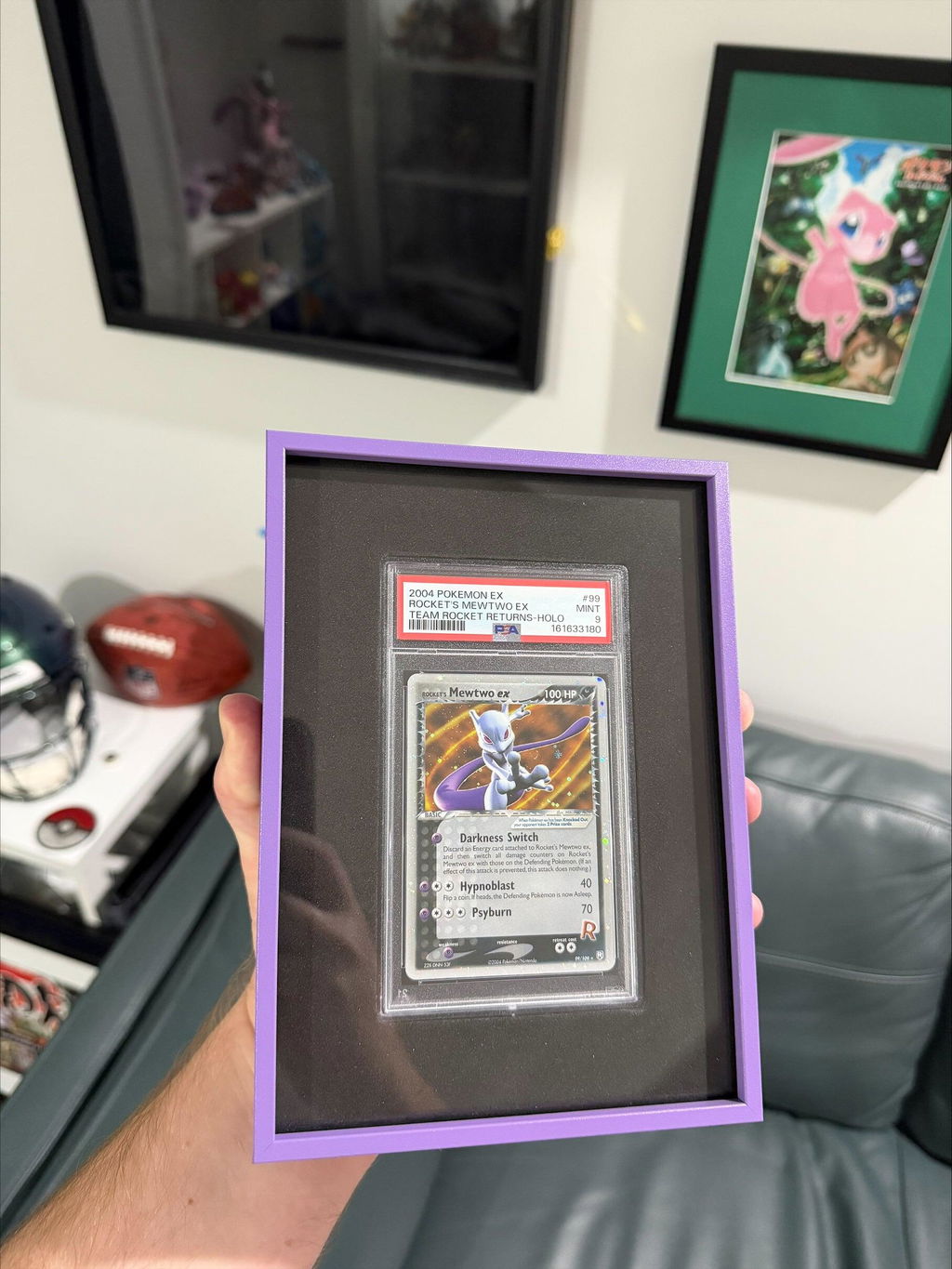
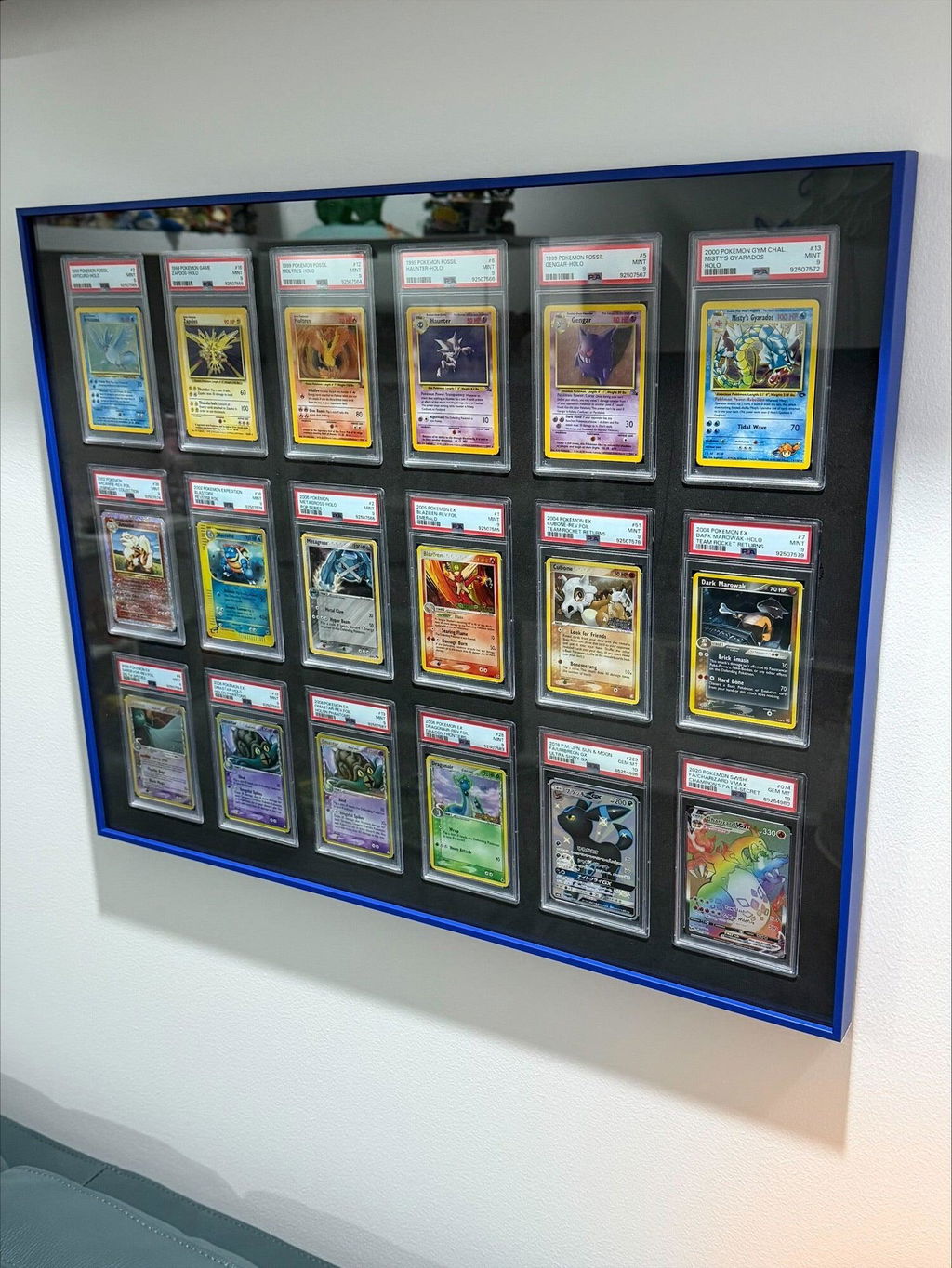
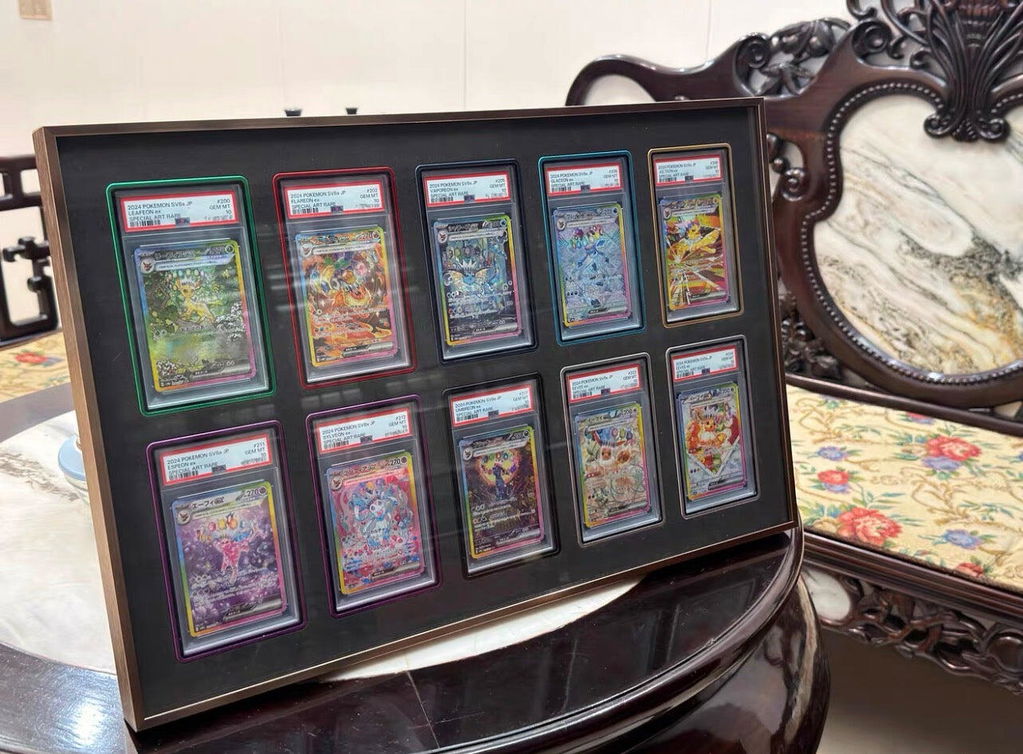
Graded MTG trading cards and top loaders introduce the same rigid-holder issues found in other TCG displays: depth, fit, label alignment and weight.
Matboard, EVA foam and the part that actually holds the trading cards
For sleeved MTG trading cards, matboard is usually the most natural starting point. It frames the artwork cleanly and works with a shallow construction. The important detail is the sleeve. A perfect-fit inner sleeve, a normal deck sleeve and a thicker premium sleeve do not necessarily occupy the same space.
If the display uses top loaders, magnetic holders or graded slabs, foam becomes more useful. EVA can support the rigid holder without clips, but the opening should be tested with the actual holder. The aim is to stop movement, not to squeeze the case.
For a collection that rotates, err on the side of serviceability. A display that looks beautiful but damages sleeves every time a trading card is swapped will become annoying very quickly.
MTG layout ideas: decks, colours, artists and eras
A wall display does not need to reproduce deck order. It can use the collection as raw material for a stronger visual layout.
Five-colour arrangements are an obvious option. Full-art lands can act as visual breaks. Old-border trading cards can be grouped together to create a completely different texture from modern borderless designs. A Commander display can place the commander at the centre and arrange the supporting trading cards around it.
Artist-focused collections also work well because the visual relationship is already built into the artwork. The important thing is to choose one organising idea and let that guide the grid.
Layout planning: where small errors become obvious
MTG gives you more ways to organise a wall than a simple numerical grid. A Commander can anchor the centre, full-art lands can separate colour groups, or one artist's work can be treated almost like a print series.
Start with the collection idea and then build the geometry around it. If the display is meant to show a deck, decide whether deck order actually looks good on a wall. Often it does not. A visual arrangement can still respect the deck without reproducing the exact stack.
Whatever structure you choose, repeat it cleanly. Rows of sleeved trading cards expose small alignment errors just as readily as slabs do.
MTG artwork can support darker, more restrained framing
Magic artwork covers everything from bright fantasy illustration to very dark, moody pieces. A neutral or black surround is often an easy way to make trading cards from different eras feel like one collection.
If you use colour, consider tying it to the deck identity or the five Magic colours rather than trying to match individual trading cards. A consistent accent is usually calmer than a frame that changes colour around every opening.
Acrylic, glass and UV protection
Glass works well for smaller MTG displays where scratch resistance matters and weight is modest. Acrylic becomes increasingly attractive as the frame gets larger because it is lighter and less fragile.
Foils make the glazing choice more noticeable because reflections can hide the finish you wanted to show. Before ordering an expensive panel, test where the display will sit and how the room lights hit it.
For UV exposure, room placement comes first. Keep valuable trading cards away from prolonged direct sun. Higher-grade filtering is useful when the wall receives more ambient light or the collection is particularly valuable, but it should not be treated as a reason to ignore the room itself.
Lighting without turning the glazing into a mirror
MTG foils and full-art trading cards can look excellent under soft light, but point sources create harsh reflections. The best lighting is often less dramatic than expected: a diffused strip, a gentle overhead source or an external light placed at an angle.
If the display includes older foils or signed trading cards, prioritise visibility and low heat over spectacle. Test the setup with the final glazing in place, because bare trading cards on a workbench will not reflect light the same way as a finished frame.
Large MTG displays need a plan for future change
MTG collections evolve constantly. Decks change, new sets release and favourites move in and out of the display. That makes access and modularity particularly important.
A large permanent grid can look excellent, but a modular wall of smaller displays may suit an active MTG collector better because individual groups can be replaced without rebuilding the whole wall.
For raw or sleeved trading cards, matboard can keep a large display visually light. For slabs and rigid holders, the frame depth, insert support and mounting load become more important.
Frame depth, backing and wall mounting
A raw sleeved MTG display can remain shallow. Top loaders, graded slabs and magnetic holders add depth quickly, so the frame should be chosen after the holder format is settled.
For backing, flatness matters more than appearance. The panel needs to keep the insert supported across the whole frame. If the collection changes regularly, make the backing removable without turning every update into a workshop job.
Wall hardware should reflect the completed weight and the wall construction. A framed Commander set may be simple; a wide wall of slabs may need multiple fixing points and a more careful installation.
Where to source materials for a DIY build
Local picture framers are particularly useful for MTG projects because they can supply matboard, cut openings and advise on glazing. Hardware stores cover timber, MDF and wall hardware, while local plastics suppliers are a good source for custom-cut acrylic.
If you are experimenting with sleeves, matboard or foam, buy a small amount first and test the fit. There is no benefit in ordering a full panel before you know how the material behaves with the trading cards you actually own.
Cheap, mid-range and premium ways to approach the build
The cheapest sensible MTG display is often a standard frame with a custom mat. That is enough for a small group of sleeved trading cards and keeps the build straightforward.
A mid-range version might use a better frame, UV-resistant acrylic and more precise mat cutting. For rigid holders, add a purpose-cut foam insert and stronger backing.
Premium builds can move into solid timber, aluminium, specialist glazing and integrated lighting. Those upgrades are worthwhile when they suit the collection, not simply because they sound expensive.
Displaying full-art lands, signed trading cards and special pieces
Full-art lands are useful in display design because they function almost like miniature art prints. A row of lands can separate two groups or create a visual transition without adding another frame material.
Signed trading cards deserve more careful handling. Avoid direct contact with the signed surface and use a holder that keeps the autograph away from glazing or backing materials.
For especially meaningful pieces, a little extra space around the trading card can work better than packing the frame as densely as possible.
Designing an MTG display around how you actually collect
Magic collections are often less static than they look. A Commander deck changes, a favourite artist releases new work, a foil treatment gets replaced by another printing, or a collector slowly builds a signed set. That makes the structure of the display important.
If the display is tied to a deck, removable access may be more important than maximum visual permanence. If it is an art collection, a more traditional framed approach may make sense because the trading cards are unlikely to move frequently. The display should match the way the collection behaves.
Using lands and colour identity as visual structure
Full-art lands can do more than fill space. They can create visual pauses between groups of trading cards, separate colours, or act as a border around a Commander-focused display. Because they are recognisable without relying on text, they work well as repeated visual elements.
Colour identity can also guide the surrounding material. That does not mean building five different coloured frames. A restrained accent mat or subtle background shift can be enough to separate sections without making the whole wall look like a game board.
Foils, curls and flatness
Some foil MTG trading cards can develop curvature over time, particularly when humidity changes. A wall display should not rely on excessive pressure to force a curled trading card flat. The better solution is to use an appropriate sleeve or rigid holder and make sure the display environment is reasonably stable.
If a foil trading card is already visibly curved, solve that storage issue before building it into a permanent frame. A display should hold a trading card securely, not act as a clamp.
Signed MTG trading cards and artist-focused collections
Signed trading cards need slightly more care because the autograph itself may be the most valuable surface on the trading card. Avoid direct glazing contact and any pressure that could rub against the ink. A sleeve or rigid holder is usually sensible before framing.
Artist-focused displays often benefit from wider visual breathing room than a dense deck display. If the artwork is the point, giving each trading card a little more space can make the wall feel more like a print collection and less like storage.
Maintaining and updating an MTG wall display
Active MTG collections change frequently, so make the rear access practical. A removable backing panel is far more useful than a permanently sealed frame if trading cards are likely to rotate.
When updating the display, check that sleeves and holders have not changed. A new premium sleeve can be slightly different from the old one, which may matter in a precise matboard opening. Test one before replacing an entire row.
Common DIY mistakes that are easy to avoid
- Measuring an unsleeved MTG trading card when the display will use premium sleeves.
- Building a permanent frame around a deck that changes every few weeks.
- Forcing curled foil trading cards flat with pressure from the frame.
- Using direct adhesive on signed or valuable trading cards.
- Letting a five-colour theme turn into five competing frame colours.
- Ignoring reflections from glossy sleeves and foil treatments.
- Choosing a backing that is difficult to reopen.
- Assuming the frame is light enough for basic wall hooks without checking the finished weight.
A practical build sequence
- Decide what the MTG display represents: deck, artist, colour identity, era or favourites.
- Choose the sleeve or holder format and measure real examples.
- Sketch the visual grouping before choosing the outer frame.
- Mark the approximate size on the wall.
- Select frame, glazing, insert and backing materials.
- Test one trading card opening with the exact sleeve or holder.
- Dry-fit the whole stack and check the frame depth.
- Assemble the display and view it from normal room distance.
- Mount it using hardware suited to the completed weight.
When DIY makes sense and when ready-made starts looking attractive
MTG is well suited to DIY because many displays are small, personal and changeable. A custom mat around a favourite Commander group can be a great weekend project.
Ready-made systems become more attractive when the collection moves into large rigid-holder grids or when you want the same frame repeated across several walls. At that point consistency can matter more than the satisfaction of fabricating each frame individually.
Commander displays: build for change rather than permanence
A Commander-focused wall is one of the most natural MTG display ideas, but it is also one of the easiest to make too permanent. Commander decks change. A new printing replaces an old one, a card leaves the deck, or the whole list is rebuilt around a different theme.
If the display is meant to reflect an active deck, make access easy. A removable backing and sleeves that can be swapped without scraping against the mat are more useful than a perfectly sealed frame. You can still make it look polished without turning every deck update into a full rebuild.
Another option is to display the Commander and a smaller group of signature cards rather than the complete deck. That keeps the wall visually focused and reduces how often it needs to change.
Full-art lands as part of the composition
Full-art lands are unusually useful in wall displays because they can act like visual separators. A row of lands can break up two groups of trading cards, establish a colour identity or give a dense wall a place to breathe.
They also work well around a centrepiece because the artwork tends to read clearly from a distance. If you have several land cycles, repeating the same visual idea across multiple frames can make a larger MTG wall feel connected without using identical layouts everywhere.
Displaying old-border, modern-border and borderless MTG trading cards together
MTG has changed visually many times, and a collection that spans eras can look quite varied. Old-border trading cards, modern frames, showcase treatments and borderless artwork do not always share the same visual weight.
The easiest way to unify them is to keep the frame and insert consistent. Trying to match the surrounding colour to every treatment usually creates more noise. Let the differences between eras be part of the collection.
If one era dominates, you can use the minority group as a deliberate break rather than scattering it randomly through the grid.
Signed trading cards and artist collections need more breathing room
A signed MTG trading card is not just another game piece. The signature itself becomes part of the object, and that often deserves a little more visual space.
Artist collections can benefit from wider margins or smaller groups instead of dense deck-style grids. The aim is closer to displaying miniature artwork than showing a functional deck list.
Keep signed surfaces protected from direct contact with glazing or rough materials. If the trading card is particularly important, use a suitable sleeve or rigid holder before it enters the frame.
Foils, humidity and why a frame should not be used as a clamp
Some MTG foils can develop curvature when humidity changes. A frame should not solve that by pressing the trading card flat between hard surfaces. That may create pressure where you do not want it.
Stabilise the trading card in an appropriate sleeve or holder first, then design the display around that holder. The frame's job is to present and support the collection, not correct a storage problem through force.
When several smaller MTG displays make more sense than one large wall
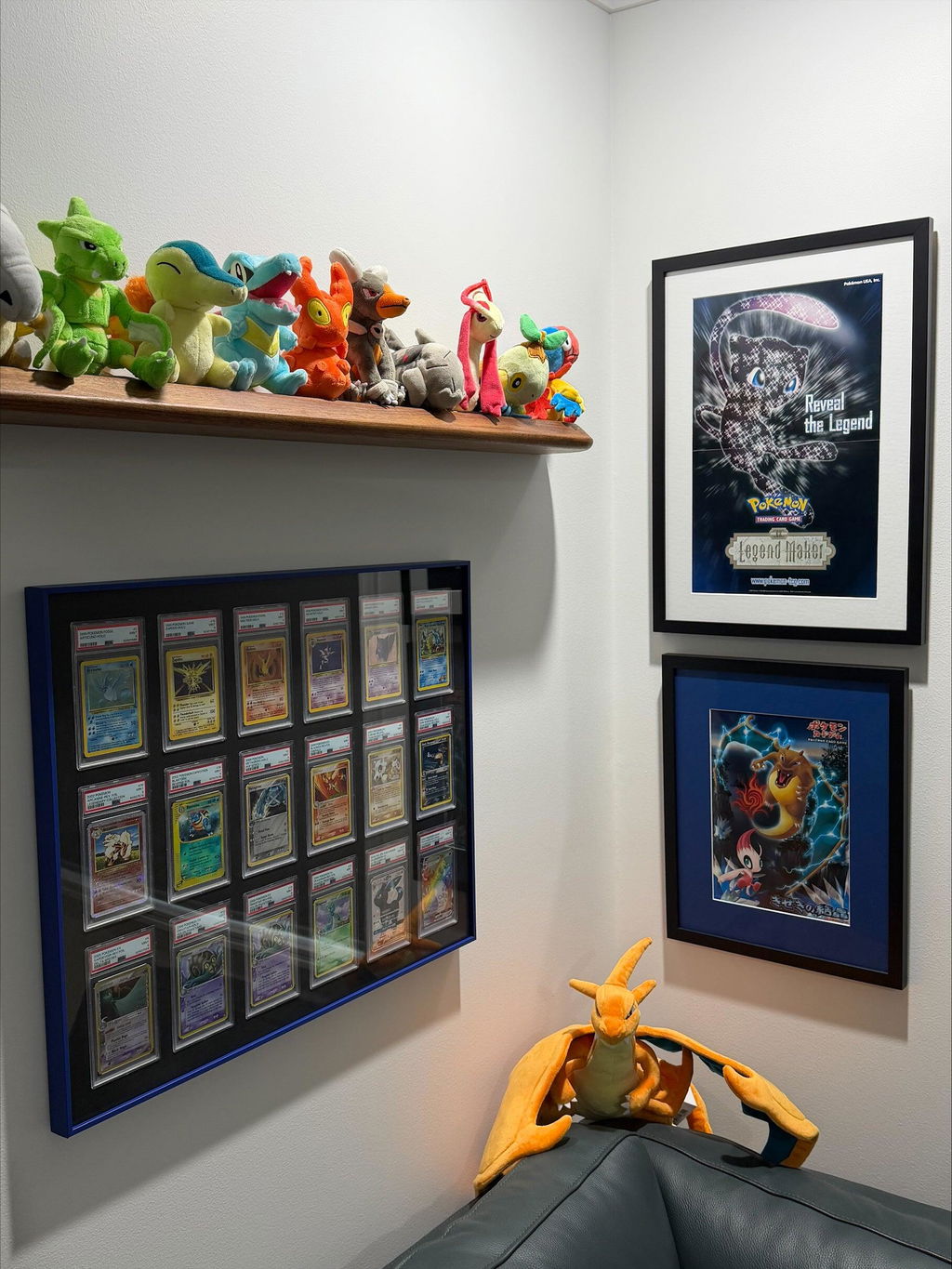
MTG collections naturally divide into themes: Commander, lands, artists, favourite sets, signed trading cards, old-border pieces and more. Separate frames can preserve those identities while still reading as one wall if the outer finishes are related.
This modular approach also makes future changes easier. One frame can be rebuilt without disturbing the rest of the collection, and a new module can be added as another theme develops.
How to make a homemade MTG trading card display
A homemade MTG trading card display is easiest when the trading cards stay in one consistent sleeve or holder type. Start with a small group, cut a clean mat or insert, and use a frame that can be reopened as the deck or collection changes.
If you want to build your own MTG card frame on a budget, a standard frame and custom matboard is often enough. A premium build can add UV-resistant acrylic, better timber, EVA foam for rigid holders and improved lighting.
Frequently asked questions
Can sleeved MTG trading cards be framed?
Yes. Build around the outside dimensions of the sleeve and make sure the trading card can be removed without scraping or bending the sleeve.
Is matboard suitable for MTG trading cards?
Yes. Matboard works particularly well for raw or sleeved MTG trading cards and can help unify mixed artwork.
Can graded MTG trading cards be displayed with raw trading cards?
They can, but the depth and visual face are very different. Separate zones or separate frames are often easier to plan.
What is a cheap way to display MTG trading cards?
A standard frame with custom matboard and acrylic can work well for a smaller group of sleeved trading cards.
Should foil MTG trading cards be displayed under LEDs?
They can be, but test the lighting angle first because foil surfaces and glazing can create strong reflections.
Final thoughts
The strongest MTG display starts with the collection idea rather than the outer frame. Decide what the wall is actually trying to show, keep the trading cards protected in the holder format you already use, and choose a construction method that leaves enough flexibility for the collection to keep changing.
Continue Exploring
If you enjoyed this guide, you may also find these collector resources helpful.
📚 Collector Guides
-
Best Trading Cards to Display & Collect
Explore Pokémon, MTG, Yu-Gi-Oh!, Sports Cards, One Piece and Disney Lorcana cards, sets, rarities and collection ideas. -
The Ultimate Trading Card Display Guide
Explore trading card wall displays, frames, shelves, layouts and display solutions for collections of every size. -
How to Display Graded Cards on a Wall
Learn how collectors display PSA, BGS and CGC graded cards using wall-mounted trading card displays.
🛒 Shop Display Collections
-
Aluminium Trading Card Wall Display Frames
Premium aluminium trading card display frames available in a wide range of grid sizes, frame colours and holder formats. -
PSA, CGC & BGS Graded Slab Wall Display Frames
Purpose-built graded trading card display frames for Pokémon, MTG, Yu-Gi-Oh!, One Piece, Sports Cards, Disney Lorcana and other collections. -
One Touch Wall Display Frames
Premium aluminium wall display frames designed for One Touch magnetic trading card holders.

0 comments