


One Piece trading cards are highly visual, which makes them excellent display pieces but also means the frame has to stay out of the way. A successful DIY build should protect the trading cards, control reflections and leave enough flexibility for a collection that may still be growing quickly.
If you want to make your own One Piece trading card display or build a DIY One Piece card frame, keep the structure simple enough that the artwork still does most of the visual work.
This guide is written around One Piece collections. For a broader technical comparison of display materials, holder types and large-format construction, see our complete DIY trading card wall display guide.
One Piece trading card displays are usually artwork-led
One Piece trading cards often have strong colour, foil and character-focused artwork, so the frame does not need to work very hard visually. In many cases the best DIY display is the one that stays quiet around the collection.
The other challenge is growth. One Piece collections can expand quickly as new releases arrive, so a wall display should not be designed so tightly around today's total that one new favourite trading card makes the whole structure obsolete.
Choosing a frame material without making the project harder than it needs to be
One Piece trading cards already bring a lot of colour and movement to the wall, so the frame usually works best when it stays restrained. Black, white, natural timber and slim metal profiles are all easy to live with across different releases.
Timber and MDF are straightforward if you want to build the outer frame yourself. Acrylic can suit a more modern transparent approach. Aluminium works well for larger grids because it keeps the border relatively slim, although accurate fabrication is more involved than a normal woodworking project.
If the collection is still expanding quickly, do not invest all the effort into one enormous permanent frame before you know how the wall will grow.
Raw One Piece trading cards, sleeves and graded slabs
Raw and sleeved One Piece trading cards can work very well in matboard because the artwork remains close to the front of the frame. Top loaders and magnetic holders provide more protection but increase the required depth.
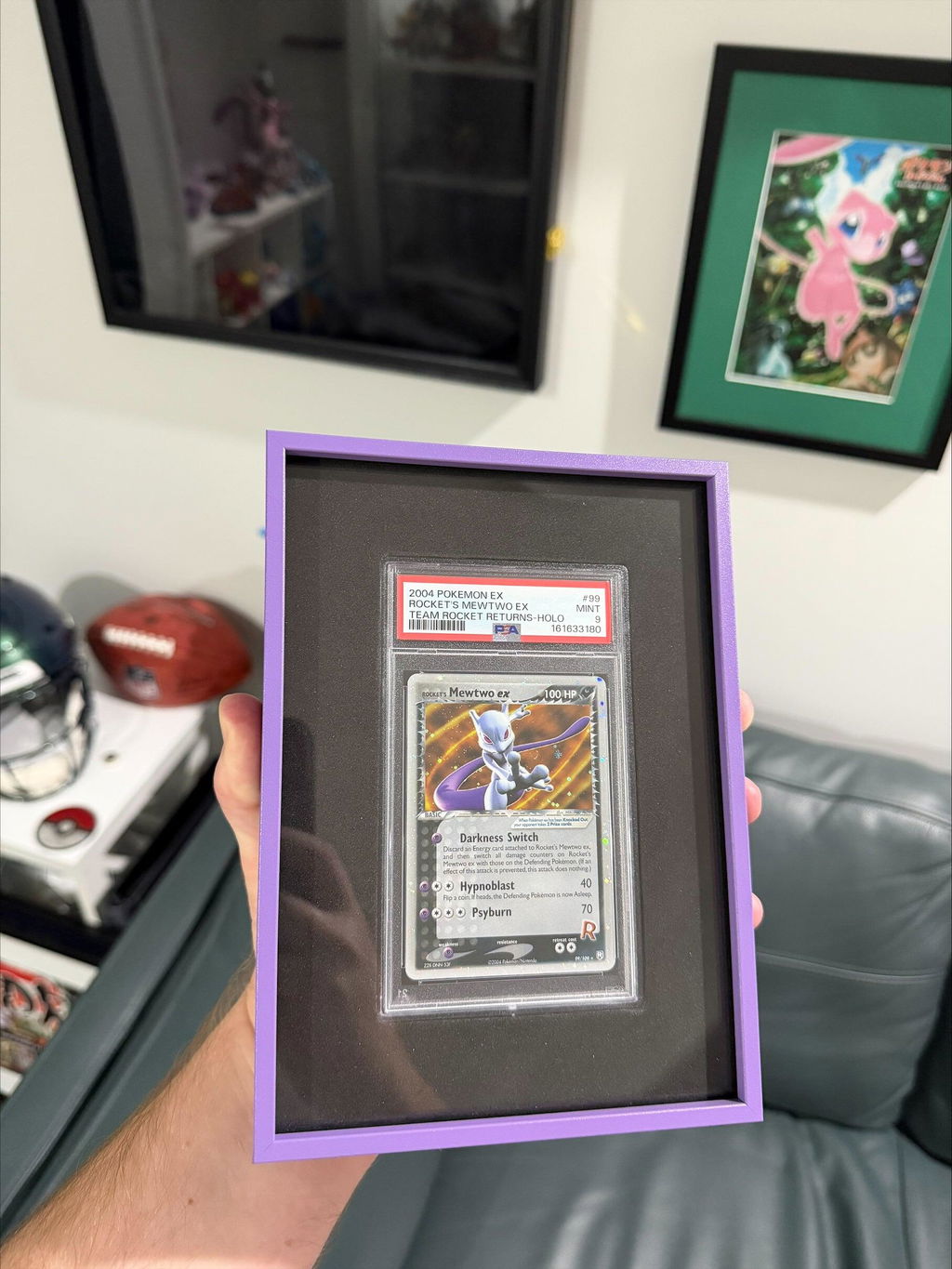
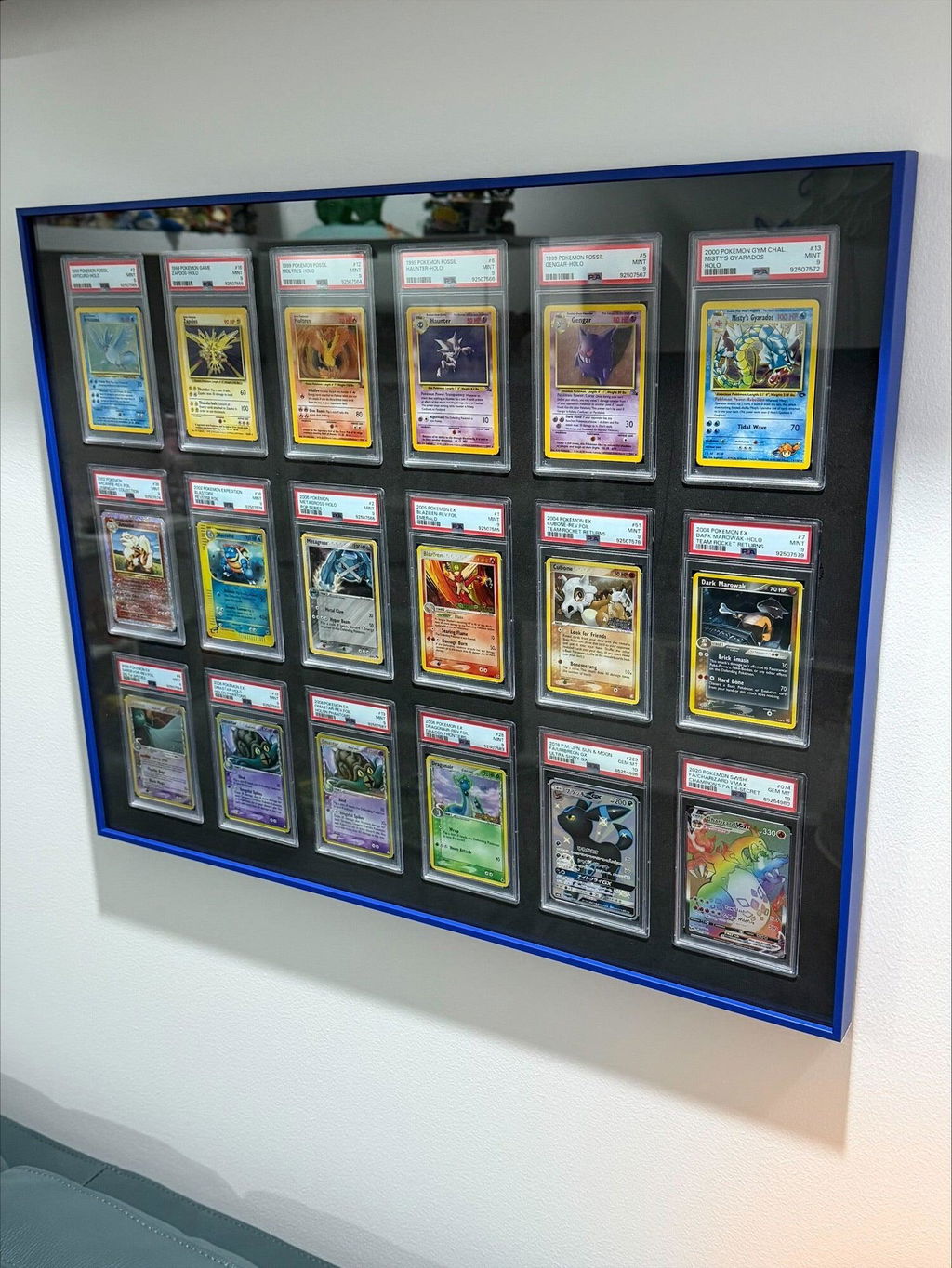
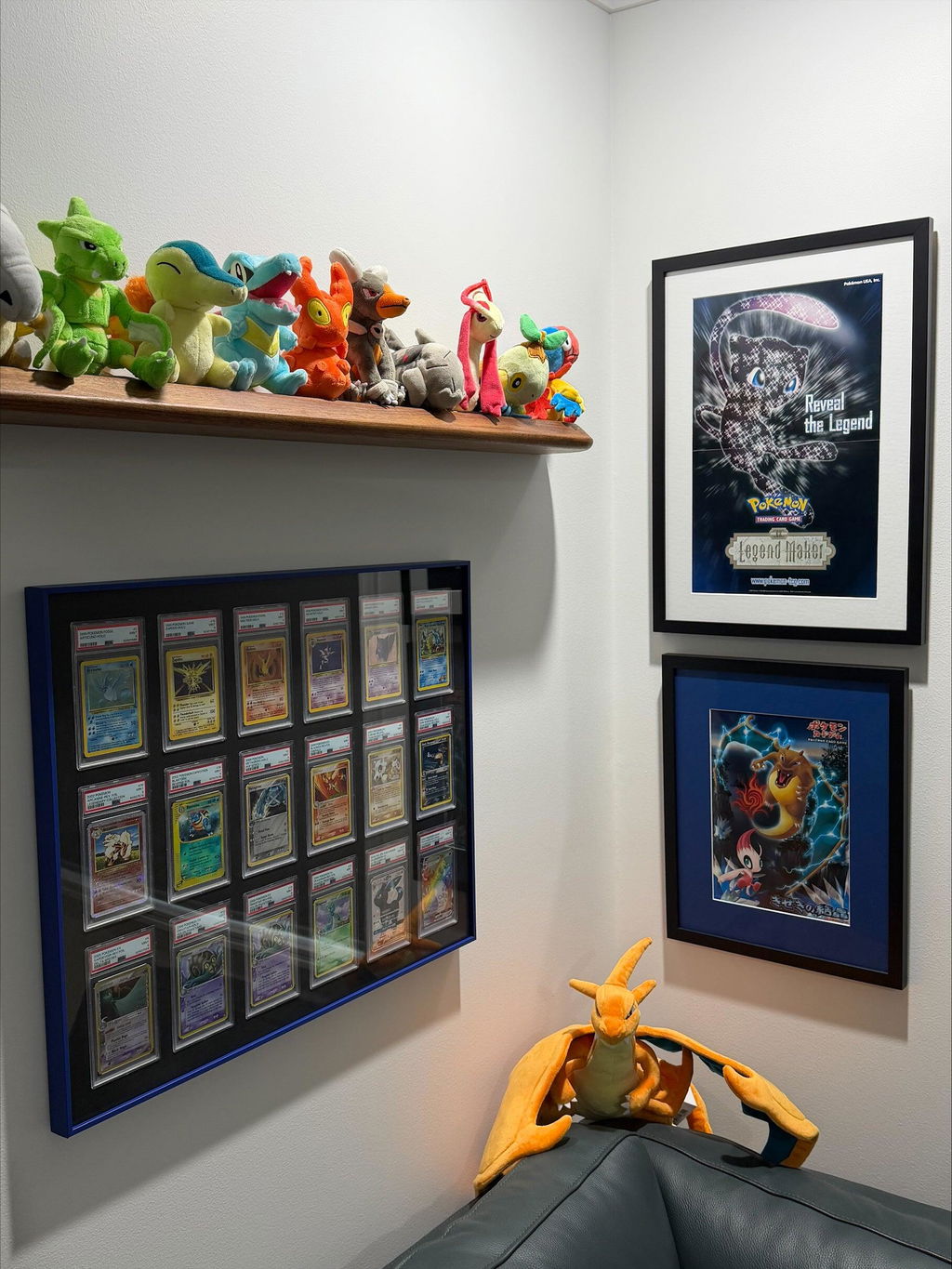
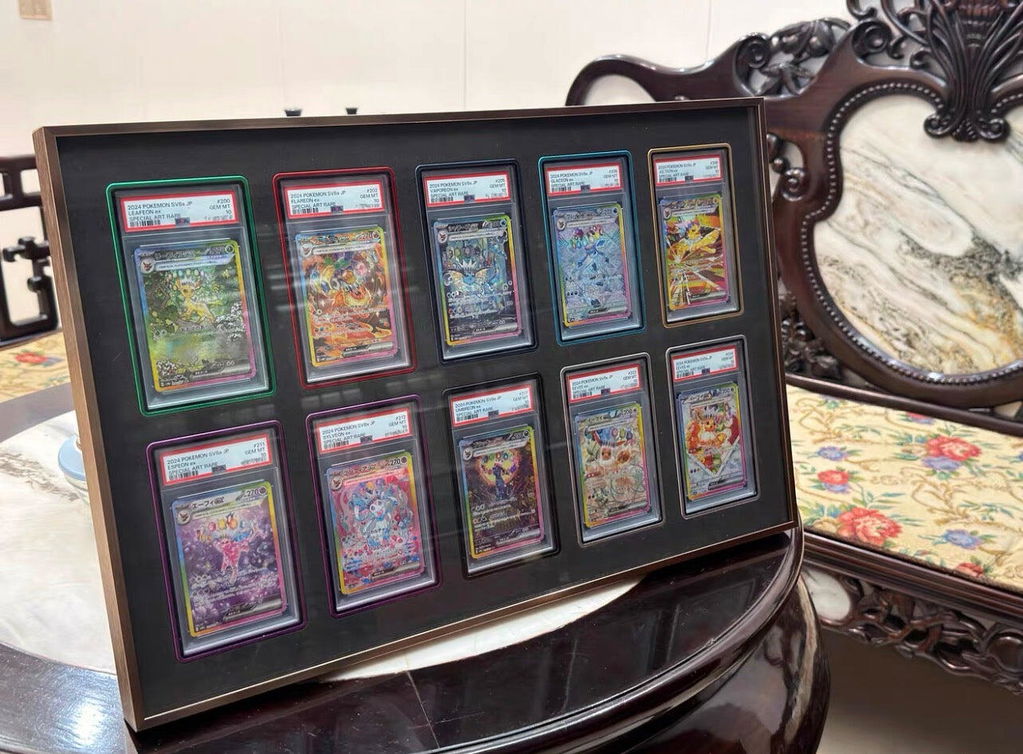
Graded One Piece trading cards work well in EVA foam or other rigid-holder inserts. As with any slab display, measure the actual holder and prototype the fit rather than using a generic opening.
Matboard, EVA foam and the part that actually holds the trading cards
Raw and sleeved One Piece trading cards work well with matboard because it gives the artwork a clean edge without adding bulk. For top loaders, magnetic holders and graded slabs, a recessed foam insert usually makes more sense.
EVA is useful because it can hold the rigid case while keeping the front visually clean. Test the fit with the actual holder, and remember that a collection may be updated often as new alternate arts and premium releases appear.
For that reason, a slightly serviceable fit is more useful than an opening that is impressively tight but difficult to use.
Crew, character and leader-focused layouts
One Piece collections lend themselves to strong themed grouping. A leader trading card can sit at the centre of a character group. Crew-based arrangements can use repeated colours without needing coloured frame materials. Another option is to organise the wall by release wave or by favourite characters.
Because the trading card artwork is already visually strong, symmetry is often enough. A clean grid can make a highly colourful collection feel more controlled.
Layout planning: where small errors become obvious
One Piece layouts can be organised by crew, character, leader, colour or release. Those themes give the wall enough identity without needing decorative labels around every section.
A strict grid can actually help calm highly colourful artwork. If you prefer a centrepiece layout, use one leader or major trading card as the anchor and keep the supporting group visually balanced around it.
Before committing to the total size, ask what happens when the next release adds another favourite. A modular wall may be a better long-term answer than filling every centimetre today.
Foil and glossy artwork can look great or become a glare problem
The same finish that makes a One Piece trading card look impressive under good lighting can make it difficult to view under a badly placed LED strip or window reflection.
Test the display at the actual viewing angle. A light that looks perfect when you are standing directly in front of the frame may reflect badly from the side. Diffusion and external lighting are often easier to control than very bright internal strips.
Acrylic, glass and UV protection
Both acrylic and glass can present One Piece trading cards clearly. Acrylic is usually easier to handle as the display gets larger, while glass offers better scratch resistance on smaller frames.
Glossy and foil finishes make reflections more noticeable, so clarity is not only about the material itself. Where the frame sits in relation to windows and room lights can have a bigger effect than a small difference in glazing specification.
Keep direct sunlight under control. UV-resistant glazing is useful, but sensible placement is still the first layer of protection.
Lighting without turning the glazing into a mirror
One Piece is one of the easiest collections to over-light because alternate arts and foil treatments already react strongly to light. A soft source usually gives a better result than a harsh LED strip aimed straight at the front.
Test the complete frame at the intended viewing angle. If individual LED points are visible in the reflection, add diffusion or move the light source. The goal is to reveal the artwork, not make the lighting itself the first thing you notice.
Plan for the collection you are likely to have next year
A large fixed display makes sense when the collection theme is already stable. If the collection is still changing quickly, modular frames can be much easier to expand.
For a large One Piece wall, consider whether the next release will create another complete row or whether the whole grid would need to be redesigned. That question can influence the layout before any material is cut.
Frame depth, backing and wall mounting
The required frame depth depends almost entirely on the holder. Sleeved trading cards can stay shallow; magnetic holders and slabs need more room. Check the full stack before choosing the outer profile.
Use a backing that remains flat across the span and can be removed later. An active One Piece collection is likely to change, so permanent sealing is rarely helpful.
Once the display becomes large, wall mounting needs the same attention as the frame. Match the hardware to the wall type and final weight rather than relying on the hook that happened to come with a generic picture frame.
Where to source materials for a DIY build
Start locally. Hardware stores can cover timber, MDF and mounting hardware. Framing suppliers can help with matboard and glass. Plastics suppliers can cut acrylic, while local foam suppliers can provide EVA for rigid-holder inserts.
For a one-off display, supplier-cut materials can save time and improve the finish. There is little value in buying specialist cutting equipment if the project only needs one panel.
Cheap, mid-range and premium ways to approach the build
A budget One Piece display can use a standard frame, simple matboard and acrylic. That is enough for a small group of sleeved trading cards and keeps the project easy to update.
A mid-range build can add custom-cut glazing, a better outer frame and a more precise insert. For graded trading cards, stronger backing and EVA foam start to matter more.
A premium wall might use aluminium, upgraded glazing, integrated lighting and professional mounting. Keep the premium spend focused on finish and function rather than adding decoration that competes with the artwork.
Keeping a colourful One Piece display from becoming visually noisy
Neutral frame materials are often the safest choice when the trading card artwork already uses strong reds, blues, golds and foil finishes. A black, white, timber or restrained metal surround gives the collection a boundary without competing with it.
If you want colour, use it in one controlled place: an accent mat, a wall colour or lighting. The trading cards should still be the first thing the eye notices.
One Piece artwork benefits from restraint around it
One Piece trading cards often contain strong character colours, dramatic foil effects and full-art layouts. That means a frame does not need to add much decoration. A neutral structure usually makes the collection feel more deliberate.
If you want to use colour, tie it to the overall theme rather than every individual trading card. A crew colour, one accent line or a wall colour can add personality without competing with the artwork.
Plan for expansion instead of pretending the collection is finished
One Piece is still an actively expanding TCG, so collectors should assume the wall may grow. That changes the value of modular frames, removable inserts and repeatable layouts.
A collector building a character-focused display may want to leave room for future alternate arts. A crew display may need another module later. Designing the wall so another matching frame can be added is often easier than trying to predict exactly how many trading cards the collection will contain in several years.
Foil glare and room lighting
Highly reflective One Piece trading cards can look spectacular under soft directional light and almost unreadable under a badly placed LED strip. The front glazing adds another reflective surface, so lighting should be tested with the complete material stack.
External room lighting is often easier to control than very bright internal LEDs. If integrated lighting is used, diffusion is worth considering so individual diodes do not reflect as a row of bright dots across the trading card holders.
Leader and character layouts
A leader trading card can work naturally as a centrepiece, but it does not have to sit in the exact middle. Asymmetrical layouts can work well when the supporting trading cards are grouped by character or colour.
For larger collections, a strict grid can actually make highly varied artwork feel calmer. The more colourful the trading cards, the more useful a simple underlying geometry becomes.
Maintenance and collection rotation
Because One Piece collections can change quickly, make sure the frame can be reopened without damaging the insert. A display that looks perfect today but is difficult to update may become frustrating after the next release.
When rotating trading cards, clean the glazing while the frame is open and check that the insert has not compressed or shifted. Small maintenance steps keep a large wall looking intentional over time.
Common DIY mistakes that are easy to avoid
- Building the frame around today's collection with no thought for future releases.
- Using strong coloured matboard that competes with already colourful artwork.
- Installing bright LEDs before testing reflections through the final glazing.
- Making slab or magnetic-holder openings unnecessarily tight.
- Choosing the outer frame before checking the full holder depth.
- Using a flexible backing on a wide display.
- Mounting a large frame with hardware intended for a small picture.
- Making the rear access so difficult that collection rotation becomes a chore.
A practical build sequence
- Choose the One Piece trading cards and the holders they will stay in.
- Measure those holders rather than the raw trading card.
- Decide whether the wall is organised by crew, character, leader or release.
- Mark the proposed frame size on the wall.
- Choose frame, insert, glazing and backing materials.
- Test one holder opening.
- Dry-fit the complete material stack to check depth and glare.
- Assemble the display and confirm that it can still be reopened.
- Mount it using hardware suitable for the finished weight.
When DIY makes sense and when ready-made starts looking attractive
A smaller One Piece display is a straightforward DIY project, especially if the trading cards are sleeved or top-loaded.
As the wall grows into a large graded collection, the work shifts from simple framing into precision fabrication. If that is not the part of the hobby you enjoy, a ready-made system can be a more sensible use of time.
Designing around alternate-art and manga-style trading cards
One Piece collectors often want the most visually dramatic trading cards on the wall, which changes the balance of the display. Alternate arts and manga-style pieces can dominate a grid even when every opening is the same size.
That is not necessarily a problem. A centrepiece trading card can be given the strongest position while the surrounding grid stays simple. The cleaner the frame, the easier it is for premium artwork to stand out naturally.
Leader-focused displays
A leader trading card is an obvious anchor for a themed group. It can sit at the centre, at the top of a vertical layout or at one side of an asymmetrical composition.
Supporting trading cards can then be grouped by character, crew or colour. This creates a display that has some visual hierarchy without needing extra labels or decoration.
If the group is likely to grow, keep the leader in a position that still works when another row or module is added later.
How to deal with a collection that is still growing quickly
One Piece is the kind of collection where a finished wall can stop feeling finished after the next release. That makes modularity especially valuable.
Instead of building one frame around the exact number of trading cards you own today, think about whether the layout can be repeated. Two or three related frames often give you more flexibility than one huge custom panel.
This also makes future changes less disruptive. One section can be updated without opening the entire wall.
Foil-heavy collections need lighting tests before final assembly
High-gloss and foil trading cards can reflect both room lights and the glazing itself. Test the frame in the actual room before permanently installing LEDs.
A light source that seems subtle on a workbench can create a strong white reflection once the frame is upright. Softer light from an angle is often more effective than brighter light straight on.
Keeping a One Piece wall visually calm
One Piece artwork can already contain strong reds, blues, golds and detailed backgrounds. If the frame adds several more colours, the result can become busy very quickly.
Neutral materials are usually easier to live with long term. If you want to introduce colour, use one controlled accent rather than trying to match each trading card individually.
When a large single frame still makes sense
Modular displays are useful, but a single large frame can be excellent when the collection theme is stable. A completed crew, a defined graded run or a deliberately chosen wall of favourites can benefit from one uninterrupted layout.
The trade-off is practical: larger glazing, stronger backing, more weight and more difficult transport. If you choose the one-frame route, plan those details from the beginning.
Raw One Piece trading cards versus graded display pieces
Many One Piece collections are mixed. A collector may keep most trading cards raw or sleeved while grading a smaller group of favourite alternate arts or premium pieces. That does not mean both formats need to share one frame.
Matching frames with different internal construction are often cleaner. The raw trading cards can use a shallow matboard layout, while the graded trading cards sit in a deeper foam-supported display. From the room, the wall still reads as one collection because the outer finishes match.
Using empty space deliberately
Colourful One Piece artwork can make a dense display feel busier than expected. Leaving a little more room around the grid can make the premium trading cards feel stronger rather than weaker.
Empty space is not wasted space when it improves the composition. This is especially true around a manga-style or highly reflective centrepiece, where a tight crowd of surrounding trading cards can compete with the piece you wanted to highlight.
Planning the wall before the next release arrives
If you already know the collection will keep growing, decide where the next frame could go before the first one is mounted. That might mean leaving room to the side, building vertically, or choosing a repeatable frame size.
A little planning now prevents the second display from looking like an afterthought later.
Do a full-room test before final mounting
Once the frame is assembled, stand it against the wall before drilling. Look at it in daylight, at night and from the normal viewing positions in the room. This is the best time to catch glare, an awkward height or a frame that feels too large for the surrounding furniture.
A few minutes of testing can save a lot of unnecessary remounting later.
It is also worth keeping a simple record of the frame material, glazing type and holder format used. If the One Piece wall expands later, you can match the next display much more easily instead of starting the design process again.
That small record can include where the materials were sourced locally and how the frame is mounted. It makes later expansion faster and helps keep multiple One Piece displays looking intentional as one wall.
How to make a homemade One Piece trading card display
A homemade One Piece trading card display can be very simple: choose the trading cards, keep the frame neutral, and use matboard for sleeved cards or a rigid-holder insert for slabs and magnetic holders.
If you want to make your own One Piece card frame cheaply, avoid overcomplicating the build. A clean grid with basic acrylic can work well. Premium materials are most useful when they improve rigidity, UV protection, mounting or finish.
Frequently asked questions
Can One Piece trading cards be framed in sleeves?
Yes. Measure the sleeve itself and make sure the trading card can be removed without bending the sleeve.
Do foil One Piece trading cards need special lighting?
They do not require special lighting, but glossy and foil surfaces can create glare. Test the lighting angle before fixing LEDs permanently.
Can graded and raw One Piece trading cards go in the same display?
They can, although the different depths are easier to manage in separate zones or separate frames.
Should a One Piece trading card wall display leave room for future releases?
If the collection is still growing, yes. Modular layouts can make future expansion much easier.
Final thoughts
A good One Piece trading card wall display should make the artwork easier to enjoy, not surround it with unnecessary complexity. Keep the frame restrained, test lighting carefully, plan for future collection growth and choose materials that suit the holder format you already use.
Continue Exploring
If you enjoyed this guide, you may also find these collector resources helpful.
📚 Collector Guides
-
Best Trading Cards to Display & Collect
Explore Pokémon, MTG, Yu-Gi-Oh!, Sports Cards, One Piece and Disney Lorcana cards, sets, rarities and collection ideas. -
The Ultimate Trading Card Display Guide
Explore trading card wall displays, frames, shelves, layouts and display solutions for collections of every size. -
How to Display Graded Cards on a Wall
Learn how collectors display PSA, BGS and CGC graded cards using wall-mounted trading card displays.
🛒 Shop Display Collections
-
Aluminium Trading Card Wall Display Frames
Premium aluminium trading card display frames available in a wide range of grid sizes, frame colours and holder formats. -
PSA, CGC & BGS Graded Slab Wall Display Frames
Purpose-built graded trading card display frames for Pokémon, MTG, Yu-Gi-Oh!, One Piece, Sports Cards, Disney Lorcana and other collections. -
One Touch Wall Display Frames
Premium aluminium wall display frames designed for One Touch magnetic trading card holders.

0 comments