


There is no single perfect number of trading cards to put in a frame.
The right number depends on the cards, the holder format, the amount of wall space available and whether you want one card to dominate the display or several cards to work together as a group.
A single graded Charizard can look excellent on its own. A nine-card Pokémon grid can feel perfectly balanced. A 36-card slab display can work just as well when the collection is large enough to justify it.
The important part is matching the number of cards to the collection rather than filling a frame simply because the space is available.
Start With the Cards, Not the Frame Size
It is easy to start by deciding that you want a 9-card, 12-card or 20-card frame and then trying to find enough cards to fill it.
Usually, the better approach is the opposite.
Choose the cards that naturally belong together first, then find a layout that fits them.
For example:
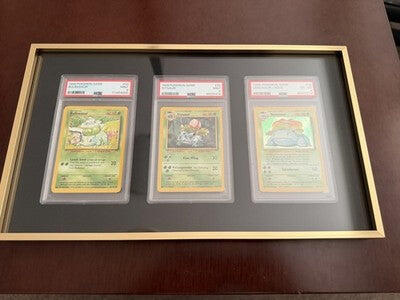
- A three-stage Pokémon evolution line naturally suggests three cards.
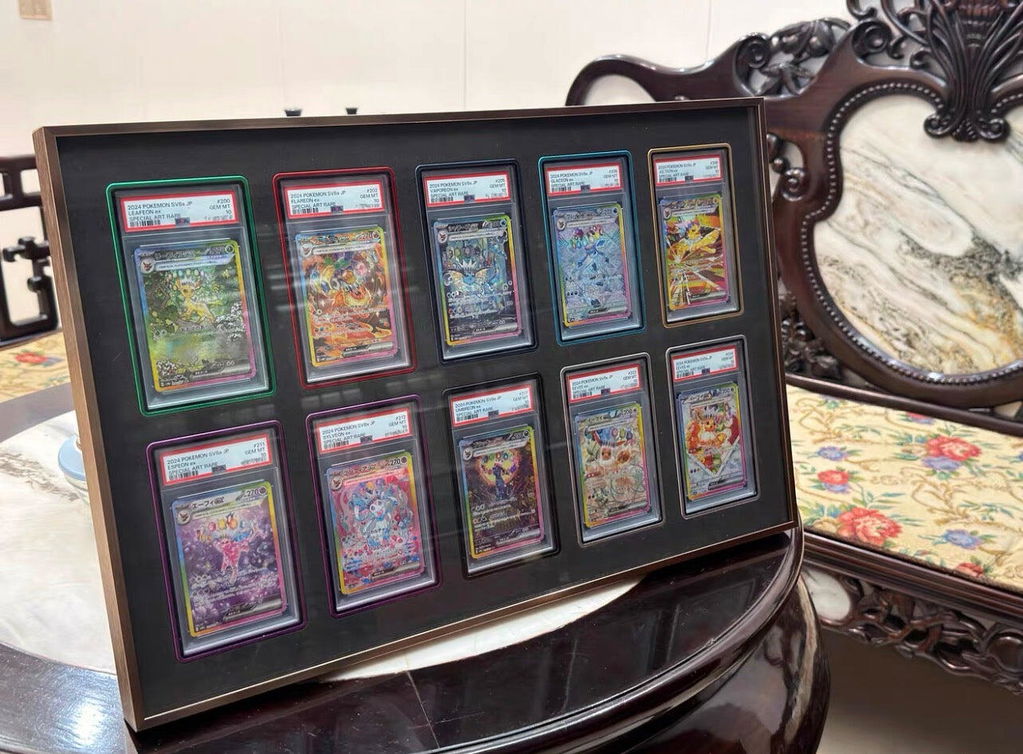
- Nine favourite PSA slabs can suit a 3 × 3 grid.
- A sports player collection may make more sense at 12 or 16 cards.
- One particularly important card may not need anything beside it.
The display usually feels more deliberate when the card count comes from the collection itself.
Single-Card Displays
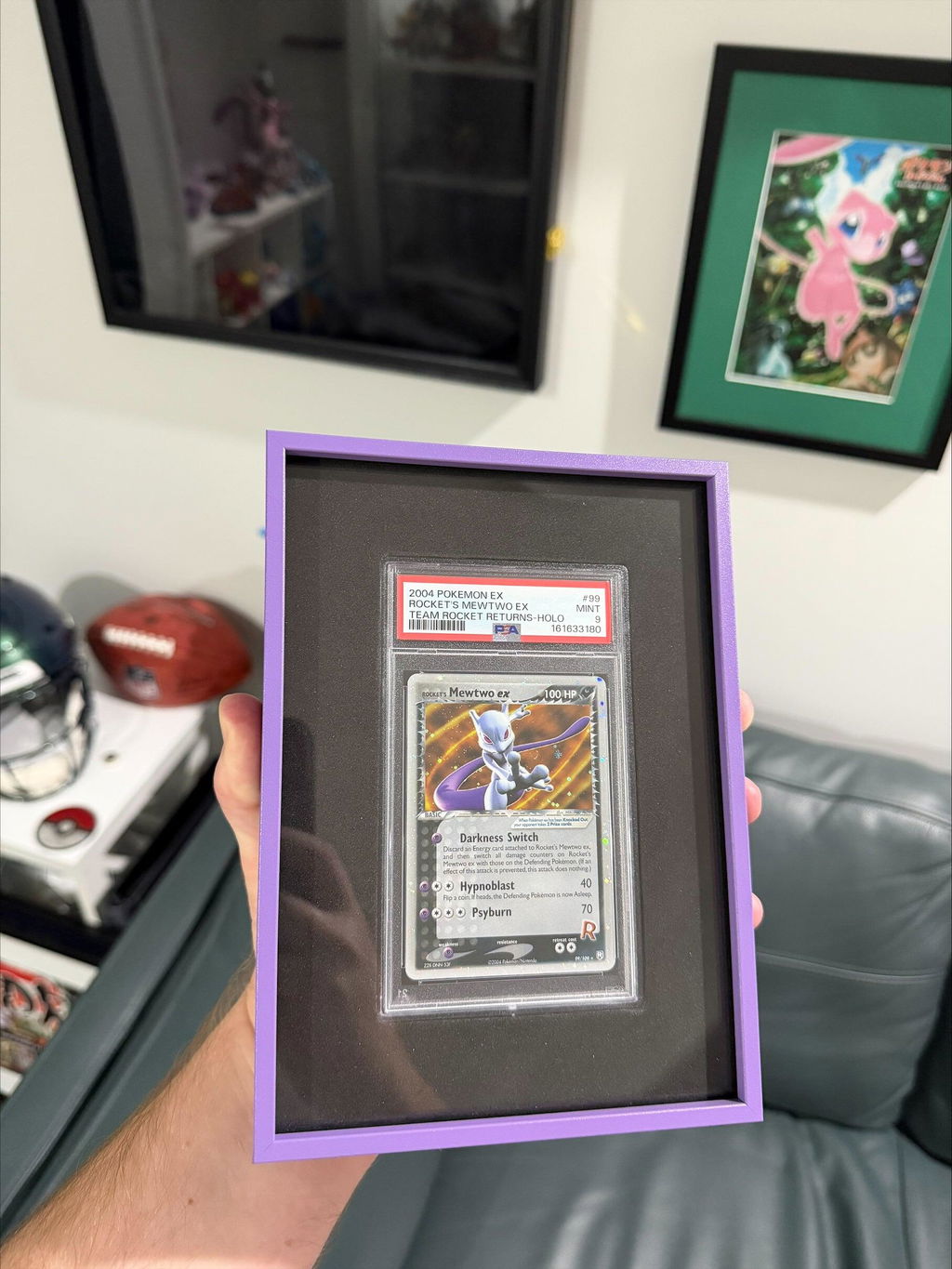
A one-card frame gives one trading card complete visual priority.
This works particularly well for:
- A favourite graded card.
- A major rookie card.
- An autograph.
- A high-end Pokémon card.
- A card with artwork you want to see without anything competing around it.
A single-card display also works well in smaller spaces where a larger grid would feel oversized.
Because there is only one card, the frame proportion and the amount of empty space around it become more noticeable. Keeping the surrounding design restrained usually works best.
Two-Card Displays
Two-card frames work best when the cards have an obvious relationship.
Examples include:
- Japanese and English versions of the same card.
- Two versions of the same Pokémon.
- A rookie card beside a later-career card.
- Two matching autographs.
- Vintage and modern versions of the same character.
A pair can look very clean because both cards receive plenty of space while still clearly belonging together.
Three-Card Displays
Three-card layouts are one of the most natural small display sizes.
Pokémon evolution lines are the obvious example, but three-card frames also work well for:
- Three versions of the same card.
- Three players from one team.
- Three graded highlights from one set.
- A small MTG or Yu-Gi-Oh! group.
Three cards provide enough variety to feel like a collection without turning the frame into a large wall piece.
Four-Card Displays
Four cards naturally suit a 2 × 2 grid and can work particularly well when every card has similar visual importance.
This layout is useful for:
- Four favourite cards from one set.
- Four players from one team.
- Four versions of the same Pokémon.
- A small graded-card group.
The square shape can also make a four-card frame easy to position above a desk, cabinet or smaller section of wall.
Five to Eight Cards
Once a display moves beyond four cards, the layout becomes more important.
Five, six, seven or eight cards can work very well when the group naturally contains that number, but you want to avoid leaving the arrangement looking like an incomplete larger grid.
These card counts are particularly useful for:
- Small character collections.
- Sports player runs.
- Favourite graded cards from one release.
- Pokémon groups where the card count does not naturally fit a 3 × 3 layout.
The layout should be chosen around the actual card count rather than trying to make eight cards look like a nine-card frame with one missing.
Nine-Card Displays
Nine cards work especially well because a 3 × 3 grid is compact, symmetrical and easy to understand visually.
This size is large enough to feel substantial without requiring a huge amount of wall space.
Nine-card layouts work well for:
- Eeveelution collections.
- Graded Pokémon displays.
- Sports player collections.
- Set highlights.
- Nine favourite One Touch cards.
- Mixed personal favourites where the holder style stays consistent.
For collectors who want something larger than a small feature frame but do not want a full wall display, nine cards are often a very practical middle ground.
Ten to Sixteen Cards
Once you reach double digits, the display starts to read more like a collection rather than a small group of individual cards.
This range works well for:
- Character collections.
- Graded set highlights.
- Sports team or player groups.
- Rookie collections.
- One Touch displays.
- Small themed walls.
At this point, consistent spacing and holder alignment become noticeably more important because small differences repeat across the entire frame.
You also need to start thinking more carefully about finished frame size and wall position.
Eighteen to Twenty-Four Cards
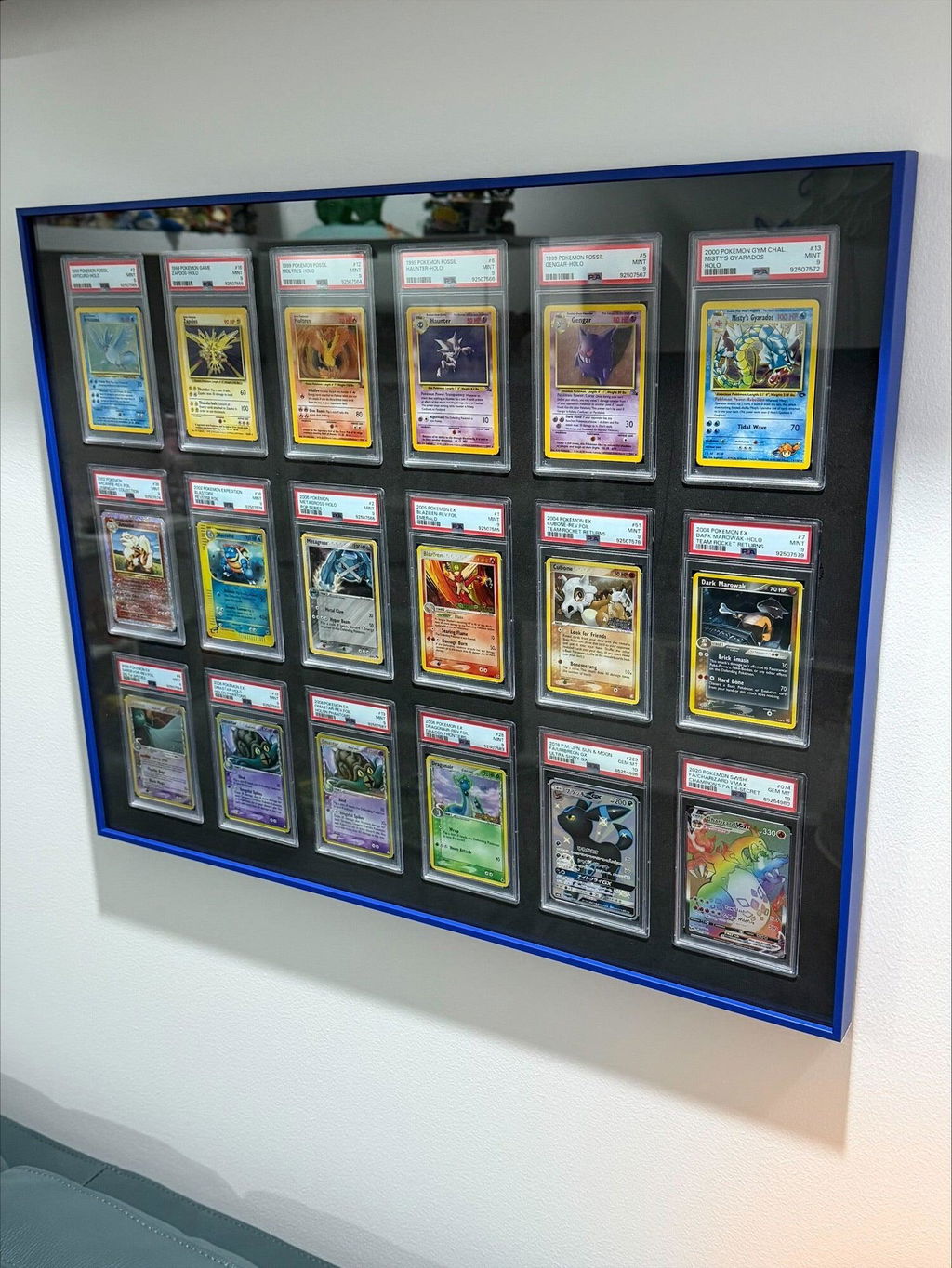
An 18-card or 24-card display has enough visual weight to become a significant part of the wall.
These sizes suit collectors who already have a clearly developed group rather than someone trying to fill empty spaces.
They can work particularly well for:
- Larger Pokémon character collections.
- Graded card groups.
- Sports player or team displays.
- Multiple related sets or eras.
At this scale, the overall grid becomes almost as important visually as the individual trading cards.
Twenty-Five Cards and Above
Once you move into 25, 36, 50 or more trading cards, you are no longer choosing a small frame. You are planning a large wall display.
That changes the practical requirements considerably.
You need to think about:
- Total frame size.
- Finished weight.
- Frame rigidity.
- Glazing weight.
- Backing strength.
- Wall mounting.
- Whether the display can be moved safely.
This is where stronger frame materials such as aluminium become particularly useful because a slim profile can still provide good rigidity across a much larger display.
Large layouts can look extremely clean when the collection genuinely supports the card count. They look much less convincing when cards have been added simply to fill the available grid.
Should Every Position in the Frame Be Filled?
Usually, yes, if the frame was designed around a fixed repeated grid.
An obvious empty position in the middle of a 3 × 3 or 4 × 4 slab layout can look accidental rather than intentional.
If you only have eight cards, it may be better to choose an eight-card layout than buy a nine-card frame and leave one opening empty.
The exception is when empty space has been designed deliberately into the composition rather than simply left over.
More Cards Do Not Automatically Make a Better Display
A bigger frame is not automatically more impressive.
Four excellent cards with an obvious connection can look much stronger than 20 unrelated cards placed together simply because they fit.
The same applies to value. The cards do not need to be the most expensive pieces in the collection. They just need a reason to sit together.
That reason might be a character, player, set, era, artist, language or simply a group of cards you personally want to see.
Holder Type Changes How Many Cards Feel Comfortable
The same card count can feel completely different depending on the holder.
Raw or sleeved trading cards are small and light, so a large raw-card grid can remain relatively compact.
Toploaders take up more space. One Touch holders are wider and deeper again. PSA, CGC and BGS slabs create larger and heavier displays because the plastic holder and grading label become part of the layout.
This means a 20-card raw display and a 20-card graded display should not be treated as the same size project.
Wall Size Matters More as the Card Count Grows
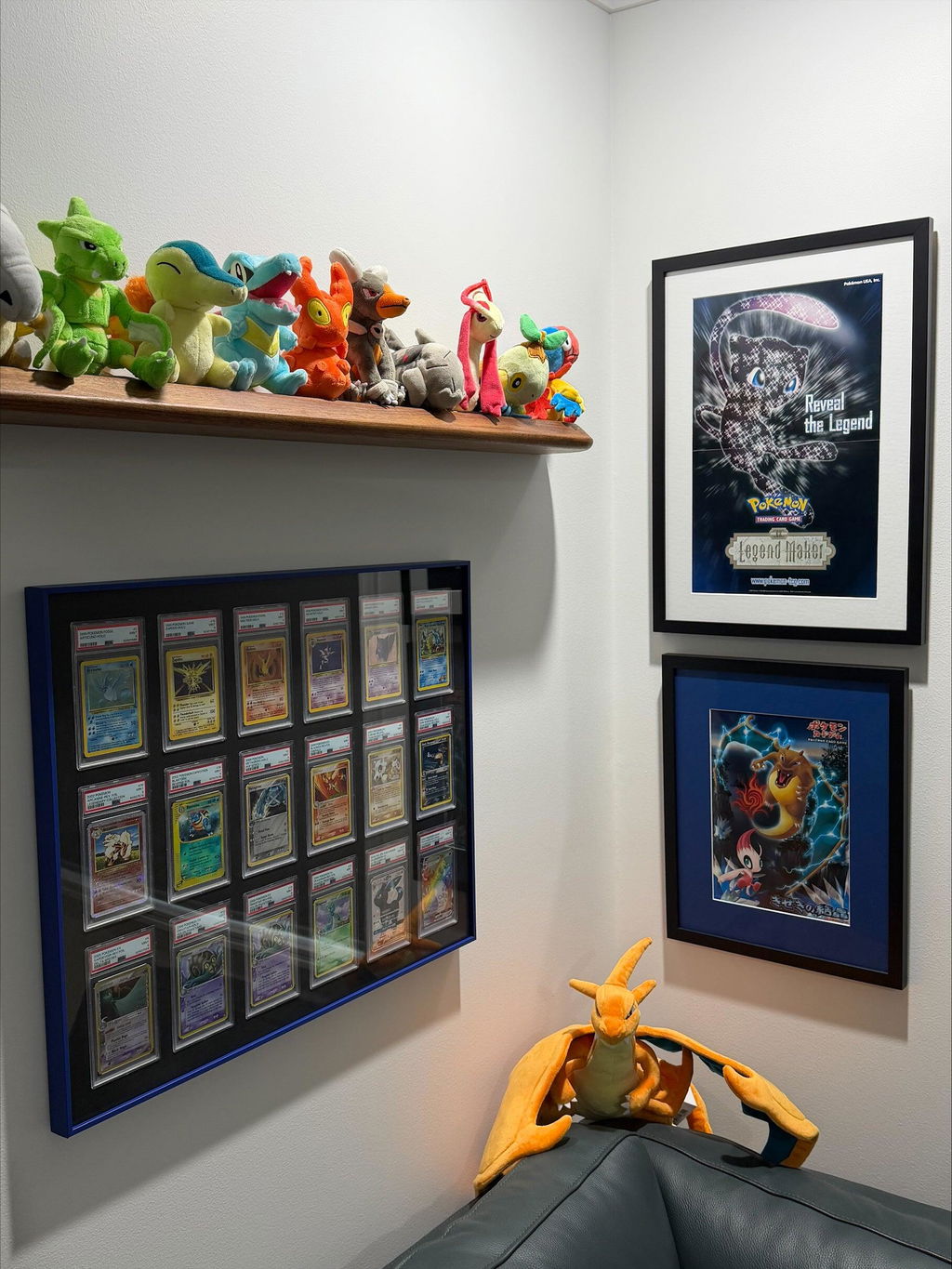
A frame should make sense for the wall where it will actually be mounted.
A nine-card display may look substantial above a small desk but relatively modest on a large empty wall.
A 36-card display may look excellent above a wide cabinet but overwhelm a narrow section of wall.
Before ordering or building a large frame, marking its approximate outside dimensions on the wall with removable tape is a simple way to judge the scale.
Viewing Distance Changes the Ideal Card Count
Small displays are usually viewed from fairly close range.
With larger displays, the overall grid starts to matter more because individual trading cards become harder to distinguish from across the room.
This means a large 36-card or 54-card frame can work as one strong visual block from a distance, while the individual cards become more important as you move closer.
If the wall is normally viewed from several metres away, a larger layout may make more sense than several tiny frames scattered across the same space.
Several Smaller Frames Can Be Better Than One Large Frame
You do not need to put every related trading card into one frame.
Several smaller displays can make a large collection easier to organise and update.
For example, a Pokémon collector might use:
- One frame for Charizard.
- One for Eeveelutions.
- One for vintage cards.
- One for modern graded cards.
If the frames share the same finish and are spaced consistently, they can still read as one larger wall display.
Think About Future Additions Before Choosing the Card Count
If the collection is actively growing, a frame that fits perfectly today may become limiting surprisingly quickly.
Before choosing the final size, think about:
- Cards you already plan to buy.
- Cards currently being graded.
- Upcoming set releases.
- Whether matching frames can be added later.
- Whether the frame can be reopened easily.
You do not necessarily need to buy a larger frame now. Sometimes leaving wall space for another matching display is the cleaner option.
How Many Graded Cards Should You Put in One Frame?
For graded cards, the practical answer depends heavily on wall space and total weight.
Small collections of 3, 4 or 9 slabs are easy to position almost anywhere. Larger 18, 24, 36 or 50-card layouts become much more substantial pieces of wall furniture.
At larger sizes, the question is not only whether the cards fit visually. You also need to consider frame construction, acrylic or glass, backing and secure wall mounting.
If you are planning a DIY slab display, our guide to making a graded trading card wall display covers those considerations in more detail.
How Many Raw or Sleeved Cards Should You Display?
Raw and sleeved cards give you much more flexibility because they are smaller and lighter.
A relatively modest frame can hold a much larger number of raw trading cards than graded slabs.
This makes raw-card frames useful for set highlights, character collections, artwork displays and larger themed grids.
If you are planning one yourself, our raw and sleeved trading card wall display guide covers sleeves, materials and layout planning in more detail.
How Many One Touch Cards Should You Display?
One Touch magnetic holders sit between raw cards and graded slabs in both size and weight.
Small One Touch groups can work well in 3, 4 or 9-card arrangements, while larger collections can be expanded into 12, 18 or larger repeated grids.
Because magnetic holders can vary in depth, particularly with sports cards, the actual holder should be considered before choosing the final frame.
Our One Touch trading card wall display guide covers magnetic holders, frame depth and layout planning in more detail.
Final Thoughts
There is no correct number of trading cards to put in a frame.
The best number is the one that makes sense for the cards you actually want to display.
One card can be enough when it deserves its own space. Nine cards can create an excellent compact grid. Thirty-six or more can work brilliantly when there is a genuine collection behind the layout and enough wall space to support it.
Start with the collection, choose the cards that belong together and then find a frame size that fits them. That usually produces a much better result than choosing the largest frame first and trying to work backwards.
Continue Exploring
If you enjoyed this guide, you may also find these collector resources helpful.
📚 Collector Guides
-
The Ultimate Trading Card Display Guide: Ideas, Frames, Shelves & Display Solutions for Every Collector
Explore display ideas, wall layouts, shelving, cabinets, lighting, budgets and display solutions for every major trading card game. -
How to Make a Trading Card Wall Display: Complete DIY Guide
Learn how to plan a DIY trading card display, including frame materials, holders, acrylic, EVA foam, layouts and wall mounting. -
How to Make a Graded Trading Card Wall Display
Explore DIY graded card displays, slab formats, frame materials, EVA foam, acrylic, layouts and mounting considerations. -
Why Premium Aluminium Trading Card Display Frames Are Worth It: The Complete Collector Guide
Explore aluminium trading card display frames, their materials and why they work particularly well for larger graded and One Touch collections.
🛒 Shop Display Collections
-
Aluminium Trading Card Wall Display Frames
Premium aluminium trading card display frames available in a wide range of grid sizes, frame colours and holder formats. -
PSA, CGC & BGS Graded Slab Wall Display Frames
Purpose-built graded trading card display frames for Pokémon, MTG, Yu-Gi-Oh!, One Piece, Sports Cards, Disney Lorcana and other collections. -
One Touch Wall Display Frames
Premium aluminium wall display frames designed for One Touch magnetic trading card holders.

0 comments