


There is a point in many trading card collections where the way the cards are displayed starts to matter almost as much as finding somewhere to put them.
At the beginning, a simple picture frame, shelf or inexpensive display may be completely appropriate. If you are framing a handful of raw trading cards or experimenting with your first wall display, there is often very little reason to make the project expensive.
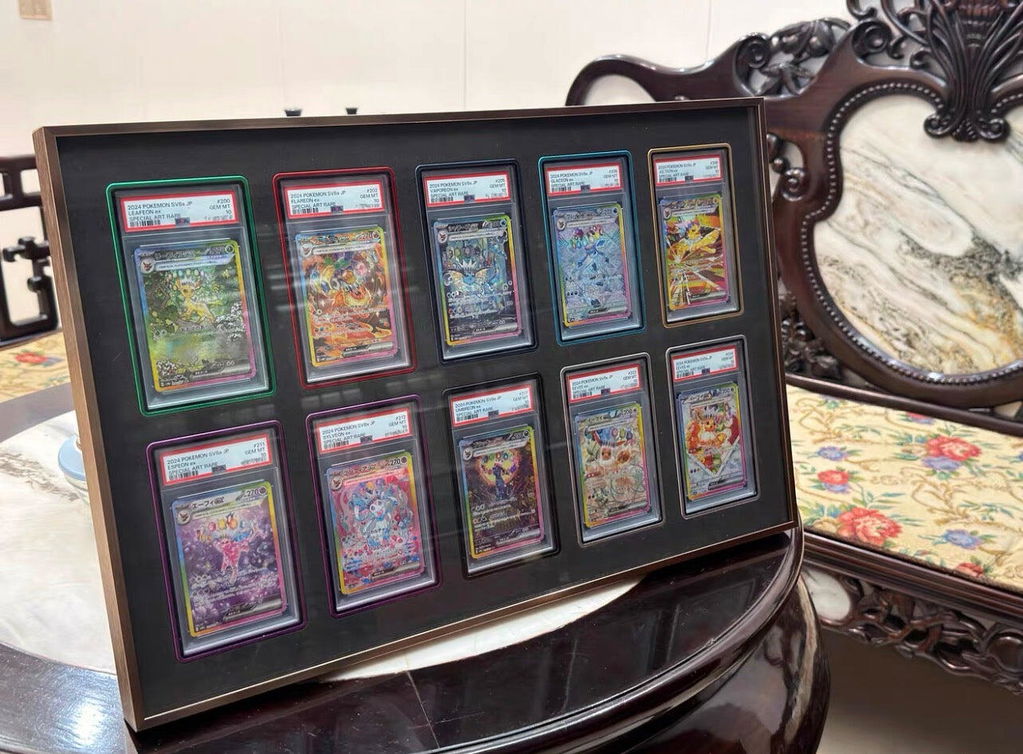
But collections change. A few favourite cards can become a wall of PSA slabs. A small sports collection can grow into dozens of rookie cards, autographs and One Touch holders. A Pokémon collection that once lived entirely in binders can eventually contain several thousand dollars' worth of graded cards and carefully selected pieces.
At that point, the question often changes.
Instead of asking, “What is the cheapest way to put these cards on the wall?” collectors start asking, “What kind of display actually makes sense for this collection?”
That does not mean an expensive trading card collection automatically needs an expensive frame. A basic frame can still work perfectly well. Likewise, spending more money does not automatically produce a better display.
The real difference is that the priorities often change as a collection becomes larger, heavier, more valuable and more permanent.
This guide looks at cheap, mid-range and premium trading card display options, what you are actually paying for at each level, and why collectors with larger or more valuable collections often move towards more substantial display systems over time.
There Is No Correct Percentage to Spend on a Display
You do not need to spend 10%, 20% or any other fixed percentage of the collection value on a frame.
A $5,000 collection does not automatically need a $500 display, just as a $500 collection does not prevent someone from buying a premium frame if that is what they want in the room.
Collection value is only one factor.
The more useful questions are:
- How many trading cards are being displayed?
- Are they raw, sleeved, graded or inside magnetic holders?
- How large will the finished frame be?
- How heavy will the finished display become?
- Will the collection remain on the wall for years?
- How important is the finished appearance?
- How often will the cards be changed?
- Is the display going into a dedicated collector room or a normal living space?
A collector with 36 graded cards may have very different requirements from someone displaying four sleeved cards, even if the total financial value of both collections happens to be similar.
Cheap Trading Card Displays Are Not Automatically Bad
There is a tendency to treat “cheap” and “bad” as the same thing when discussing display products. They are not.
A low-cost display can look excellent when the materials suit the scale of the project and the cards are positioned accurately.
For example, a small raw-card display might use:
- A standard picture frame.
- Basic timber or MDF construction.
- Standard glass or acrylic.
- Simple matboard.
- A lightweight backing board.
For three, four or nine raw trading cards, that can be completely appropriate.
If the mat openings are straight, the cards are aligned properly and the frame suits the room, there is no reason a relatively inexpensive display cannot look good.
This is especially true for collectors who enjoy DIY projects and do not mind spending some time measuring, cutting and adjusting the frame themselves.
What a Cheap Display Is Actually Good At
Lower-cost displays are strongest when the project is small, light and straightforward.
They work particularly well for:
- Raw and sleeved trading cards.
- Small Pokémon collections.
- Short evolution lines.
- Small MTG or Yu-Gi-Oh! groups.
- Temporary displays.
- Collections that change frequently.
- Collectors experimenting with wall displays for the first time.
At this scale, the frame is mainly solving a simple problem: keeping a small number of lightweight cards organised behind glazing.
You do not necessarily need advanced materials or substantial structural framing to do that well.
Where Cheap Frames Start to Reach Their Limits
The problems usually appear when the display becomes larger or heavier.
A standard MDF or lightweight picture frame may be perfectly suitable for a handful of cards, but its limitations become more noticeable when you start adding:
- Large numbers of PSA, CGC or BGS slabs.
- One Touch magnetic holders.
- Thick sports cards.
- Large acrylic or glass panels.
- Wide frame spans.
- Heavier backing materials.
- High card counts.
The frame is now being asked to do much more than hold a few lightweight cards.
It has to resist flexing, support a larger front panel, keep a much wider grid aligned and remain stable once mounted vertically.
The Bigger the Display, the More the Construction Matters
Small inaccuracies that are almost invisible in a three-card frame become much easier to see across 18, 36 or 50 trading cards.
If one opening is slightly misaligned, the eye may barely notice it.
If the same inconsistency repeats across several rows, it becomes part of the entire display.
The same is true of the outer frame.
A little flex in a small picture frame may not matter. Across a large wall display, that same behaviour can affect how the glazing, insert and backing sit together.
This is one of the first reasons collectors begin looking beyond basic off-the-shelf frames.
Mid-Range Trading Card Displays
The middle of the market is often where the biggest improvement in materials occurs without moving into fully premium construction.
A mid-range display might use:
- Better-quality timber framing.
- Custom-cut matboard.
- More substantial backing.
- Higher-quality acrylic.
- Purpose-cut openings.
- Better wall hardware.
- Improved internal spacing.
This can be a very good option for collectors who want something more refined than a standard picture frame but do not need the structure or finish of a large premium display system.
Who Mid-Range Displays Suit Best
Mid-range displays make particular sense for:
- Small graded collections.
- Moderate One Touch collections.
- Raw-card displays where presentation is important.
- Collectors who want specialist acrylic or matboard.
- Frames that will remain on the wall long term.
- Collections where accurate holder fit matters.
For many collectors, this is the practical middle ground.
You get noticeably better materials and construction without needing to move all the way into a high-end aluminium or highly specialised custom display.
What Makes a Trading Card Display Premium?
A premium display should not simply be a frame with a higher price.
The additional cost should result in something tangible.
That might include:
- Stronger framing.
- Better rigidity at larger sizes.
- More accurate holder fit.
- Higher-density insert materials.
- Better acrylic or specialist glazing.
- Cleaner joins and finishes.
- More refined proportions.
- Better access when cards need to be changed.
- More substantial wall mounting.
The most important thing is that the extra cost improves the display in a way that matters.
Premium should mean better execution, not more decoration.
Why Premium Displays Often Look Simpler
There is sometimes an assumption that premium means decorative, ornate or visually complicated.
With trading cards, the opposite is often true.
The collection already contains colour, artwork, foil, labels, signatures, textures and different card designs.
A premium frame therefore often works best when it is relatively restrained.
Clean outer lines, controlled spacing and a simple background can make an expensive collection feel much more considered than adding extra decorative elements around it.
Why Aluminium Often Appears at the Premium End
Aluminium is particularly well suited to premium trading card displays because it solves several practical problems at the same time.
It can provide good rigidity while maintaining a relatively slim outer profile.
That becomes increasingly useful as a frame gets larger.
A large graded-card wall can contain dozens of rigid plastic slabs, acrylic, backing and an internal insert. A bulky outer frame around all of that can make the finished display feel visually heavy.
Aluminium allows the outside of the frame to remain relatively clean while still giving the display substantial structure.
This does not make aluminium necessary for every collection. It simply explains why it becomes more attractive once the display itself becomes large and permanent.
Why Expensive Collections Often Move Towards Premium Displays
There is no rule saying expensive cards deserve expensive frames.
But in practice, collectors often move in that direction naturally.
The reason is not simply financial value.
As the collection becomes more complete and more permanent, collectors tend to become more selective about how it is presented.
If someone has spent years building a carefully chosen PSA collection, it makes sense that they may eventually care about:
- The quality of the frame around it.
- How every slab aligns.
- How the display looks from across the room.
- Whether the frame suits the rest of the space.
- How easy the collection is to update.
The frame becomes part of the finished collection rather than a temporary method of hanging cards on a wall.
A $3,000 Collection Can Look Strange in the Wrong Frame
This is not really about price. It is about proportion.
A collection containing several thousand dollars' worth of graded trading cards can look surprisingly underwhelming if it is placed inside a frame that feels too flimsy, too bulky or poorly proportioned around the cards.
The cards themselves have not changed.
What changes is how the collection reads as one object.
From several metres away, you do not see the value of each individual slab. You see the overall grid, the outer frame, the spacing and the way the display sits on the wall.
That is where better framing begins to matter visually.
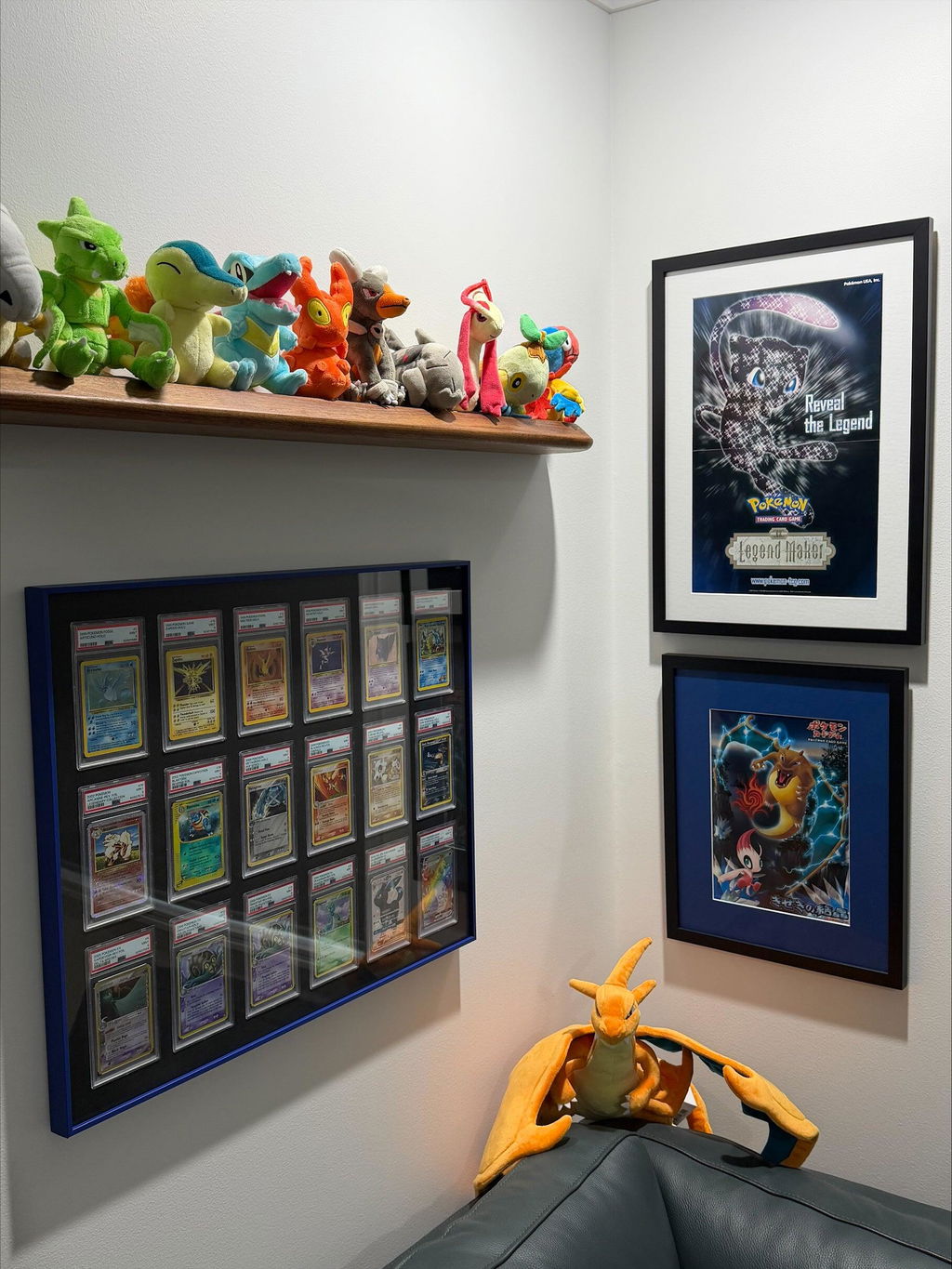
The Frame Becomes Part of the Room
A large trading card display is not only something holding cards.
Once it is mounted, it becomes a significant object within the room.
That means the collector starts noticing:
- The outer frame profile.
- The frame colour.
- The scale relative to furniture.
- The amount of empty wall around it.
- The reflections across the glazing.
- The overall grid from a distance.
For this reason, premium trading card displays often start being treated more like furniture or wall design than ordinary picture frames.
The Difference Between Protecting and Presenting
Protection and presentation overlap, but they are not the same thing.
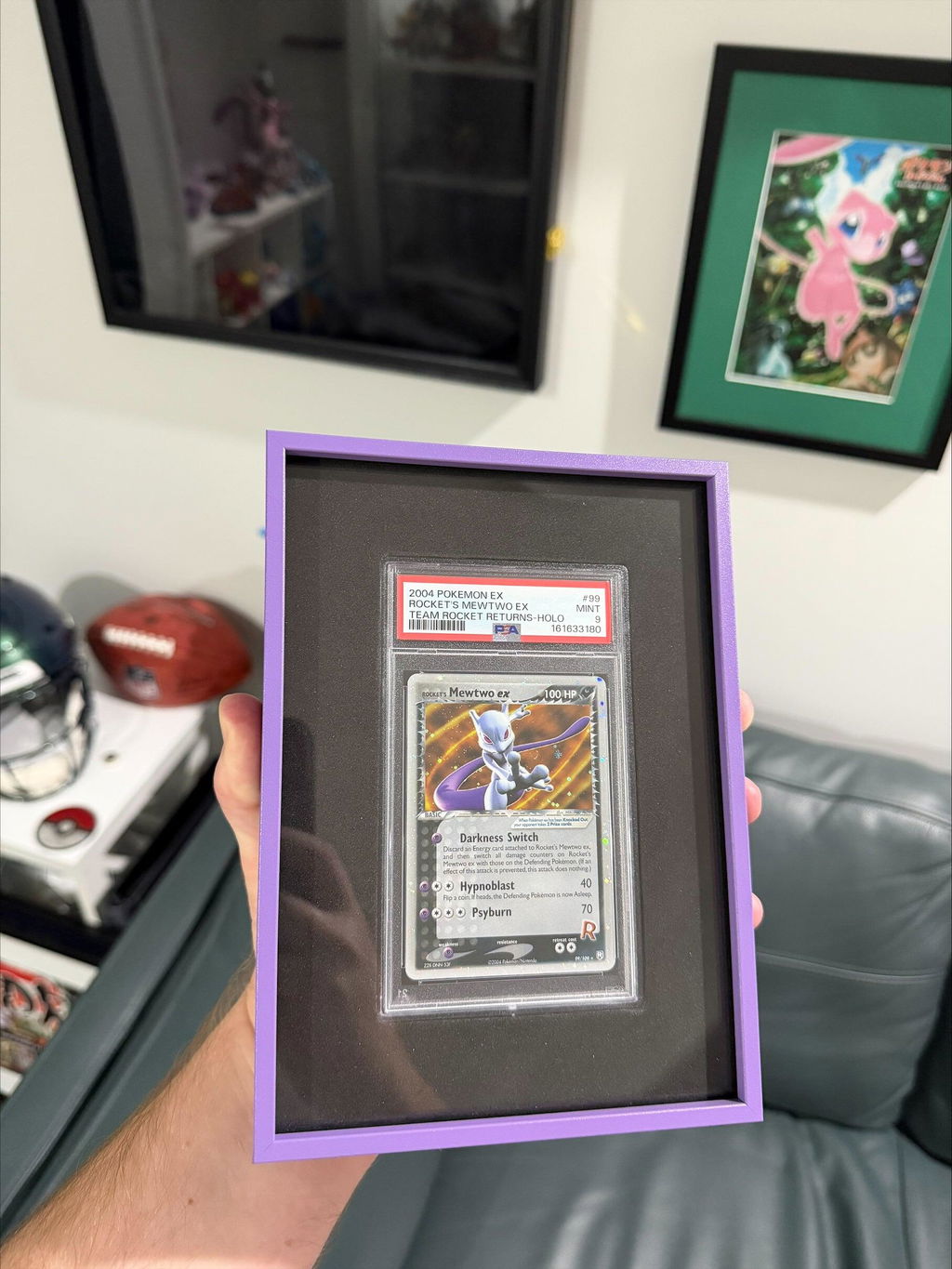
A PSA slab already gives the trading card a rigid protective holder.
A One Touch magnetic case already protects the card from direct handling.
The display frame therefore has another job.
It needs to:
- Organise the holders.
- Keep them visually aligned.
- Support the finished display.
- Provide front glazing.
- Make the cards work as one collection.
- Allow the wall to carry the display securely.
This is why a premium display is not simply about “more protection.”
A large part of the value is structural and visual.
Raw Cards Need Less Structure
Raw and sleeved trading cards are light and thin.
That gives collectors much more flexibility.
A high-value raw-card collection can still look excellent inside a relatively modest timber frame with clean matboard and suitable glazing.
There is often less structural reason to move into an expensive frame simply because the cards themselves are valuable.
The exception is when the display becomes very large.
Large raw-card grids still need flat backing, good glazing and a frame capable of remaining straight across the finished span.
Toploader Displays Sit Somewhere in the Middle
Toploaders add more weight and thickness than sleeves while remaining significantly lighter than most graded slabs.
They can therefore work well in mid-range displays.
A custom timber frame, accurate insert and acrylic front can produce an excellent result without requiring particularly heavy construction.
As with all formats, the requirements increase as the card count increases.
One Touch Displays Benefit More From Better Construction
Magnetic holders add both depth and weight.
This becomes especially noticeable in sports collections where thicker patch and memorabilia cards may use deeper cases.
Once a frame contains many One Touch holders, you start caring more about:
- Frame depth.
- Insert fit.
- Backing rigidity.
- Glazing weight.
- Wall mounting.
This is one reason premium framing makes more practical sense with larger One Touch collections.
Graded Slabs Change the Equation the Most
Graded slabs add significant weight very quickly.
A handful of PSA cards are easy to manage.
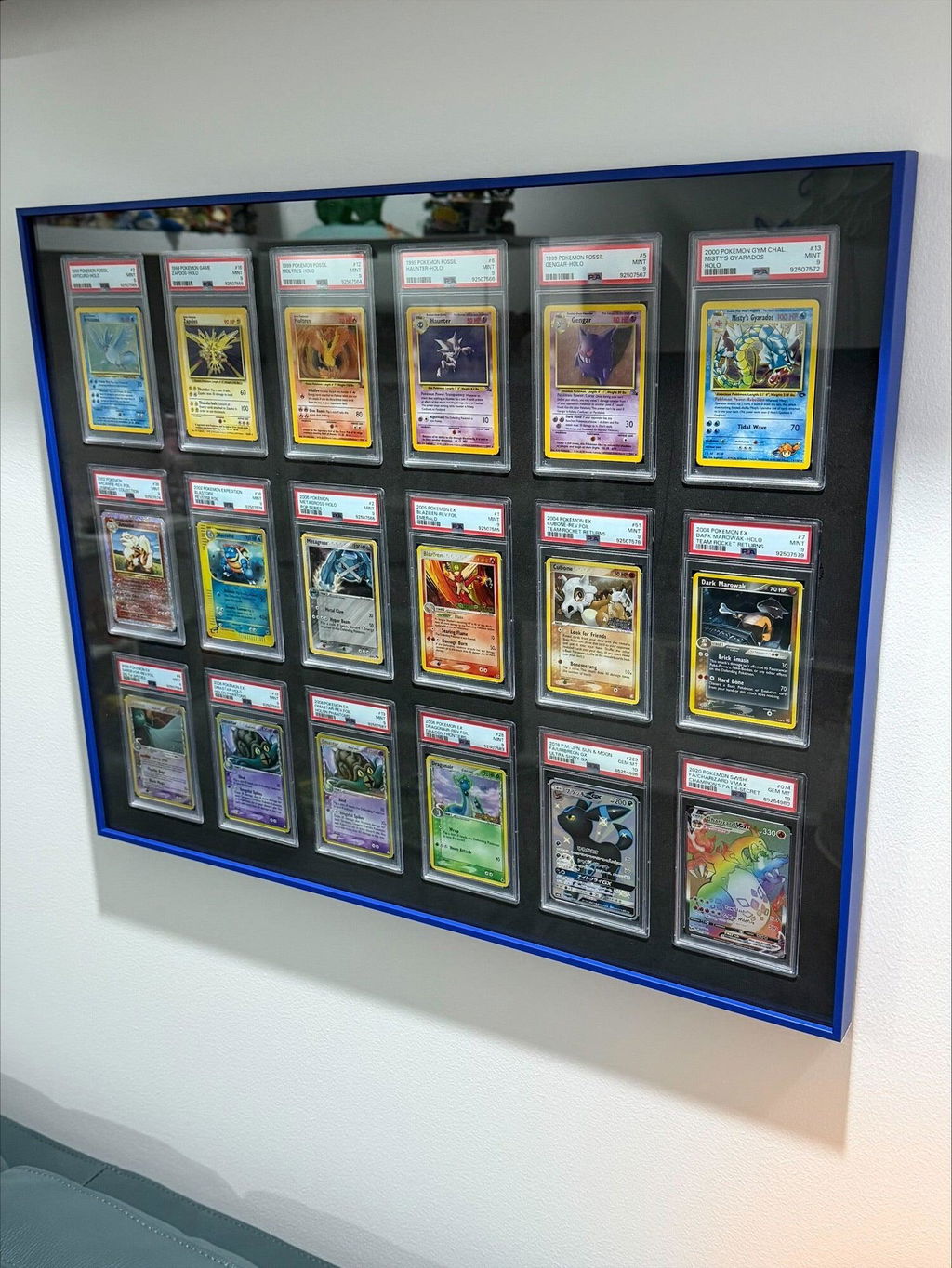
Once the collection grows to 18, 24, 36, 50 or more slabs, the frame becomes a substantial object.
At that point, stronger framing and lighter glazing are no longer only aesthetic upgrades.
They become practical ways to manage:
- Total frame weight.
- Rigidity.
- Transport.
- Wall mounting.
- Long-term alignment.
Large Displays Are Where Premium Materials Make the Most Sense
The bigger the display becomes, the less useful the simple “cheap vs expensive” comparison becomes.
A large trading card wall is a different product from a small picture frame.
The frame must span a much larger distance, hold more weight and keep many repeated positions aligned.
That is why materials such as aluminium, higher-quality acrylic and dense insert materials start to make more sense at larger sizes.
You are not simply paying for a more expensive version of the same frame.
You are solving a larger structural problem.
MDF Has a Place, but It Also Has Limits
MDF is widely used because it is inexpensive, consistent and easy to machine.
For smaller displays, it can work very well.
It is particularly useful for painted frames where the material itself is not intended to remain visible.
The limitations become more noticeable as size increases.
MDF can become heavy, and larger sections can feel bulkier than other framing materials.
That does not make it a poor material. It simply means its strengths are different.
Timber Can Be Both Affordable and Premium
Timber covers an enormous range of display quality.
A simple mass-produced timber picture frame can be inexpensive, while custom hardwood framing can sit firmly in the premium category.
Timber works particularly well when:
- You want a traditional framed appearance.
- The display is relatively small.
- You want deeper frame profiles.
- The room already contains timber furniture.
The main trade-off with larger displays is that substantial timber frames can become physically and visually heavy.
Aluminium Is Not Premium Simply Because It Is Metal
Aluminium is useful when its properties solve the requirements of the display.
The appeal comes from the combination of rigidity, comparatively slim profiles and clean finishes.
Those qualities are particularly useful for:
- Large slab grids.
- One Touch displays.
- Modern collector rooms.
- Wide wall displays.
- Collections where the cards should visually dominate the frame.
For a three-card raw display, those advantages may not matter very much.
For a 36-card graded wall, they become much more relevant.
Acrylic Quality Matters More as the Panel Gets Larger
Acrylic can look like a relatively simple component, but it becomes increasingly important on large displays.
Small acrylic sheets are easy to manage.
Larger panels need to remain flat, clear and practical to handle.
Better acrylic can also offer improved clarity, UV resistance or surface quality depending on the product selected.
The front panel is one of the largest visible surfaces in the whole display, so defects, scratches or distortion become much more noticeable as the frame grows.
Glass Can Still Be the Right Premium Choice
Premium does not automatically mean acrylic.
Specialist glass can provide excellent clarity, scratch resistance and UV performance.
For smaller frames, high-quality glass can be an excellent premium option.
The trade-off is weight.
As the frame gets larger, glass can add a significant amount of mass to a display that may already contain dozens of slabs.
This is why acrylic often becomes more attractive at larger sizes even when premium glass is available.
The Insert Material Is Part of the Display Quality
For rigid holders, the insert is doing more than filling empty space.
It controls how the slabs or magnetic holders sit, how consistently they align and how the background around each card looks.
Matboard works very well for raw and sleeved cards.
EVA foam is particularly useful with rigid holders such as graded slabs and One Touch cases.
Higher-quality insert materials can offer:
- Better edge finish.
- More consistent density.
- Cleaner holder fit.
- Improved appearance around the cards.
This becomes much easier to appreciate in large grids where the same opening repeats dozens of times.
Cheap Displays Often Hide Their Cost in Time
A DIY frame can absolutely save money.
But material cost is only one part of the project.
You may also need to spend time on:
- Researching materials.
- Measuring holders.
- Finding acrylic or glass.
- Cutting matboard or foam.
- Testing fit.
- Reworking mistakes.
- Finding suitable mounting hardware.
- Assembling the finished frame.
If you enjoy the project, that time may be part of the appeal.
If you only want the finished result, the calculation changes.
The First DIY Attempt Is Not Always the Final Cost
Another thing collectors sometimes underestimate is rework.
Acrylic can be damaged. Matboard openings can be cut incorrectly. Foam can fit too tightly or too loosely. A frame can end up too shallow. The finished layout can look different on the wall than it did on the table.
None of these problems are unusual in DIY projects.
They simply mean the cheapest material list does not always equal the final project cost.
Premium Displays Can Save Time as Well as Improve Finish
Part of what you are paying for with a purpose-built display is that many of those decisions have already been solved.
The holder format, frame depth, glazing, insert and backing have already been considered as one system.
For someone who enjoys making things, that may not matter.
For someone who owns 50 graded cards and simply wants them on the wall, it can matter a lot.
Future Access Is Easy to Forget
A display can look excellent on the day it is built and still become frustrating later if the cards are difficult to change.
Collections evolve.
You may:
- Upgrade a grade.
- Add another card.
- Change grading companies.
- Rotate cards seasonally.
- Replace one part of the collection.
A better display system should account for that.
Easy access is often one of the differences between something that merely looks good and something that remains practical for years.
Premium Displays Usually Make More Sense When the Collection Is Stable
If you change your display every week, spending heavily on one permanent frame may not make much sense.
Shelves, stands or smaller modular displays may be more useful.
Premium frames make more sense when:
- The collection has a clear theme.
- The card count is reasonably stable.
- The display will remain on the wall long term.
- You know which holder format you prefer.
The more permanent the collection becomes, the more reasonable it is to invest in the object surrounding it.
Several Smaller Premium Frames Can Be Better Than One Huge One
Premium does not necessarily mean buying the biggest display possible.
A large collection can often be organised more effectively across several matching frames.
For example:
- One frame for vintage Pokémon.
- One for modern Pokémon.
- One for sports rookies.
- One for One Touch cards.
This makes each section easier to update and can reduce the handling problems associated with extremely large frames.
Premium Is Also About Proportion
One of the hardest things to quantify in a display is proportion.
Two frames can hold the same cards and use similar materials but feel completely different because of the relationship between:
- The outer frame width.
- The internal grid.
- The surrounding margin.
- The card spacing.
- The overall wall size.
Premium displays often feel premium because these relationships have been considered carefully rather than because one component is dramatically more expensive.
Lighting Changes the Perception of Quality
A good frame can look poor under bad lighting.
Strong light directly opposite acrylic, glass, slabs or magnetic holders can create reflections that obscure the cards.
Soft room lighting or light positioned above or at an angle generally works better.
Premium displays are often placed more deliberately within the room, which means lighting becomes part of the overall result rather than an afterthought.
UV Protection Is Useful, but It Is Not the Whole Story
Collectors with valuable cards often focus heavily on UV protection.
UV-resistant acrylic or specialist glass can certainly add another layer of protection.
But the simplest protection remains sensible room placement.
Valuable trading cards should still be kept away from prolonged direct sunlight where possible.
Premium glazing is useful, but it should complement good placement rather than replace it.
Mounting Quality Matters More With Expensive Collections
Wall mounting is easy to ignore because the hardware disappears once the frame is installed.
But a large frame containing valuable slabs is exactly where mounting deserves more attention.
The hardware should suit:
- The wall construction.
- The finished frame weight.
- The size of the display.
- The way the frame loads the mounting points.
A premium wall display should feel physically secure as well as visually refined.
Think About Cost Per Card
A large premium frame can look expensive when viewed as one purchase.
But the economics change once the display contains many cards.
A frame holding 36, 54 or more slabs spreads the cost across a much larger collection.
That does not automatically make the purchase cheap, but it can make the comparison more meaningful.
Comparing a large purpose-built slab wall directly with a $30 picture frame is often misleading because they are solving completely different display problems.
Collection Value Can Change the Psychology of the Purchase
Collectors rarely calculate display spending purely mathematically.
If someone owns four inexpensive cards, they may understandably hesitate to spend heavily on the frame around them.
If someone owns 36 professionally graded cards worth several thousand dollars in total, spending more on a permanent display may feel much easier to justify.
The frame price has not changed in isolation.
Its relationship to the collection has.
A Valuable Collection Does Not Need to Look Expensive
Premium presentation does not mean making the collection look flashy.
In fact, expensive collections often benefit from restraint.
Simple black, silver or neutral framing can allow the card artwork and grading labels to provide most of the visual interest.
The aim is not to advertise how much the collection costs.
It is to give the collection a level of finish that feels appropriate to the room and to the effort that went into building it.
Premium Does Not Mean You Need Every Upgrade
It is easy to overcomplicate a premium display.
You do not necessarily need:
- Integrated lighting.
- Multiple decorative layers.
- Complex matboard colours.
- Specialist glass.
- Oversized framing.
If those features improve the display, they can be useful.
If they are only being added because the frame is supposed to feel expensive, they may actually make the result worse.
When a Cheap Display Is Probably Enough
A lower-cost display is often the right choice when:
- You are displaying only a few cards.
- The cards are raw or sleeved.
- The display is temporary.
- You enjoy building the frame yourself.
- You change the cards frequently.
- The frame is not particularly large.
- You care more about function than finish.
There is no reason to spend heavily simply because a premium option exists.
When Mid-Range Usually Makes Sense
A mid-range display often becomes attractive when:
- The collection is moderately sized.
- You want accurate matboard or holder openings.
- You want better acrylic.
- The frame will remain on the wall long term.
- You want stronger construction without moving to a full premium system.
This is a very sensible category for collectors who want a clear step up in quality without treating the display as a major piece of the room.
When Premium Starts to Make Sense
Premium displays tend to make the most sense when several factors overlap.
For example:
- The collection is financially valuable.
- The collection took years to assemble.
- The card count is high.
- The holders are heavy.
- The frame is physically large.
- The display will remain in the room permanently.
- The room itself is carefully designed.
- You care strongly about the finished proportions.
- You want a purpose-built system rather than an adapted picture frame.
That is usually where collectors begin considering aluminium, premium timber, custom inserts, higher-quality acrylic and stronger mounting systems.
Example: A Small $300 Raw-Card Collection
Imagine a collector wants to display nine raw Pokémon cards worth around $300 in total.
The cards are sleeved, lightweight and easy to arrange.
A standard picture frame with well-cut matboard may be completely appropriate.
There may be very little practical benefit in moving into a large premium aluminium display unless the collector simply prefers the look.
Example: A $3,000 PSA Collection
Now imagine a collector owns 18 PSA slabs worth around $3,000 in total.
The collection is permanent, carefully selected and intended to remain on the wall.
The frame now needs to carry significantly more weight, keep 18 slabs aligned, provide glazing and work as a substantial object within the room.
A more premium frame starts to make more sense here, not simply because the collection is worth $3,000, but because the display requirements have also become more demanding.
Example: A Large Sports Card Collection
A sports collector may own dozens of One Touch holders containing rookies, autographs and patch cards.
The holders may use different depths, and some cards may be portrait while others are landscape.
At this point, the display needs much more planning than a basic picture frame.
Frame depth, insert design, finished weight, layout and mounting become meaningful parts of the project.
This is another situation where premium materials may be justified by the complexity of the display rather than simply the financial value of the cards.
Example: A $10,000 Collection That Rarely Changes
If a collector has spent years building a $10,000 graded collection and expects the wall to remain largely unchanged, investing in a high-quality permanent display is relatively easy to understand.
The frame will likely remain part of the room for years.
In that situation, the cost is being spread not only across the cards but across the amount of time the display will be used.
The question becomes less about finding the cheapest possible frame and more about choosing something the collector will still be happy to look at several years later.
DIY Can Still Be Premium
Premium does not automatically mean ready-made.
A skilled collector can absolutely build an excellent premium display at home.
The difference is that the DIY project usually becomes more involved.
You may need to source:
- Higher-quality framing materials.
- Custom-cut acrylic.
- Dense EVA foam or specialist matboard.
- Rigid backing.
- Suitable wall hardware.
You also need the tools, time and confidence to assemble those pieces accurately.
For someone who enjoys making things, that can be part of the appeal.
Premium DIY Is Where the Project Gets Harder
The jump from a basic DIY frame to a premium DIY frame is larger than many people expect.
It is relatively easy to buy a standard frame, cut a mat and display a few cards.
It is much harder to build a large rigid display with dozens of consistent holder openings, a substantial acrylic panel, accurate backing and clean external framing.
This is where the time involved can become a significant part of the project.
If you are interested in building one yourself, our complete guide to making a trading card wall display covers the materials, holders, glazing, inserts and layout considerations in much more detail.
Ready-Made Premium Displays Are Mainly Selling Convenience and Execution
A purpose-built premium frame is not useful because collectors are incapable of building one themselves.
Its value comes from removing the need to solve the entire display system independently.
The collector does not need to separately work out:
- Frame construction.
- Holder fit.
- Insert material.
- Glazing.
- Backing.
- Layout.
- Assembly.
For collectors who only care about the finished result, that can be worth paying for.
There Is No Shame in Choosing the Cheap Option
A collector should not feel pressured into premium framing simply because the cards are valuable.
If a $40 frame looks good, fits the cards properly and does everything you need, then it is doing its job.
The purpose of comparing display levels is not to turn framing into another status competition inside the hobby.
It is simply to understand why different products exist and why a frame that makes sense for four cards may not make sense for 50.
There Is Also No Need to Apologise for Buying Premium
The opposite is also true.
If you own a carefully built collection and want the frame itself to feel substantial, well finished and permanent, that is a perfectly reasonable reason to spend more.
You are not paying only to protect the cards.
You are paying for the way the entire collection is presented inside the room.
Think About the Frame Over Five Years, Not Five Minutes
Premium displays make more sense when you think about how long they will actually be used.
A frame that stays on the wall for five or ten years is a very different purchase from a temporary display you expect to replace next season.
If the collection is stable and the frame becomes part of the room, the initial price becomes only one part of the ownership experience.
Do Not Overbuild a Collection That Is Still Changing
One of the situations where premium framing can be premature is a collection that is still changing rapidly.
If you are buying and selling slabs constantly, switching grading companies or changing the theme of the collection every few months, flexibility may be more valuable than finish.
In that situation, shelves, stands or smaller modular displays may make more sense until the collection settles.
The Premium Option Is Usually About the Whole System
The most important difference between cheap and premium displays is often that the premium option treats the frame as one complete system.
The outer frame, insert, glazing, backing and mounting all need to work together.
A very expensive frame paired with poor acrylic or badly cut openings is not a premium display.
Likewise, relatively modest materials can produce an excellent result when every part of the system has been planned properly.
Cheap vs Mid-Range vs Premium: A Practical Summary
Cheap Displays
Best suited to smaller, lighter and more temporary collections.
- Standard picture frames.
- Basic timber or MDF.
- Standard glazing.
- Simple matboard.
- Ideal for raw or sleeved cards.
- Good for collectors who enjoy DIY.
Mid-Range Displays
Best suited to collectors who want better fit and materials without moving into a fully premium system.
- Better-quality timber.
- Custom matboard or inserts.
- Higher-quality acrylic.
- Stronger backing.
- Better wall hardware.
- Useful for small graded and One Touch collections.
Premium Displays
Best suited to larger, heavier or more permanent collections where the frame itself becomes a significant part of the room.
- Premium aluminium or high-quality timber.
- Purpose-built holder openings.
- Higher-quality EVA or matboard.
- Better acrylic or specialist glazing.
- Greater rigidity.
- Cleaner overall proportions.
- More substantial mounting.
So How Much Should You Actually Spend?
Spend enough to solve the display problem you actually have.
If you are framing four sleeved cards, that may be very little.
If you are mounting 36 graded slabs worth several thousand dollars across a large wall, the frame requirements are completely different.
Do not buy premium materials simply because the cards are expensive.
Buy better materials when they improve:
- Rigidity.
- Fit.
- Finish.
- Glazing.
- Mounting.
- Access.
- Long-term usability.
That is the point where the additional cost starts doing something useful.
Final Thoughts
There is nothing wrong with putting expensive trading cards into an inexpensive frame.
For small collections, basic frames can look excellent and may be the most sensible option available.
But as a collection becomes larger, heavier, more valuable and more permanent, the display itself starts taking on a different role.
It stops being a simple container and starts becoming part of how the collection is experienced within the room.
That is why premium trading card displays tend to appear most often around premium collections. It is not because expensive cards require an expensive frame. It is because collectors who have invested heavily in the cards often also care about rigidity, materials, proportion, finish and the way the complete collection looks on the wall.
A cheap frame, a mid-range frame and a premium frame can all be the right choice. The best option is the one that matches the size, weight, permanence and importance of the collection you actually want to display.
Continue Exploring
If you enjoyed this guide, you may also find these collector resources helpful.
📚 Collector Guides
-
How to Make a Trading Card Wall Display: Complete DIY Guide
Learn how to plan a DIY trading card display, including frame materials, holders, acrylic, EVA foam, layouts and wall mounting. -
The Ultimate Trading Card Display Guide: Ideas, Frames, Shelves & Display Solutions for Every Collector
Explore trading card wall displays, frames, shelves, layouts and display solutions for collections of every size. -
Why Premium Aluminium Trading Card Display Frames Are Worth It: The Complete Collector Guide
Explore aluminium trading card display frames, their materials and why they work particularly well for larger graded and One Touch collections. -
How Many Trading Cards Should You Display in a Frame?
Compare small trading card displays, compact grids and larger collection layouts to find a size that suits your wall.
🛒 Shop Display Collections
-
Aluminium Trading Card Wall Display Frames
Premium aluminium trading card display frames available in a wide range of grid sizes, frame colours and holder formats. -
PSA, CGC & BGS Graded Slab Wall Display Frames
Purpose-built graded trading card display frames for Pokémon, MTG, Yu-Gi-Oh!, One Piece, Sports Cards, Disney Lorcana and other collections. -
One Touch Wall Display Frames
Premium aluminium wall display frames designed for One Touch magnetic trading card holders.

0 comments