


Choosing a trading card display frame sounds simple until you start comparing the actual options.
A frame that works perfectly for nine sleeved Pokémon cards may be completely unsuitable for 36 PSA slabs. A display designed around standard trading cards may not properly suit Yu-Gi-Oh! cards. A shallow picture frame may work for raw cards but not for One Touch magnetic holders, and a large wall display introduces questions around weight, rigidity, glazing and mounting that barely matter on a smaller frame.
The right trading card display frame therefore depends less on finding the “best frame” and more on matching the frame to the collection you actually own.
That means considering the holder format, number of cards, overall collection value, available wall space, frame material, glazing, insert material, future expansion and how permanent you expect the display to be.
This guide walks through those decisions from the beginning, so you can work out whether your collection needs a simple picture frame, a better custom timber display, a larger aluminium system or something in between.
Start With the Cards, Not the Frame
One of the easiest mistakes to make is choosing a frame first and then trying to find enough cards to fill it.
The better approach is usually the opposite.
Start by deciding exactly what you want to display.
That might be:
- One favourite card.
- A Pokémon evolution line.
- Nine graded slabs.
- A sports player collection.
- A group of One Touch cards.
- A complete character collection.
- Twenty, fifty or more graded cards.
Once the collection group is clear, almost every other decision becomes easier.
Decide Whether the Cards Actually Belong Together
A display normally works better when the trading cards have some connection.
That connection does not need to be complicated.
It might simply be:
- The same Pokémon.
- The same player.
- The same set.
- The same grading company.
- The same era.
- The same rarity.
- A group of personal favourites.
What matters is that the card count comes from the collection rather than the frame.
If you have eight cards that genuinely belong together, an eight-card layout may make more sense than buying a nine-card frame and searching for something to fill the final position.
Choose the Holder Format Before the Frame
The holder format is one of the biggest factors determining what kind of trading card display you need.
Raw cards, sleeves, toploaders, One Touch holders and graded slabs all create different requirements.
The same number of cards can produce completely different finished displays depending on how those cards are protected.
Raw Trading Cards
Raw trading cards are the easiest format to frame because they are thin and lightweight.
They work particularly well for:
- Large artwork grids.
- Set highlights.
- Character collections.
- MTG collections.
- Yu-Gi-Oh! collections.
- Pokémon collections.
A conventional picture frame with matboard can be completely appropriate for raw cards, particularly at smaller sizes.
Because the cards add very little weight, the frame itself does not need the same level of structure as a large slab display.
Sleeved Trading Cards
Sleeving cards before displaying them adds another removable layer of protection without dramatically increasing the thickness of the display.
This can be useful for valuable raw cards, particularly if you expect to remove them later.
Sleeved cards still work comfortably with matboard-based framing and relatively shallow displays.
If you are specifically planning a raw or sleeved display, our guide to making a raw and sleeved trading card wall display covers those options in more detail.
Toploaders
Toploaders add more structure than sleeves while remaining relatively lightweight.
They can be useful for collectors who want a rigid holder without moving into magnetic cases or grading.
Compared with raw cards, the main differences are:
- More depth.
- More overall frame size.
- A more visible clear holder around each card.
- Slightly more weight.
Toploader frames still tend to sit closer to conventional picture framing than large slab displays.
One Touch Magnetic Holders
One Touch holders change the frame requirements much more noticeably.
The cards now sit inside rigid magnetic cases, which add depth and weight.
One Touch holders are particularly common with:
- Sports rookies.
- Autographs.
- Patch cards.
- Premium Pokémon cards.
- Cards collectors prefer to keep ungraded.
The holder depth matters here. Standard cards and thick memorabilia cards may require very different magnetic cases.
If a collection contains several holder depths, that needs to be considered before choosing the frame.
Our One Touch trading card wall display guide goes much deeper into magnetic holder displays.
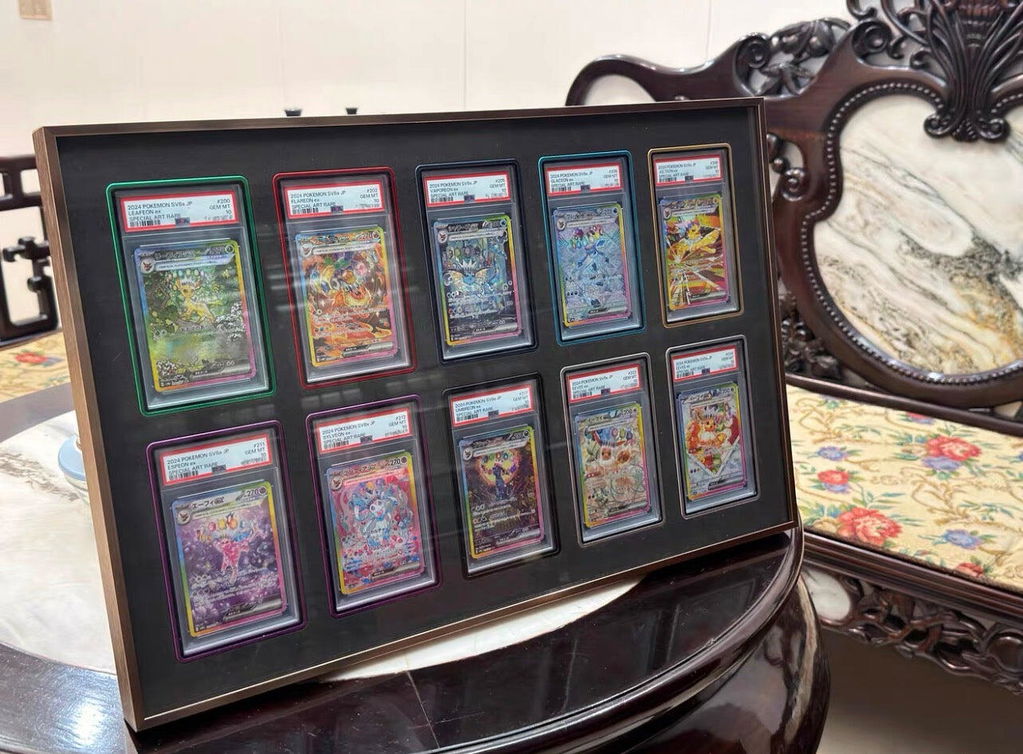
PSA, CGC and BGS Graded Slabs
Graded slabs create the most demanding frame requirements of the common trading card formats.
They are larger, heavier and deeper than raw cards, and the holder itself becomes a major visual component of the display.
A frame designed for graded cards therefore needs to account for:
- Slab dimensions.
- Slab thickness.
- Label position.
- Finished weight.
- Frame depth.
- Internal support.
PSA, CGC and BGS slabs should not automatically be treated as interchangeable because their holder formats are not identical.
If you are planning a slab wall, our graded trading card wall display guide covers these considerations in more depth.
Do Not Assume Every Graded Card Frame Fits Every Slab
A generic “graded card frame” description can hide an important problem.
Different grading companies use different slab shapes, thicknesses and proportions.
A frame designed specifically for one slab format will usually provide a more controlled fit than one trying to accommodate every possible holder.
This matters even more in large displays where the same fit repeats across dozens of positions.
Work Out How Many Cards You Actually Want to Display
Card count determines much more than the number of openings in the frame.
It influences:
- Finished frame size.
- Weight.
- Wall position.
- Viewing distance.
- Frame material.
- Glazing choice.
- Mounting requirements.
A 3-card frame and a 54-card slab display should not be approached as larger and smaller versions of the same project.
They are physically different display problems.
One to Four Cards
Small displays give individual cards a lot of visual importance.
This range suits:
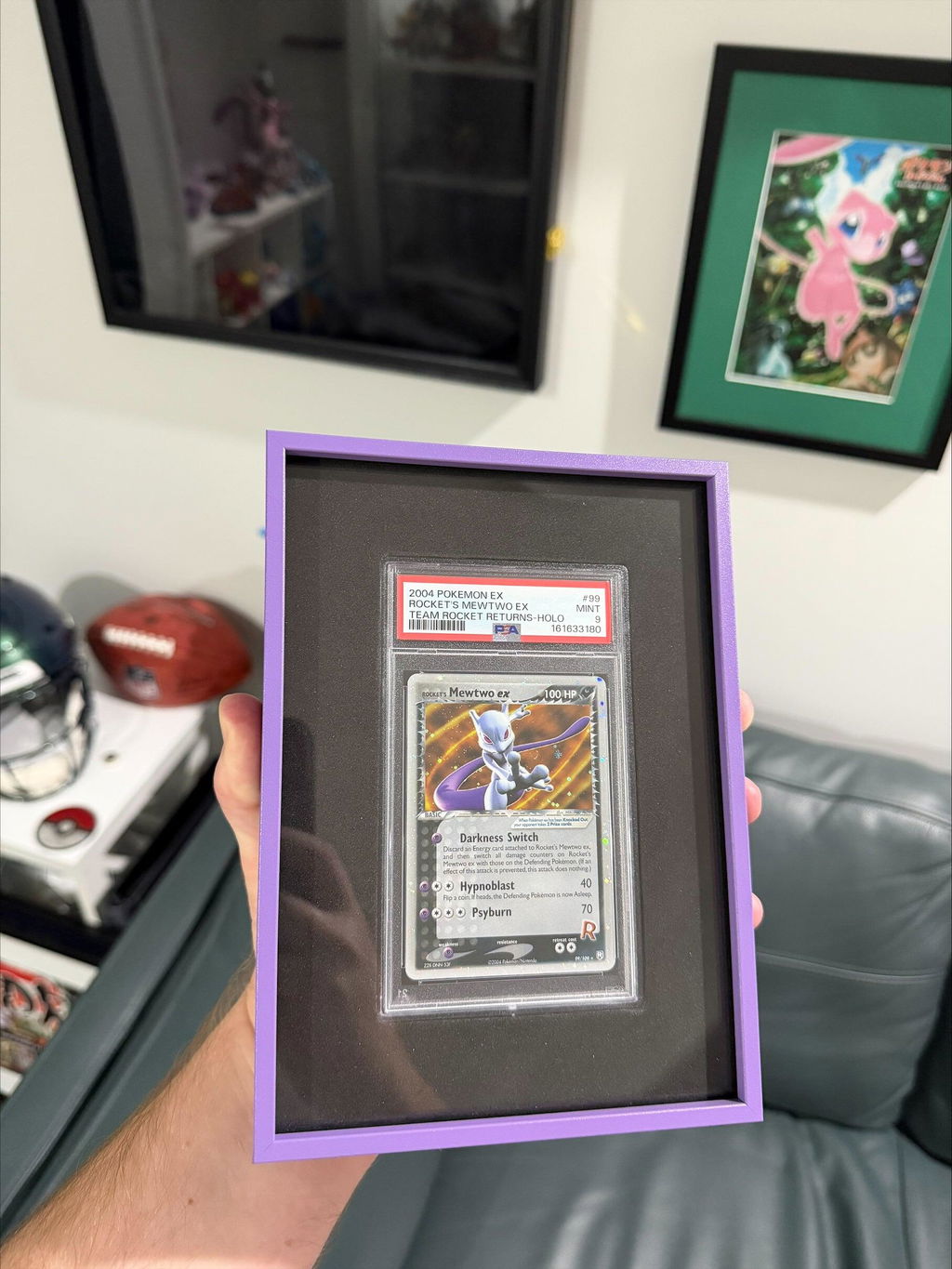
- One favourite card.
- Japanese and English card pairings.
- Pokémon evolution lines.
- Small sports groups.
- Autographs.
At this size, conventional picture framing can work extremely well.
You have much more freedom to choose timber, glass and decorative framing because the overall weight remains manageable.
Five to Nine Cards
This is where the display starts feeling more like a collection than an individual framed card.
Nine-card 3 × 3 layouts are especially practical because the grid is symmetrical and compact.
Five to nine cards work well for:
- Eeveelutions.
- Player collections.
- Set highlights.
- One Touch collections.
- Graded favourites.
Ten to Eighteen Cards
At this point, the frame starts having a significant presence on the wall.
This is also where material choice begins to matter more, particularly with rigid holders.
An 18-card raw display is still relatively light. An 18-card PSA display is a substantially heavier object.
The holder format must therefore remain part of every size decision.
Twenty-Four to Thirty-Six Cards
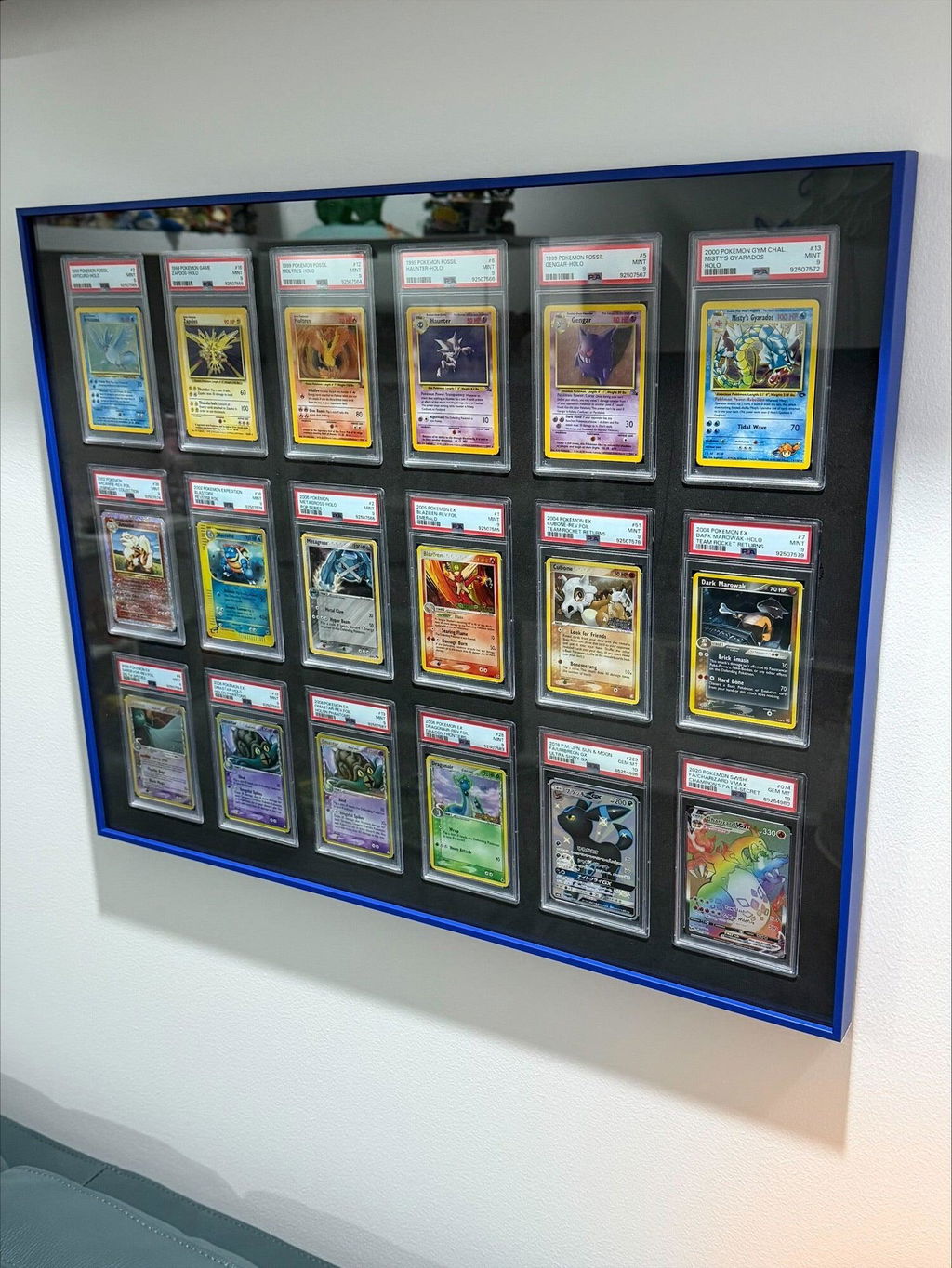
A display containing 24 or 36 cards is no longer a small frame.
At this scale, you should start thinking seriously about:
- Frame rigidity.
- Acrylic versus glass.
- Total weight.
- Backing strength.
- Wall type.
- How the display will actually be installed.
For graded cards and One Touch holders, stronger framing begins to have genuine practical value.
Fifty Cards and Above
Once a collection moves beyond 50 cards, you are essentially planning a large-format wall installation.
The display should be considered as one substantial object rather than simply a picture frame containing lots of cards.
You need to think about:
- Overall width and height.
- Whether it can be transported through the building.
- How it will be lifted.
- Finished weight.
- Mounting points.
- Wall structure.
- Future access.
- Whether multiple frames would be more practical.
One Huge Frame or Several Smaller Frames?
More cards do not automatically mean you need one enormous display.
Several smaller coordinated frames can often be easier to manage.
Advantages include:
- Easier installation.
- Lower weight per frame.
- Easier card changes.
- Better separation of different collection themes.
- More flexibility if the collection expands.
For example, instead of one 72-card Pokémon frame, a collector might use separate displays for Charizard, Eeveelutions, vintage cards and modern cards.
If the outer frame finish and wall spacing remain consistent, the separate frames can still look like one complete collection.
When One Large Frame Makes More Sense
A single large frame can be the better choice when the collection genuinely belongs together.
This might include:
- A large PSA character collection.
- A complete graded set.
- A sports player collection.
- A large One Touch display.
- A carefully planned raw-card grid.
A single frame also produces one uninterrupted visual grid, which can look extremely clean when the collection is large enough to justify it.
Measure the Wall Before You Choose the Frame
Frame dimensions can be difficult to judge from a product page.
A large slab display may look manageable on a screen and feel enormous once it is physically on the wall.
Before ordering a large display, mark the approximate outside dimensions on the wall with removable tape.
Then stand back and look at it from the normal viewing position.
This simple step can reveal whether the frame is:
- Too small for the wall.
- Too wide for nearby furniture.
- Too tall for the available space.
- Likely to interfere with shelves, lights or doors.
Think About Viewing Distance
A frame should make sense from the distance at which it will normally be viewed.
Small displays are usually inspected closely.
Large frames are often seen first from several metres away.
At that distance, the individual cards become less important and the overall grid becomes more noticeable.
This is another reason larger collections benefit from consistent alignment and strong proportions.
Choose the Frame Material Around the Scale of the Display
No single frame material is best for every trading card collection.
MDF, timber and aluminium all have useful applications.
MDF Trading Card Frames
MDF is inexpensive, consistent and widely used in picture framing and furniture.
It works well for small and moderate displays where the frame does not need to span a particularly large distance.
Advantages include:
- Low cost.
- Easy availability.
- Consistent surface.
- Easy painted finishes.
The main limitations appear at larger sizes, where MDF can become heavy and relatively bulky.
That does not make it unsuitable. It simply means there may be better materials once the display becomes large and structurally demanding.
Timber Trading Card Frames
Timber is extremely flexible because it can sit anywhere from inexpensive picture framing to premium custom hardwood work.
It works particularly well when:
- You prefer a traditional frame appearance.
- The room already contains timber furniture.
- The display is small or medium sized.
- You want decorative or stained finishes.
Custom timber framing can also accommodate substantial depth.
The main consideration on very large displays is that deeper and stronger timber profiles can become visually and physically heavy.
Aluminium Trading Card Frames
Aluminium tends to become most useful at the premium and large-format end of trading card displays.
Its main advantage is the relationship between rigidity and profile size.
A larger frame can remain relatively slim around the outside while still providing meaningful structure.
This is particularly useful for:
- Large PSA displays.
- CGC and BGS collections.
- Large One Touch grids.
- Modern rooms.
- Wide wall installations.
Aluminium is not necessary simply because the cards are valuable. Its advantages become more relevant as the frame becomes larger and heavier.
Do Not Choose a Material Only Because It Sounds Premium
A beautifully made timber frame may suit one collection better than aluminium.
A simple MDF frame may be completely appropriate for another.
The best material is the one that solves the actual requirements of the display.
Premium should describe the quality of the finished result, not simply the material name.
Choose Between Glass and Acrylic
Glazing is another major decision.
Both glass and acrylic can work extremely well, but they have different strengths.
When Glass Makes Sense
Glass is hard, clear and resistant to everyday scratching.
It works especially well for:
- Small frames.
- Raw-card displays.
- Desktop or low-card-count displays.
- Collectors who prioritise scratch resistance.
Specialist glass can also offer strong optical and UV performance.
The main downside is weight.
When Acrylic Makes Sense
Acrylic is much lighter than glass and more impact resistant.
Those advantages become increasingly important as the frame gets larger.
A large graded display already contains significant weight from the slabs themselves, so reducing the weight of the front panel can make installation and handling easier.
Acrylic is therefore particularly useful for:
- Large wall displays.
- Graded-card frames.
- One Touch collections.
- Frames that need to be moved occasionally.
UV-Resistant Glazing Is Useful, but Placement Still Matters
Collectors with valuable trading cards often look for UV-resistant acrylic or specialist glass.
That can provide another layer of protection.
However, UV-resistant glazing should not be treated as permission to place valuable cards in strong direct sunlight.
Where possible, choose a wall that avoids prolonged direct sun.
Room placement is still one of the simplest ways to reduce unnecessary exposure.
Think About Reflections and Glare
Every transparent layer can create reflections.
A graded display may have the slab surface plus the acrylic or glass in front of it.
A One Touch display creates a similar situation.
Foil Pokémon cards, chrome sports cards and reflective TCG finishes can make glare even more noticeable.
Before deciding where the frame will go, consider the location of:
- Windows.
- Ceiling lights.
- Desk lamps.
- LED strips.
- Televisions and monitors.
Choose the Right Material Around the Cards
The material surrounding the cards or holders is another important part of the frame.
The two most common approaches are matboard and foam-based inserts such as EVA.
Matboard
Matboard is especially useful for raw and sleeved cards.
It creates clean openings and works naturally within conventional picture frames.
It is also available in a wide variety of colours, textures and finishes.
For smaller displays, good matboard can provide an extremely clean result without adding unnecessary depth.
EVA Foam
EVA foam is particularly useful when the display needs to support rigid holders such as PSA, CGC, BGS or One Touch cases.
The material can support the outside of each holder while leaving the card itself visible.
It can also provide a cleaner way of managing the extra depth of rigid holders than conventional matboard alone.
Black EVA tends to visually reduce the appearance of clear holder edges, while lighter EVA makes those edges more noticeable.
Insert Quality Matters More on Large Displays
A slightly rough opening may be barely noticeable on a one-card frame.
Across 36 or 54 repeated positions, every inconsistency becomes much easier to see.
This is why large displays benefit from accurate cutting, consistent material density and clean edges.
Frame Depth Is Easy to Underestimate
One of the most common practical differences between trading card frames is depth.
A frame that easily handles raw cards may be completely unsuitable for:
- Toploaders.
- One Touch magnetic holders.
- BGS slabs.
- Thicker sports-card holders.
The internal depth should be considered as part of the frame design from the beginning, not added as an afterthought.
Check Whether You Can Access the Cards Later
A display does not stop being useful after it is mounted.
You may eventually want to:
- Replace a card.
- Upgrade a grade.
- Move a raw card into grading.
- Change the theme.
- Rotate favourites.
A frame that can be reopened cleanly makes those changes much easier.
This becomes increasingly important as the collection value rises.
Avoid Permanent Card Mounting Where Possible
Trading cards and expensive holders are usually better treated as removable objects.
A display that relies heavily on permanent adhesives may make future changes unnecessarily difficult.
Where possible, choose systems that support or locate the cards without permanently attaching them.
Think About the Backing
Backing is easy to ignore because it normally cannot be seen once the frame is mounted.
But it contributes significantly to the way the complete display behaves.
A larger frame needs backing that remains reasonably flat and supports the internal materials consistently.
This becomes especially important with large slab grids where any movement behind the insert can affect alignment across many cards.
Wall Mounting Should Match the Finished Weight
The mounting hardware should be chosen around the complete display, not the empty frame.
A large graded-card display may contain:
- Dozens of slabs.
- Acrylic.
- EVA.
- Backing.
- The frame itself.
That total can be very different from what the frame appears to weigh before the cards are installed.
Mounting should suit both the finished weight and the construction of the wall.
Collection Value Should Influence the Decision, but Not Control It
A valuable collection does not automatically require a premium frame.
However, financial value can change what matters to the collector.
If the collection is worth several thousand dollars, you may care more about:
- Long-term durability.
- Easy access.
- Frame rigidity.
- Glazing quality.
- Wall mounting.
- How the finished frame looks in the room.
The frame becomes part of a collection that already matters enough to justify careful presentation.
Do Not Match Frame Price Directly to Collection Value
There is no useful rule saying a frame should cost a certain percentage of the cards inside it.
A $500 collection can reasonably sit inside a premium frame if the collector cares about the finished display.
A $10,000 collection can sit inside a modest frame if that frame suits the owner's priorities.
The more useful question is whether the additional cost improves something you actually care about.
Our guide to how much you should spend on a trading card display frame explores cheap, mid-range and premium options in much more detail.
Think About How Permanent the Collection Is
A permanent display and a constantly changing display should not necessarily use the same system.
If you regularly buy, sell and rotate cards, flexibility may be more important than having one perfectly finished permanent frame.
In that situation, you may prefer:
- Shelves.
- Desktop stands.
- Small modular frames.
- Several easily reopened displays.
If the collection is stable and will remain on the wall for years, investing more in the complete display becomes easier to justify.
Cheap Frames Make Sense in the Right Situation
A basic MDF or standard picture frame can be an excellent solution when:
- The collection is small.
- The cards are raw or sleeved.
- The frame is relatively light.
- The display may change frequently.
- You want to keep costs low.
- You enjoy doing some of the work yourself.
There is no benefit in buying a more complicated frame when a simple one already solves the problem properly.
Mid-Range Frames Make Sense When Fit and Finish Start Matter
A mid-range frame becomes attractive when you want:
- Better-quality timber.
- Custom matboard.
- Better acrylic.
- Purpose-cut openings.
- Stronger backing.
- More substantial mounting.
This is often the right level for small graded collections and moderate One Touch displays.
Premium Frames Make More Sense as the Display Gets Larger
Premium framing tends to become easiest to justify when several factors overlap.
For example:
- The collection is large.
- The holders are heavy.
- The frame will stay on the wall long term.
- The room itself matters visually.
- The collection is valuable or difficult to replace.
- You want a purpose-built rather than adapted display.
That is where aluminium, higher-quality inserts, better acrylic and more substantial mounting start offering real advantages.
Do Not Confuse Premium With Decorative
A premium trading card display does not need elaborate moulding, excessive colours or extra decorative layers.
Trading cards already contain plenty of visual information.
Grading labels, card borders, foil effects, signatures and artwork all compete for attention.
Simple framing often produces the strongest result.
Premium is usually more about:
- Better materials.
- Better proportions.
- Cleaner fit.
- Better rigidity.
- More controlled finishing.
Choose a Frame Colour That Works With the Whole Collection
It can be tempting to match the frame colour to one specific card.
That works for a small one-card display, but it becomes difficult across larger collections.
Neutral finishes are generally easier to use across varied trading cards.
Black Frames
Black works with almost every card category and is especially effective when you want the outer frame to recede visually.
It suits:
- Pokémon.
- Sports cards.
- MTG.
- Yu-Gi-Oh!
- Graded slabs.
Silver Frames
Silver can make larger displays feel lighter and works especially well with modern rooms.
It also complements clear slab edges and acrylic naturally.
Gold Frames
Gold gives the outer frame more visual presence.
It can work particularly well for smaller premium collections, trophy cards or displays where the frame itself is intended to remain noticeable.
Darker Metallic Finishes
Titanium and other darker metallic finishes can sit between black and silver, providing some metallic detail without the brightness of standard silver.
Timber Finishes
Natural timber can work particularly well in rooms with existing wooden furniture or where the collector wants a less modern appearance.
Choose the Insert Colour Separately From the Frame
The frame and the material immediately surrounding the cards do not need to be the same colour.
A black outer frame with a lighter insert can create a completely different effect from black-on-black.
Dark inserts tend to reduce the visibility of clear slab and holder edges.
Light inserts make those clear edges more visible and can make the display feel brighter overall.
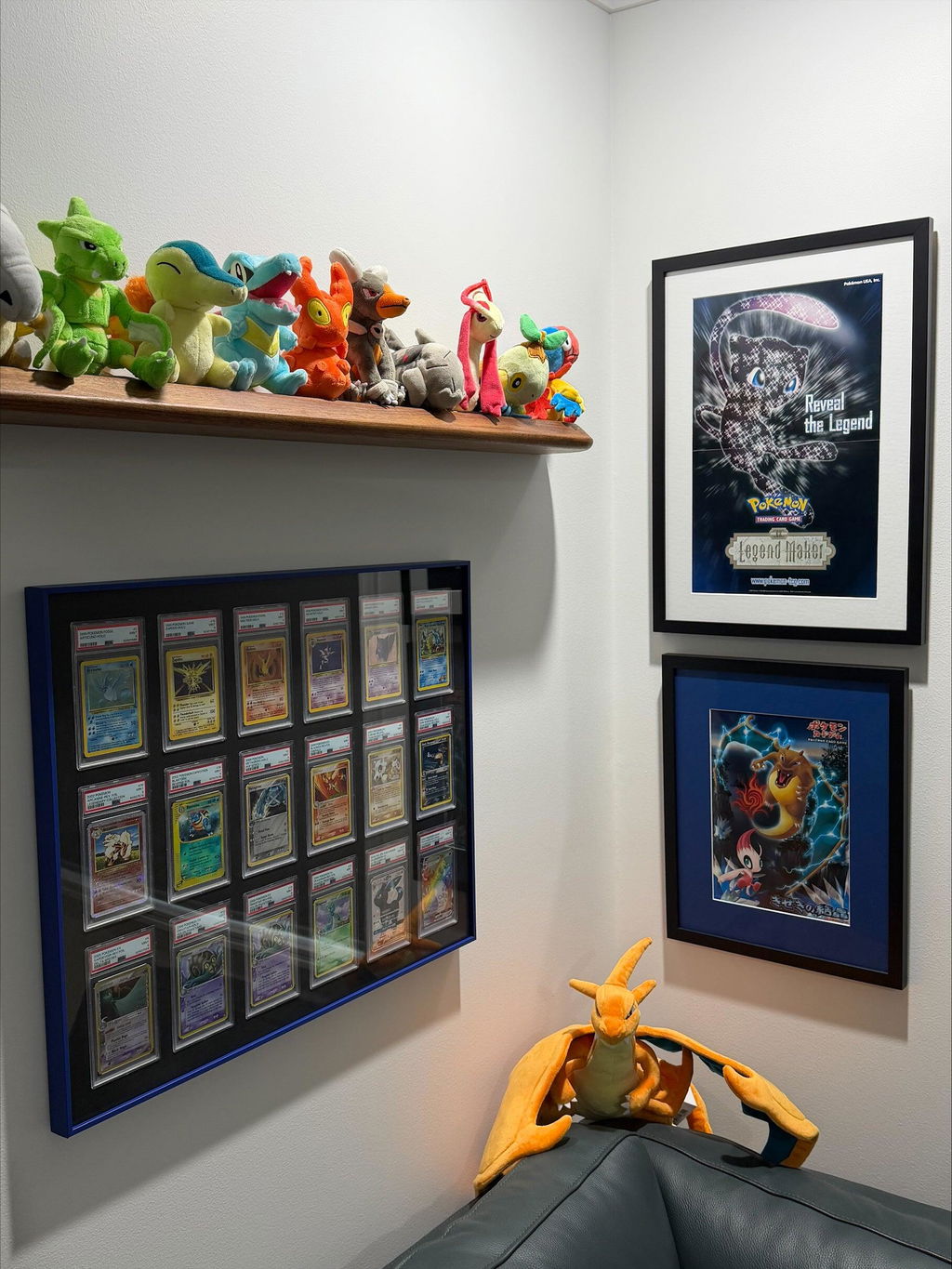
Think About the Room, Not Just the Cards
A trading card display exists within a room.
The right frame should therefore make sense beside:
- Furniture.
- Wall colour.
- Other frames.
- Shelving.
- Lighting.
- Televisions or monitors.
A large wall of graded cards may become one of the biggest visual objects in the room.
That means the outer frame matters much more than it would on a single-card display.
Match Multiple Frames Rather Than Matching Every Card
If you expect the collection to grow into several displays, consistency between the frames is usually more useful than matching each frame to its individual cards.
For example, several matte black aluminium frames can contain completely different Pokémon, sports or graded collections while still reading as one organised wall.
Plan for Future Collection Growth
Trading card collections rarely stay exactly the same.
You may eventually:
- Add more cards.
- Upgrade grades.
- Change holder formats.
- Expand into another set.
- Build another frame beside the first.
You do not need to buy an oversized frame immediately just because the collection might grow.
In many cases, leaving space for another matching display later is cleaner.
Avoid Empty Positions Unless They Are Deliberate
A fixed grid usually looks best when every opening is filled.
An empty position inside a 3 × 3 or 4 × 4 layout can look accidental.
If the collection is still growing, either choose a smaller frame now or use a layout where the empty space appears intentional.
Do Not Buy a Huge Frame Only Because You Might Need It One Day
A 36-card frame containing 18 cards does not necessarily look like a display with room to grow.
It can simply look unfinished.
If the collection eventually doubles, adding another matching frame can often produce a better result.
Think About Whether the Collection Will Ever Be Sold
Some collections are permanent. Others change constantly.
If you regularly sell cards, avoid a display system that makes removal unnecessarily difficult.
Frames that can be reopened and inserts that do not permanently attach the cards give you much more flexibility.
Choosing a Frame for Pokémon Cards
Pokémon collections can be extremely varied.
You may be displaying:
- Raw cards.
- Illustration Rares.
- Special Illustration Rares.
- Vintage holos.
- PSA slabs.
- One Touch cards.
- Character collections.
Smaller raw collections work well with conventional framing. Larger graded Pokémon displays benefit more from stronger frame construction and lighter glazing.
If you are building one yourself, our Pokémon trading card wall display guide covers the practical options in detail.
Choosing a Frame for Sports Cards
Sports collections introduce more variation in card thickness than most TCG collections.
A single display might contain:
- Standard rookies.
- Chrome cards.
- Autographs.
- Patch cards.
- PSA slabs.
- BGS slabs.
- Different One Touch depths.
The frame should therefore be chosen around the actual holders rather than simply the sport.
Choosing a Frame for MTG Cards
Magic: The Gathering cards are often displayed raw or sleeved, which makes matboard and conventional framing particularly useful.
Collectors may build frames around:
- Commanders.
- Full-art lands.
- Artists.
- Signed cards.
- Foils.
- Favourite sets.
Graded MTG displays are possible as well, although raw-card grids often allow a much denser arrangement.
Choosing a Frame for Yu-Gi-Oh! Cards
Yu-Gi-Oh! cards use a smaller physical card format than Pokémon and MTG.
That means raw-card frames should be planned specifically around the actual card or sleeve rather than assuming every trading card format is identical.
Yu-Gi-Oh! also suits dense archetype and rarity displays particularly well.
Our Yu-Gi-Oh! wall display guide covers this format in more detail.
Choosing a Frame for One Piece Cards
One Piece collections often focus heavily on artwork, characters, leaders, alternate arts and Manga Rares.
This makes simple framing particularly effective because the card artwork can provide most of the visual interest.
Raw, sleeved, One Touch and graded options can all work depending on the collection.
Choosing a Frame for Disney Lorcana Cards
Lorcana collections often contain colourful artwork and premium rarity treatments, which means neutral framing can work especially well.
Raw and sleeved displays allow larger groups to remain compact, while graded frames can suit smaller groups of premium cards.
Should You Use a Standard Picture Frame?
Standard picture frames are a good solution more often than people realise.
They make sense when:
- The cards are thin.
- The collection is small.
- The frame does not need unusual depth.
- The overall weight remains low.
- You are comfortable cutting or ordering matboard.
For raw and sleeved collections, a standard frame can provide excellent value.
When Custom Picture Framing Makes Sense
A professional framer becomes useful when you want a more specific combination of:
- Frame size.
- Matboard.
- Specialist glass.
- Colour.
- Depth.
- Mounting.
Custom picture framing works particularly well for smaller premium raw-card displays and unusual wall spaces.
When a Purpose-Built Trading Card Frame Makes Sense
Purpose-built displays become increasingly useful as the card format becomes more specialised.
That includes:
- Large graded collections.
- One Touch displays.
- High card counts.
- Large wall installations.
- Collections where consistent holder fit matters.
The value of a purpose-built system is not simply that it is more expensive. It is that the components have been designed around trading card holders rather than adapted from ordinary picture framing.
DIY vs Ready-Made
Whether to build the frame yourself depends largely on what you enjoy doing.
DIY makes sense when:
- You enjoy making things.
- You have suitable tools.
- The display is relatively straightforward.
- You want maximum control.
- You want to minimise material cost.
Ready-made displays make more sense when:
- You care mainly about the finished result.
- The display is large.
- The holder format is specialised.
- You do not want to source each component separately.
- You want a repeatable system for several frames.
If you are considering the DIY route, our complete DIY trading card wall display guide walks through materials, holders, glazing and layouts in much greater detail.
Do Not Forget the Cost of DIY Mistakes
DIY can be significantly cheaper, especially at smaller sizes.
But the first material list is not always the final cost.
Common rework includes:
- Replacing scratched acrylic.
- Recutting matboard.
- Replacing an insert that fits incorrectly.
- Changing a frame that turns out to be too shallow.
- Buying different mounting hardware.
If you enjoy the process, those adjustments may simply be part of the project.
If you only want the finished wall display, they become more relevant to the cost comparison.
What Features Are Actually Worth Paying For?
A higher price should ideally improve something practical.
Features worth paying more for can include:
- Better rigidity.
- Cleaner holder fit.
- Higher-quality glazing.
- Better insert material.
- Reliable wall mounting.
- Clean external finishes.
- Easy future access.
What Features May Not Matter to You?
Not every upgrade improves every display.
You may not need:
- Integrated lighting.
- Decorative multi-layer matboard.
- Specialist glass.
- Custom frame colours.
- Oversized construction.
If the feature does not improve the way you use or view the collection, there may be little reason to pay for it.
How to Avoid Underbuying
Underbuying usually means choosing a frame that technically fits the cards but does not suit the finished display.
Signs you may be underbuying include:
- The frame is too shallow for the holders.
- The glazing becomes excessively heavy.
- The frame flexes noticeably.
- The mounting system is inadequate for the finished weight.
- The insert does not hold the cards consistently.
This becomes most relevant on larger slab and One Touch displays.
How to Avoid Overbuying
Overbuying means paying for features that the collection does not really need.
A four-card raw display probably does not need the same structural approach as a 54-card slab wall.
If a simple timber frame, matboard and glass produce the result you want, that may be the better choice regardless of what more expensive options exist.
How to Choose a Frame for a $500 Collection
Imagine you own nine trading cards worth around $500 in total.
If they are raw or sleeved, a relatively simple frame may be completely sufficient.
You might prioritise:
- Clean matboard.
- Suitable glazing.
- Accurate alignment.
- A frame finish you like.
There may be little structural reason to move into premium aluminium unless you specifically prefer the look.
How to Choose a Frame for a $3,000 Graded Collection
Now imagine the collection contains 18 PSA slabs worth around $3,000.
The display requirements have changed considerably.
You are now dealing with:
- More weight.
- More depth.
- A larger overall frame.
- More repeated positions.
- More substantial mounting.
A stronger and more purpose-built frame becomes much easier to justify here.
That is not simply because the collection is worth $3,000. It is because the physical display itself is more demanding.
How to Choose a Frame for a $10,000 Collection
A $10,000 collection can still use an inexpensive frame if the owner prefers it.
But if the collection is permanent, carefully curated and expected to remain on the wall for years, factors such as materials, finish, glazing, future access and mounting become increasingly important.
At that point, the display is often being treated as a permanent part of the room rather than temporary storage.
How to Choose a Frame for 50+ Graded Cards
Large slab collections need to be approached differently regardless of financial value.
With 50 or more holders, consider:
- One frame versus several.
- Total wall area.
- Finished weight.
- Frame rigidity.
- Acrylic rather than heavy glass.
- Access for future card changes.
- How the display will physically reach the installation location.
This is where large-format aluminium and other substantial frame systems become particularly relevant.
How to Choose Between One Premium Frame and Several Smaller Ones
If the collection is large, ask whether it genuinely needs to remain together.
One large frame gives you:
- One uninterrupted grid.
- A strong visual impact.
- One installation.
Several smaller frames give you:
- Easier handling.
- More flexible layouts.
- Easier collection changes.
- Less weight per frame.
- Better separation of collection themes.
Neither is automatically better.
How to Decide Whether Premium Is Worth It
Premium framing tends to be worth considering when you can identify exactly what you are getting for the additional cost.
For example:
- You need more rigidity.
- You want a slimmer profile.
- You need lighter glazing.
- You want a better holder insert.
- You want the frame to remain on the wall for years.
- You care about the finished object as much as the cards inside it.
If none of those things matter, the premium option may not offer much practical value to you.
How to Choose a Trading Card Display Frame Step by Step
Step 1: Choose the Cards
Decide exactly which trading cards belong in the display.
Step 2: Choose the Holder Format
Raw, sleeved, toploader, One Touch or graded.
Step 3: Count the Cards
Let the collection determine the required grid rather than filling arbitrary empty positions.
Step 4: Measure the Wall
Work out how much space the room can comfortably support.
Step 5: Estimate the Scale and Weight
Rigid holders and large glazing panels change the physical requirements quickly.
Step 6: Choose the Frame Material
MDF, timber and aluminium all have valid uses depending on the project.
Step 7: Choose Glass or Acrylic
Consider scratch resistance, weight, impact resistance and overall frame size.
Step 8: Choose Matboard or EVA
Raw cards generally suit matboard. Rigid holders often benefit from foam-based inserts.
Step 9: Think About Future Access
Make sure cards can be removed or changed without destroying the display.
Step 10: Choose the Frame Finish
Choose a finish that works with the whole collection and the room.
Step 11: Plan the Mounting
Mounting hardware should suit the finished display weight and wall construction.
Step 12: Decide Whether to DIY, Custom Frame or Buy Purpose-Built
Choose the route that matches your budget, skill level, time and desired finish.
A Simple Decision Guide
If You Have 1–4 Raw or Sleeved Cards
Start with a good-quality conventional picture frame, matboard and appropriate glazing.
If You Have 5–18 Raw Cards
Custom matboard and a larger picture frame can still work extremely well.
If You Have a Small PSA, CGC or BGS Collection
Look for a frame designed around the actual slab format, with enough depth and a reliable holder insert.
If You Have a Small One Touch Collection
Choose a frame that accounts for the actual magnetic holder depth and allows the cards to remain removable.
If You Have 18–36 Graded Cards
Start prioritising frame rigidity, acrylic weight, insert quality and mounting rather than treating the project as ordinary picture framing.
If You Have 50+ Graded Cards
Approach the project as a large wall display. Compare one large frame with several coordinated frames and pay close attention to finished size, weight and installation.
If the Collection Is Worth Several Thousand Dollars
Do not assume you need the most expensive frame. Instead, decide how permanent the collection is and whether better materials, finish, access and rigidity are worth paying for.
If You Want the Frame to Become Part of the Room
Pay more attention to proportions, finish and material quality. This is where premium timber or aluminium often starts making more sense.
The Right Frame Should Solve the Collection, Not Compete With It
The most successful trading card frames tend to disappear visually once you start looking at the cards.
The frame still needs to be strong, well finished and appropriate for the room, but it should not become the most complicated part of the display.
A good frame provides structure.
The collection provides the interest.
Final Thoughts
Choosing the right trading card display frame starts with understanding the collection rather than choosing a material or price point first.
Raw cards, sleeves, toploaders, One Touch holders and graded slabs all create different requirements. A three-card frame and a 50-card slab wall need completely different levels of structure, glazing and mounting.
For smaller and lighter collections, inexpensive picture frames and matboard can work extremely well. Mid-range custom framing becomes useful when fit, glazing and finish matter more. Premium timber and aluminium systems start making the most practical sense when the collection becomes larger, heavier, more permanent or more important within the room.
The goal is not to buy the most expensive frame available. It is to choose enough frame for the collection you actually have.
If the frame fits the holder format, supports the finished weight, suits the room, allows access to the cards and gives the collection enough structure without overwhelming it, you are already most of the way to the right answer.
Continue Exploring
If you enjoyed this guide, you may also find these collector resources helpful.
📚 Collector Guides
-
How to Make a Trading Card Wall Display: Complete DIY Guide
Learn how to plan and build a trading card wall display, including frame materials, holders, acrylic, EVA foam, layouts and mounting. -
How Much Should You Spend on a Trading Card Display Frame?
Compare cheap, mid-range and premium trading card displays and learn when spending more starts to make practical sense. -
How to Make a Graded Trading Card Wall Display
Explore PSA, CGC and BGS slab displays, frame materials, EVA foam, acrylic, layouts and mounting considerations. -
How to Make a One Touch Trading Card Wall Display
Explore magnetic holder displays, frame depth, EVA foam, acrylic, layouts and larger One Touch collections. -
The Ultimate Trading Card Display Guide: Ideas, Frames, Shelves & Display Solutions for Every Collector
Explore wall displays, shelves, frames, lighting and display solutions for trading card collections of every size. -
Why Premium Aluminium Trading Card Display Frames Are Worth It: The Complete Collector Guide
Explore aluminium trading card display frames, their materials and why they become particularly useful for larger graded and One Touch collections.
🛒 Shop Display Collections
-
Aluminium Trading Card Wall Display Frames
Premium aluminium trading card display frames available in a wide range of grid sizes, frame colours and holder formats. -
PSA, CGC & BGS Graded Slab Wall Display Frames
Purpose-built graded trading card display frames for Pokémon, MTG, Yu-Gi-Oh!, One Piece, Sports Cards, Disney Lorcana and other collections. -
One Touch Wall Display Frames
Premium aluminium wall display frames designed for One Touch magnetic trading card holders.

0 comments