


A Yu-Gi-Oh! trading card wall display has one immediate difference from many other TCG projects: the raw trading card format is smaller. That gives you more layout options, but it also means a generic frame designed around another trading card game can look awkward.
For anyone searching how to make a Yu-Gi-Oh! trading card display or planning a homemade Yu-Gi-Oh! card frame, the smaller raw trading card format is the first thing to account for.
This guide deals specifically with Yu-Gi-Oh! and its smaller raw trading card format. For the wider technical comparison of materials, holders and wall-display construction, see our complete DIY trading card wall display guide.
Yu-Gi-Oh! has one important difference: the raw trading card format is smaller
Yu-Gi-Oh! trading cards use a smaller raw format than many standard-size TCG trading cards. That affects the visual scale of the whole display. A generic opening designed around another game can leave too much dead space and make the trading cards look lost inside the frame.
The smaller format also makes dense layouts possible, but density has to be controlled. A wall of tightly packed Yu-Gi-Oh! trading cards can look impressive or overwhelming depending on spacing, margins and the frame around it.
Choosing a frame material without making the project harder than it needs to be
Because raw Yu-Gi-Oh! trading cards are smaller, the outer frame can easily overpower the collection if the profile is too heavy. For compact displays, a simple timber or painted MDF frame usually gives enough structure without swallowing the artwork.
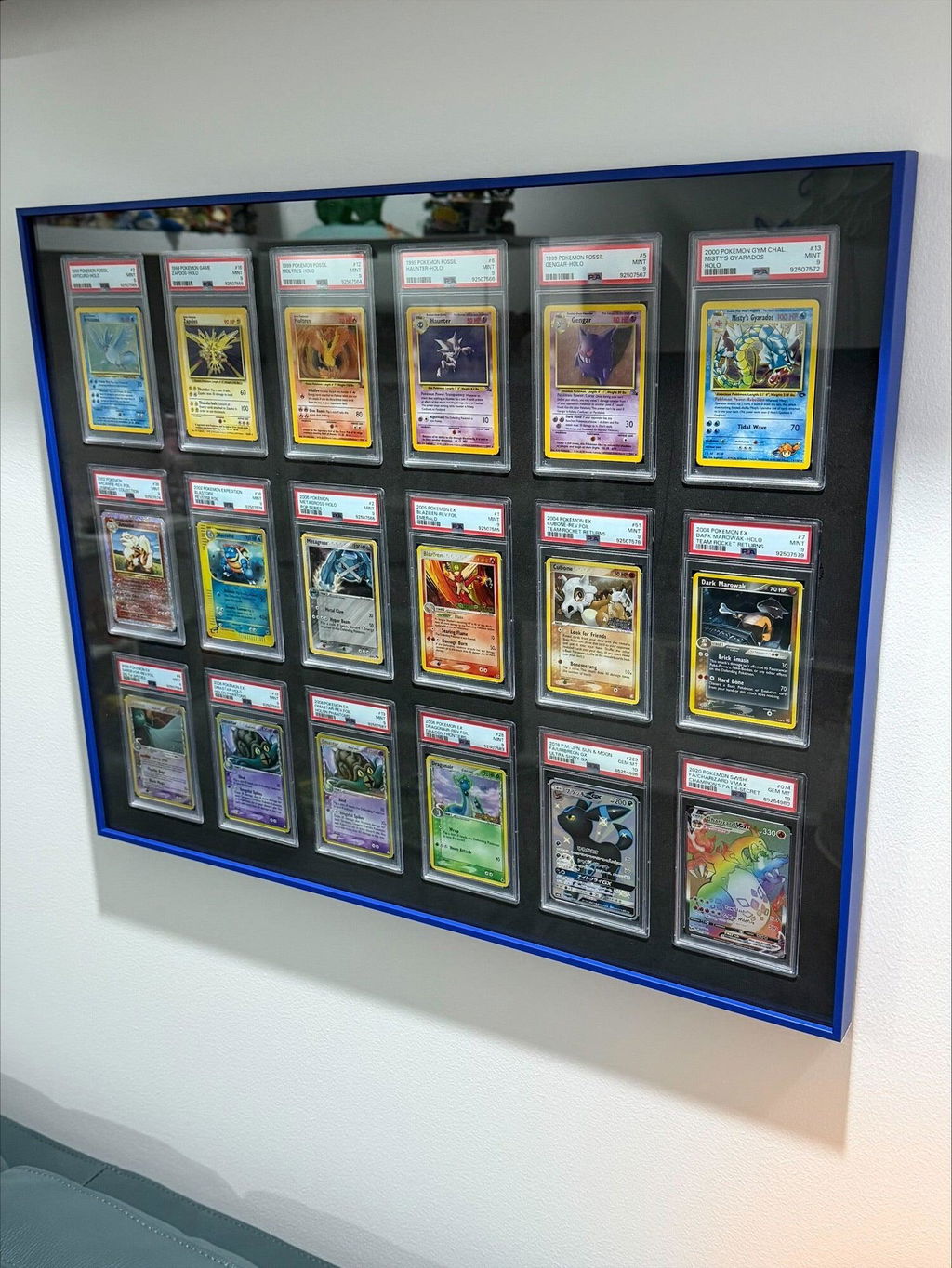
Acrylic works well when you want a lighter modern look. Aluminium becomes more interesting on larger graded-card grids because the slim outer profile keeps the focus on the rows of slabs. It is also a more specialised DIY material, so collectors who want that finish often prefer a ready-made system.
Think about the room as well. A dense wall of dark Yu-Gi-Oh! artwork already has plenty of visual weight. The frame does not need to add more.
Measure the sleeve or slab, not a different TCG
Yu-Gi-Oh! sleeves, top loaders and graded holders should be measured directly. Do not borrow measurements from Pokémon or MTG just because the products look similar on a screen.
Raw and sleeved Yu-Gi-Oh! trading cards work well with matboard. Graded trading cards need the same kind of slab-specific planning as other TCG displays, including depth, insert fit and label alignment.
If you are mixing English, Japanese and Korean trading cards, the raw trading card size may be consistent while the overall visual density of the text and artwork changes. That is a design issue rather than a construction problem, but it matters on a large wall.
Matboard, EVA foam and the part that actually holds the trading cards
Matboard is ideal for raw or sleeved Yu-Gi-Oh! trading cards because the opening can be proportioned to the smaller format rather than relying on a generic TCG frame. That alone can make the finished result look much more intentional.
For graded trading cards, EVA foam or another rigid-holder insert is usually cleaner. Test the slab fit before cutting the full panel, especially if the collection mixes grading companies.
The smaller raw trading card size does not mean the holder should be squeezed more tightly. The same rule applies across every format: secure enough to stay level, loose enough to remove without a fight.
Archetype displays can make a large Yu-Gi-Oh! wall easier to read
Yu-Gi-Oh! naturally lends itself to grouped displays. An archetype can be shown as one block, with Monsters, Spells and Traps arranged into a visual system. A character deck can be treated the same way.
Dense grids work because the trading cards are smaller, but larger outer margins can help stop the frame from looking crowded. Another option is to break the collection into several smaller archetype frames rather than one huge wall.
Layout planning: where small errors become obvious
Yu-Gi-Oh! can support denser layouts than many standard-size TCGs, but that makes planning even more important. More trading cards on the wall means more repeated lines for the eye to judge.
Archetypes give you a natural way to organise the display. A signature monster can anchor a section, with supporting Monsters, Spells and Traps around it. Another approach is to separate eras or characters into their own modules.
Do not use density as the only goal. A slightly more generous outer margin can make a packed grid feel controlled rather than cramped.
Dark trading card frames and busy artwork need contrast
Many Yu-Gi-Oh! trading cards already use dark or saturated borders and detailed artwork. A neutral insert often works better than a strong competing colour.
White can create strong contrast. Black can make the frame disappear. A coloured accent can work when it is tied to one archetype, but using too many colours at once can turn a dense layout into visual noise.
Acrylic, glass and UV protection
Small Yu-Gi-Oh! frames are light enough that either glass or acrylic can work. Acrylic becomes more appealing as the display grows because the overall weight stays lower and breakage is less of a concern.
Older trading cards and premium foils are still best kept away from direct sunlight. UV-resistant glazing helps, but it does not make a bright window harmless. Choose the wall first and the glazing specification second.
Lighting without turning the glazing into a mirror
Yu-Gi-Oh! artwork is detailed and many trading cards use reflective foils, so bright front-facing LEDs can make the wall harder to read. Soft light from above or from the room often works better than a strong strip pointed directly at the glazing.
If you want integrated lighting, use diffusion and test the display from several angles. The frame should still look good when the LEDs are switched off.
Large Yu-Gi-Oh! grids can become visually dense very quickly
The smaller trading card format means a collector can fit more openings into the same wall area, but that does not mean the display should always be packed as tightly as possible.
Use full-scale mock-ups before committing. A layout that looks tidy in a spreadsheet can feel much busier once dozens of detailed trading cards are viewed together.
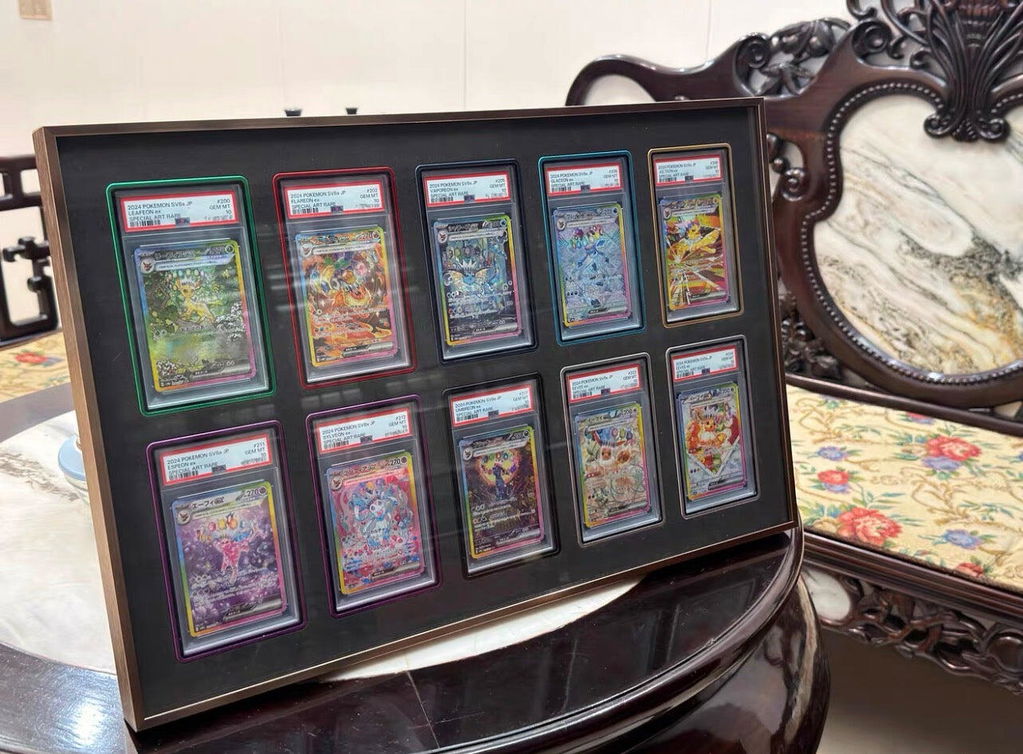
For graded Yu-Gi-Oh! trading cards, the slab size removes much of the raw-card density advantage, so treat the project like any other large graded display.
Frame depth, backing and wall mounting
Raw Yu-Gi-Oh! trading cards need very little depth compared with slabs, so do not overspecify the frame unless you need to. A shallow, clean frame can suit a dense raw-card wall beautifully.
Graded displays need more room and stronger backing. Once dozens of slabs are involved, the total weight becomes a mounting question as much as a framing question.
Use wall hardware suited to the actual surface and finished display. If the frame is large enough that lifting it feels awkward, plan the installation with two people rather than trying to improvise at the last minute.
Where to source materials for a DIY build
For a Yu-Gi-Oh! DIY frame, local picture-framing suppliers are a good place to start because they can help with matboard and glazing. Hardware stores cover the outer frame materials and mounting, while acrylic and foam can be sourced from local specialist suppliers.
Bring the holder or sleeve with you when practical. It is much easier to explain the project when the supplier can see the actual object you are trying to frame.
Cheap, mid-range and premium ways to approach the build
A low-cost Yu-Gi-Oh! display can be very simple: a standard frame, a custom mat and basic acrylic. Because the raw trading cards are compact, even a modest frame can hold a meaningful group.
Move into custom-cut acrylic, better matboard and stronger backing for a more polished mid-range build. Graded collections can add EVA foam or another purpose-made insert.
For a large premium slab wall, aluminium, higher-grade glazing and professional mounting can make sense. The value comes from consistency and scale, not from making the frame visually loud.
English, Japanese and Korean Yu-Gi-Oh! trading cards in one display
Mixed-language collections can look excellent because the artwork remains the visual link even when the text changes. The simplest approach is to keep the frame and insert consistent and let the language differences become part of the collection.
If the trading cards are graded, check label colour and size before committing to a very tight visual pattern. The slab label may affect the overall wall more than the language printed on the trading card itself.
Use the smaller Yu-Gi-Oh! format as an advantage
The smaller raw trading card size gives Yu-Gi-Oh! collectors more freedom to create dense walls without immediately using huge frame dimensions. That can be a major advantage in bedrooms, offices and game rooms where wall space is limited.
The risk is overpacking. Because more trading cards fit into the same area, it is easy to keep adding openings until the display becomes visually exhausting. A strong outer margin, consistent spacing and clear grouping can keep a dense layout readable.
Archetype displays should have a visual hierarchy
An archetype collection can include key monsters, supporting monsters, Spells, Traps and alternate artworks. Instead of treating every trading card as equally important, decide which ones should anchor the composition.
A boss monster or signature trading card can sit in the centre, with supporting pieces arranged around it. Another option is to keep strict chronological or card-type rows. The important thing is that a viewer can understand the structure without reading every trading card name.
Older Yu-Gi-Oh! trading cards and changing visual styles
Older Yu-Gi-Oh! trading cards can look very different from modern releases because of print finish, frame style and artwork density. A neutral surrounding material helps bridge those visual differences.
If the display mixes very old and very new trading cards, avoid trying to force the frame colour to match one era. A consistent black, white or natural material usually gives the collection more room to show its own history.
Language-mixed Yu-Gi-Oh! displays
Japanese, Korean and English trading cards can sit together successfully because the artwork provides a strong visual link. The main thing to watch is consistency of holder and sleeve format.
If the collection is graded, label design can become more noticeable than language. A mixed grading-company wall may look busier than a mixed-language wall using one holder format.
Cleaning and preserving a dense Yu-Gi-Oh! wall
Dense displays can collect dust around frame edges and recessed openings. Keep the front glazing easy to access for cleaning and avoid materials that shed fibres into the display cavity.
For raw trading cards, make sure sleeves remain flat and are not being compressed by the mat. If a trading card needs to be removed, the frame should open without requiring the surrounding insert to be bent or damaged.
Common DIY mistakes that are easy to avoid
- Using a generic opening designed for standard-size trading cards.
- Packing the grid so tightly that the artwork becomes visually exhausting.
- Mixing slab types without checking how the labels line up.
- Choosing a deep shadow-box frame for raw trading cards when a shallower frame would look cleaner.
- Using bright LEDs that reflect across foil surfaces.
- Skipping a test opening before cutting a full multi-card mat or foam panel.
- Ignoring future additions to an archetype collection.
- Underestimating the weight of a large graded display.
A practical build sequence
- Choose raw, sleeved, top-loaded or graded Yu-Gi-Oh! trading cards.
- Measure the exact sleeve or holder format.
- Choose the archetype, era or collection theme.
- Mock up the total size on the wall.
- Select the frame and insert materials.
- Test one opening and check the visible border.
- Dry-fit the glazing, insert and backing to confirm depth.
- Assemble the full grid and check it from a distance.
- Mount the frame with hardware appropriate to its finished weight.
When DIY makes sense and when ready-made starts looking attractive
Small raw-card Yu-Gi-Oh! displays are excellent DIY projects because the materials are accessible and the frame can stay compact.
The economics change with a large slab wall. Once the project involves precision foam cutting, large acrylic panels and substantial mounting, a ready-made display can save a lot of time while still giving the same clean grid effect.
Why generic TCG frames can look wrong with Yu-Gi-Oh!
The smaller raw trading card format is one of the biggest reasons to build a Yu-Gi-Oh! display specifically for the collection rather than adapting a frame designed around another TCG. An oversized opening leaves too much empty material around each trading card and can make the collection look lost.
This does not mean the display needs to be packed tightly. It means the proportions should feel intentional. A smaller trading card can still have generous breathing room as long as that space is part of the design rather than an accident.
Building an archetype wall that is easy to understand
A strong archetype display usually has a hierarchy. The signature monster or central piece gets the strongest position, while supporting Monsters, Spells and Traps build around it.
You can organise by card type, release chronology or visual importance. What matters is that the wall has an obvious logic. A viewer should be able to understand the grouping before reading every name.
If one archetype becomes too large, split it into two related frames rather than forcing every trading card into one dense block.
Displaying older Yu-Gi-Oh! trading cards with modern releases
Older Yu-Gi-Oh! trading cards often have a different visual character from current releases. Print finish, artwork density and border treatment can all change how they sit on the wall.
A neutral insert and consistent frame help those eras coexist. The surrounding structure becomes the common element while the trading cards show the history of the game.
For older raw trading cards, avoid direct adhesive and unnecessary pressure. Sleeves or rigid holders are a much safer basis for a display.
Mixed-language Yu-Gi-Oh! collections
English, Japanese and Korean trading cards can work extremely well together because the artwork is the visual link. There is no need to separate languages unless the collection itself is organised that way.
Try to keep the holder format consistent. A mixed-language wall in matching sleeves can look cleaner than a single-language wall using several unrelated holder types.
If the collection is graded, the grading labels may introduce more visual variation than the language on the trading cards.
Dense displays need stronger outer margins
Because more raw Yu-Gi-Oh! trading cards can fit into a given wall area, it is tempting to use every available centimetre. That often makes the display feel more like storage than presentation.
A stronger border around the outside of the grid can calm the whole composition without wasting much wall space. This is especially helpful when the artwork itself is dark, detailed or heavily foiled.
Modular Yu-Gi-Oh! displays are useful for collectors with several archetypes
If your collection spans several archetypes, separate matching frames can be a better solution than one universal grid. Each archetype gets its own identity, and you can add another frame later without disturbing the earlier ones.
Keep the frame finish and general visual language consistent so the wall still feels like one collection.
Raw Yu-Gi-Oh! trading cards versus graded slabs on the same wall
Raw trading cards and graded slabs do not need to live inside the same physical frame to feel like one collection. In fact, separating them often makes the wall cleaner because each format can use the depth and insert material that suits it best.
A shallow matboard frame can hold raw or sleeved trading cards, while a deeper slab frame can sit beside it with the same outer finish. That gives you visual consistency without forcing a compromise inside the frame.
This approach is also useful when the raw collection changes more often than the graded collection. You can update one section without disturbing the other.
Planning for a future graded upgrade
If you expect some raw trading cards to be graded later, avoid building an arrangement that only works while every trading card is thin. A modular wall gives you somewhere to move a trading card once it returns in a slab.
You do not need to leave obvious empty spaces. The better solution is a display system that can grow or be rearranged without starting from zero.
Final layout check before you cut anything
Before committing to the finished insert, print or sketch the proposed grid at a rough scale and place the actual sleeves or slabs over it. This quickly reveals whether the collection feels too dense, whether the outer margin is doing enough work, and whether the archetype grouping still makes sense away from a spreadsheet.
That short check is usually more valuable than squeezing in one extra row simply because the wall technically has room.
One final practical point: keep a note of the materials and holder format you used. If you build a second matching Yu-Gi-Oh! frame later, having that information saves you from trying to reverse-engineer your own first project.
How to make your own Yu-Gi-Oh! trading card frame
A DIY Yu-Gi-Oh! trading card frame should be planned around the smaller raw trading card format rather than copied from a standard-size TCG display. That keeps the openings and surrounding material in proportion.
A cheap homemade Yu-Gi-Oh! display can use a standard frame and custom matboard. A premium version can use better glazing, a purpose-cut insert and stronger backing for graded slabs.
Frequently asked questions
Are Yu-Gi-Oh! trading cards the same size as Pokémon trading cards?
No. Raw Yu-Gi-Oh! trading cards use a smaller format, so a DIY display should be measured specifically for the holder or sleeve being used.
Can Yu-Gi-Oh! trading cards be displayed in standard picture frames?
Yes, especially raw or sleeved trading cards, but a custom mat or insert will usually give a cleaner result.
Is EVA foam useful for graded Yu-Gi-Oh! trading cards?
Yes. EVA can support rigid slabs well when the fit is tested and the foam is not excessively soft or tight.
How do you make a large Yu-Gi-Oh! trading card wall display look less crowded?
Use consistent spacing, stronger outer margins and consider splitting archetypes into separate modules.
Can Japanese and English Yu-Gi-Oh! trading cards be displayed together?
Yes. Keep the frame system consistent and let the language variation become part of the collection.
Final thoughts
Yu-Gi-Oh! displays reward accurate planning because the smaller raw trading card format can make a wall look incredibly clean when the spacing and margins are deliberate. Measure the holder you actually use, control the visual density and let the collection theme decide whether one large grid or several smaller modules make more sense.
Continue Exploring
If you enjoyed this guide, you may also find these collector resources helpful.
📚 Collector Guides
-
Best Trading Cards to Display & Collect
Explore Pokémon, MTG, Yu-Gi-Oh!, Sports Cards, One Piece and Disney Lorcana cards, sets, rarities and collection ideas. -
The Ultimate Trading Card Display Guide
Explore trading card wall displays, frames, shelves, layouts and display solutions for collections of every size. -
How to Display Graded Cards on a Wall
Learn how collectors display PSA, BGS and CGC graded cards using wall-mounted trading card displays.
🛒 Shop Display Collections
-
Aluminium Trading Card Wall Display Frames
Premium aluminium trading card display frames available in a wide range of grid sizes, frame colours and holder formats. -
PSA, CGC & BGS Graded Slab Wall Display Frames
Purpose-built graded trading card display frames for Pokémon, MTG, Yu-Gi-Oh!, One Piece, Sports Cards, Disney Lorcana and other collections. -
One Touch Wall Display Frames
Premium aluminium wall display frames designed for One Touch magnetic trading card holders.

0 comments