


How to Catalogue a Trading Card Collection: Tracking Cards, Grades, Values & Storage
As a trading card collection grows, remembering exactly what you own becomes surprisingly difficult. A small collection might be easy to keep track of from memory, but once you have multiple sets, graded cards, duplicates, sealed products and cards stored in different locations, a proper catalogue can make the collection much easier to manage.
Cataloguing does not need to mean recording every common card you own. The right system depends on the size of your collection, what you collect and what information is actually useful to you.
This guide covers practical ways to catalogue a trading card collection, what information is worth recording, how to track graded and raw cards, and how a catalogue can help you decide what to keep, sell, trade, store or display.
What Does It Mean to Catalogue a Trading Card Collection?
Cataloguing a trading card collection simply means creating a record of the cards you own. That record could be as simple as a spreadsheet containing card names and sets, or it could include photographs, grades, purchase prices, current values, storage locations and other information.
The purpose is not necessarily to create a perfect database. It is to make your collection easier to understand and manage.
- Which cards do I already own?
- Which cards am I still looking for?
- Where is a particular card stored?
- Which cards have been graded?
- Which cards are currently on display?
- How much did I pay for a card?
- Which cards are duplicates?
- Which cards would I consider selling or trading?
Why Catalogue Your Trading Cards?
The main advantage of cataloguing is visibility. Large collections can become fragmented across binders, boxes, graded slabs, display frames and storage containers. Without a record, it becomes easy to forget what is where.
A catalogue can also prevent unnecessary duplicate purchases. If you are working through a large set or collecting a particular player, character or card type, checking your catalogue before buying can save both time and money.
It also becomes increasingly useful when your collection changes. Cards may move from storage to display, raw cards may be graded, duplicates may be sold and new cards may replace older examples.
Do You Need to Catalogue Every Trading Card?
No. For many collectors, cataloguing every single card would create more work than value.
If you own thousands of inexpensive commons and duplicates, recording each individual card may not be worthwhile. You could instead catalogue complete sets, boxes, binders or groups of bulk cards.
- Pokémon bulk box: approximately 800 cards
- Scarlet & Violet binder: complete or near-complete set
- Duplicate holo box
- Trade binder
More valuable, graded, rare or personally important cards can then be recorded individually.
What Information Should You Record?
You can make a trading card catalogue as simple or detailed as you want. However, several fields are particularly useful.
Card Name
Record the name of the card, player, character or subject. This is usually the most obvious identifier.
Set or Release
Record the set, series or product the card came from. This becomes particularly important when the same character or player appears on many different cards.
Card Number
Card numbers make it much easier to distinguish between similar cards and variants.
Year
For sports cards and long-running trading card games, recording the year can make searching and sorting much easier.
Condition
For raw cards, you may want to record a simple condition estimate using a condition system you apply consistently.
Grading Company and Grade
For graded cards, record the grading company and grade. PSA, CGC and BGS slabs may also have certification numbers that can be useful to record.
Purchase Price
Recording what you actually paid can be more useful than trying to remember it later, particularly for higher-value cards.
Current Estimated Value
If value matters to you, you can add an estimated current value. Remember that card prices change, so this field will require updating if you want it to remain useful.
Storage or Display Location
This is one of the most underrated fields in a large collection. A simple location entry such as âBinder 3â, âPSA Box 2â or âDisplay Frame 1â can save a lot of searching later.
Status
A status field can quickly separate cards into categories such as Collection, Display, For Grading, At Grading, For Sale, For Trade and Wishlist.
Spreadsheet vs Trading Card Collection App
Using a Spreadsheet
A spreadsheet gives you complete control over the information you record. You can create columns for exactly the information that matters to you and sort or filter the collection however you like.
Spreadsheets are particularly useful for collectors who want to track storage locations, custom categories or information that may not be supported by a dedicated card app.
Using a Collection App
Dedicated collection apps can make card identification and value tracking faster, particularly when they already contain databases for the cards you collect.
However, different apps support different games, sports and grading companies. Some collectors therefore use both: an app for card identification and market information, and a spreadsheet for their own collection management.
How to Catalogue Graded Trading Cards
Graded cards are particularly suitable for individual cataloguing because each slab already contains structured information.
- Card name
- Set
- Year
- Card number
- Grading company
- Grade
- Certification number
- Purchase price
- Estimated value
- Storage or display location
If you collect slabs from multiple grading companies, keeping the grading company as a separate field makes it easy to filter your collection by PSA, CGC, BGS or another holder format.
How to Track Cards Sent for Grading
Cards sent for grading temporarily leave your physical collection, so it can be useful to give them their own status.
You could record when the card was submitted, which grading company received it, the submission number and its current status. Once the card returns, update the entry with its final grade and certification number.
How to Catalogue Raw Cards
Raw cards can require slightly more work because they do not have the grading label and certification information found on slabs.
For important raw cards, record enough information to identify the exact version. Set, card number, language, parallel, variation and condition may all matter depending on the card.
You do not necessarily need this level of detail for inexpensive cards. Use more detailed records where the additional information actually helps you manage the collection.
How to Track One Touch Cards
Cards stored in magnetic One Touch holders can be catalogued similarly to raw cards, with the holder type added as an extra field.
This can become useful when planning physical storage or display because a One Touch holder has different dimensions from a graded slab.
How to Track Duplicate Cards
Duplicates can make a large collection much harder to understand if they are not separated from the main collection.
You can create one catalogue entry and use a quantity field, or create separate entries when individual copies have different conditions, grades or values. For inexpensive cards, quantity is usually enough. For valuable cards, separate records are more useful.
Should You Record Trading Card Values?
That depends on why you are cataloguing.
If your main goal is organisation, value tracking may be unnecessary. If you buy, sell, trade or insure higher-value cards, recording values can be more useful.
It is important to separate purchase price from estimated current value. They represent different information. Purchase price is historical and usually does not change, while estimated market value can move considerably over time.
How Often Should You Update Card Values?
You probably do not need to constantly update every card.
For a large collection, consider focusing on the cards where value actually matters. If a card is being sold, traded or documented for insurance, that is a sensible time to check its current market information.
Should You Photograph Your Trading Card Collection?
Photographs can add another useful layer to a catalogue, especially for valuable or condition-sensitive cards.
- Front and back condition
- Grading labels
- Certification numbers
- Autographs
- Serial numbering
- Unique defects or characteristics
- How a collection is arranged
You do not need professional photographs of every card. Even straightforward reference images can be useful.
How to Catalogue a Large Pokémon Card Collection
Pokémon collections can become complicated because collectors may own cards across many eras, languages, sets and product types.
- Set
- Pokémon
- Generation or era
- Language
- Raw or graded
- Grade
- Rarity
- Collection goal
If you collect a specific Pokémon, adding a character field allows you to filter every card featuring that Pokémon regardless of set.
How to Catalogue a Sports Card Collection
Sports collectors may find player, team, season and card manufacturer particularly useful fields.
- Sport
- Player
- Team
- Year or season
- Manufacturer
- Set
- Parallel
- Serial number
- Rookie status
- Autograph or memorabilia
This makes it possible to filter a large collection around one player or team without physically storing every related card together.
How to Catalogue MTG, Yu-Gi-Oh! and Other TCG Collections
The same basic principles apply to Magic: The Gathering, Yu-Gi-Oh!, One Piece and other trading card games.
However, useful fields may differ. Set, card number, language, rarity, printing and condition may be more useful than fields designed around sports cards. The catalogue should reflect what you actually collect.
How to Record Where Your Cards Are Stored
A location system becomes increasingly valuable as your collection expands.
- Binder 01
- Binder 02
- Graded Box A
- Graded Box B
- Display 01
- Display 02
- Trade Box
- Sealed Storage Shelf
Record that location against the relevant card or group in your catalogue. The exact naming convention matters less than consistency.
Cataloguing Cards That Are on Display
Display can be treated as another physical location.
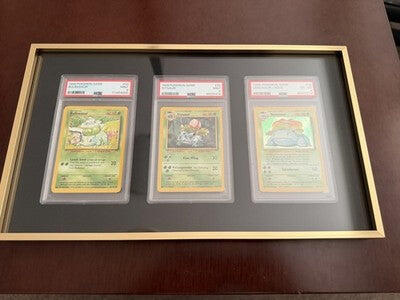
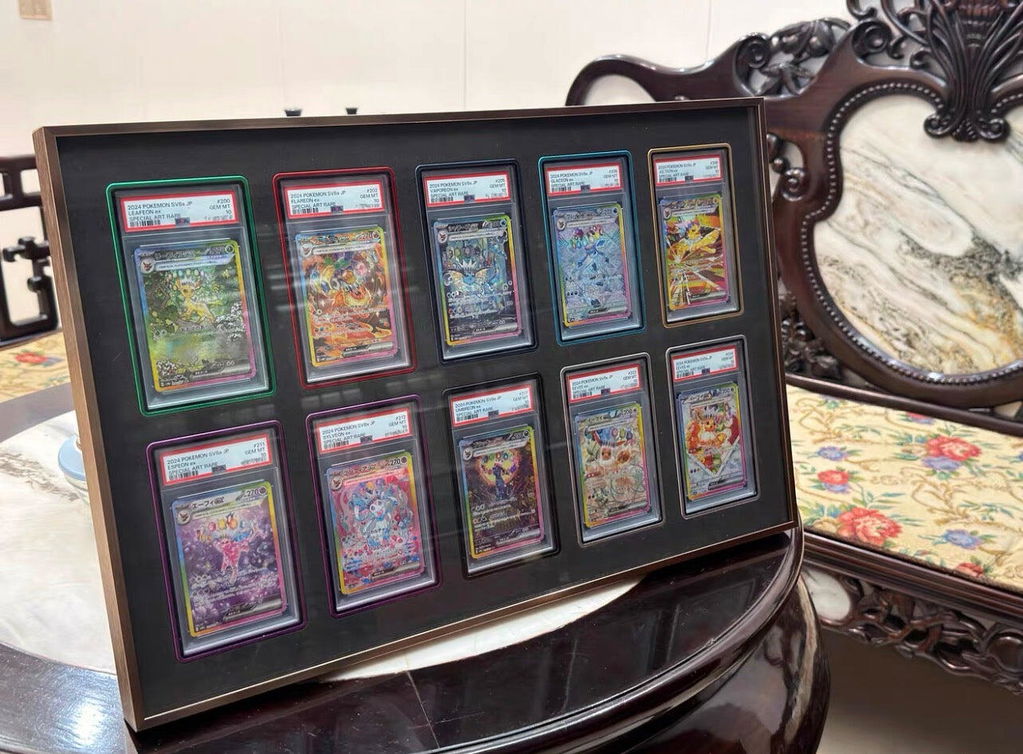
If a group of cards is installed in a wall display, record which cards are in that display. This is particularly useful if you rotate cards regularly or have several displays around a room.
You could also give each display its own name or number and record the layout. For example, a 3 Ã 3 display could be recorded as nine positions.
Using a Catalogue to Decide What to Display
One of the useful side effects of cataloguing is that it makes patterns within the collection easier to see.
You might discover that you own nine graded cards featuring the same Pokémon, twelve cards from one set, a complete group of a particular player, or several slabs that work naturally as one display.
Rather than choosing cards individually every time, you can filter your catalogue by character, player, set, grade, holder type or another category and see which groups already exist.
Planning a Trading Card Display From Your Catalogue
Once you have chosen a group of cards, the next step is determining the physical arrangement.
Start with the number of cards and holder format. A collection of PSA slabs will require a different aperture size from BGS slabs or cards protected in One Touch holders.
Then consider the grid. Nine cards could suit a 3 Ã 3 arrangement, while a larger group may work better as a wider landscape configuration or a taller portrait layout.
The Card Collective produces aluminium trading card display frames across multiple capacities and dedicated holder formats, allowing the physical display to be matched to the group you have selected rather than forcing different holders into a generic opening.
If your collection does not suit an existing configuration, a custom display can also be planned around the number of cards, holder type, preferred layout, orientation, EVA foam colour and frame finish.
Should Your Catalogue Match Your Physical Organisation?
Not necessarily.
Your digital catalogue can organise cards by set or player while the physical cards are stored by size or holder type. The important part is recording the physical location so you can still find them.
How to Start Cataloguing an Existing Large Collection
If you already own hundreds or thousands of cards, do not feel that everything needs to be entered at once.
- Graded cards
- Higher-value raw cards
- Cards currently on display
- Cards intended for grading
- Complete or near-complete sets
- Trade and sale cards
- Bulk only if useful
This gives you a useful catalogue quickly without turning the process into a massive data-entry project.
How to Keep the Catalogue From Becoming Outdated
The easiest system to maintain is one that requires as little work as possible.
When you buy a significant new card, add it. When you sell one, remove it or change its status. When a card comes back from grading, update its grade. When you move cards into a display, update their location.
Common Trading Card Cataloguing Mistakes
Recording Too Much Information
A catalogue with dozens of fields may look comprehensive, but it can become annoying to maintain. Only record information that you expect to use.
Trying to Catalogue All Your Bulk Individually
Unless there is a specific reason, individually entering thousands of inexpensive cards can create a huge amount of work with little practical benefit.
Using Inconsistent Names
If one card is marked âPSAâ, another âP.S.A.â and another âPSA Gradedâ, filtering becomes messy. Choose consistent labels.
Forgetting Physical Locations
A detailed spreadsheet is not very useful if you still have to search six boxes to find the card.
Tracking Values Without Updating Them
Old estimated values can create a misleading picture of the collection. If you do not intend to maintain values, it may be better to focus on purchase prices and organisation.
Can a Catalogue Help You Reduce the Size of a Collection?
Yes. Once everything important is visible in one place, it becomes easier to identify duplicates, cards that no longer fit your collecting goals and areas where the collection has become unnecessarily repetitive.
You can add a simple status such as Keep, Sell, Trade or Undecided and work through the collection gradually.
Can a Catalogue Help With Insurance?
A detailed record may be useful when documenting a valuable collection, particularly when combined with photographs, purchase records and grading certification numbers.
Insurance requirements vary between insurers and policies. If you are documenting a collection specifically for insurance purposes, check what evidence your insurer requires.
Frequently Asked Questions
What is the best way to catalogue trading cards?
There is no single best method. A spreadsheet offers flexibility, while dedicated collection apps may make card identification and market tracking easier. The best system is one you can maintain consistently.
What information should I record for trading cards?
Useful fields include card name, set, card number, year, condition, holder type, grade, purchase price, estimated value, storage location and collection status.
Should I catalogue every card I own?
Not necessarily. Valuable, graded or important cards are usually worth recording individually. Large quantities of inexpensive bulk can often be recorded as groups.
Can I use Excel or Google Sheets to catalogue trading cards?
Yes. A spreadsheet is one of the simplest ways to build a custom trading card inventory because you can create your own columns, filters and categories.
How do I catalogue a collection with thousands of cards?
Start with the most important cards rather than attempting everything at once. Catalogue graded cards, valuable cards, display cards and important sets first, then decide whether the remaining bulk needs individual records.
How should I catalogue PSA cards?
Record the card information along with PSA as the grading company, the numerical grade and the certification number. You can also record purchase price, estimated value and physical location.
How do I catalogue BGS or CGC slabs?
The process is similar to PSA. Record the grading company, grade and certification information alongside the underlying card details.
Should I track the value of my trading card collection?
You can, but it is optional. Value tracking is most useful for significant cards, selling, trading or insurance. Market values change, so estimates need to be updated periodically.
Should I record what I paid for each card?
For significant purchases, recording the purchase price can be useful. Unlike estimated market value, the amount you paid is historical information that does not need constant updating.
How do I keep track of cards sent for grading?
Create a status such as âAt Gradingâ and record the grading company, submission information and date. Update the entry when the card returns.
How should I track duplicate cards?
For inexpensive duplicates, a quantity field is usually sufficient. Valuable duplicates with different grades or conditions are better recorded separately.
Should I photograph my trading cards for my catalogue?
Photographs are optional but can be useful for valuable cards, documenting condition, serial numbers, autographs and grading labels.
How do I keep track of where my trading cards are stored?
Give each binder, box, display or storage area a simple name or number and record that location in your catalogue.
How do I catalogue cards displayed on a wall?
Treat the display as a storage location. You can record the frame or display number and, if useful, the position of each card within the layout.
How can I choose which trading cards to display?
Filter your catalogue by player, character, set, holder type, grade or another theme. Groups that naturally appear in the collection can then be considered for display.
Can I catalogue raw and graded cards together?
Yes. Add fields for holder type, grading company and grade. Raw cards can simply leave grading-specific fields blank.
Do I need a paid trading card collection app?
No. A basic spreadsheet can be enough for many collectors. Paid software may be worthwhile if its card database, scanning or market-tracking features save you significant time.
How often should I update my trading card catalogue?
Update it whenever meaningful changes happen, such as buying, selling, grading or moving important cards. This is usually easier than performing large periodic updates.
What should I do when my trading card collection becomes too large?
A catalogue can help you identify duplicates, low-priority cards and groups that no longer fit your collecting goals. From there, you can decide what to keep, sell, trade, store or display.
Final Thoughts
A trading card catalogue does not need to be complicated to be useful.
For a small collection, a simple list may be enough. For a larger collection, adding holder types, grades, locations, purchase prices and statuses can turn that list into a practical management system.
The biggest advantage is being able to see the collection as a whole. Instead of individual cards disappearing into different binders, boxes and slabs, you can identify what you own, where it is and how different parts of the collection fit together.
That can also make decisions about display much easier. Once you can filter the collection into groups, you can identify combinations that suit a particular grid, holder format or wall space rather than choosing cards at random.
If you are planning a dedicated display, explore The Card Collective aluminium trading card display frames or use our contact form to discuss a custom configuration for a collection that does not fit an existing layout.
Continue Exploring
If you are planning a premium trading card wall display, these guides and collections can help with the next step.
📚 Collector Guides
-
How to Choose the Right Trading Card Display Frame Size: The Complete Collector Guide
Compare display capacities and Grid layouts before choosing the colour configuration for your collection. -
Why Premium Aluminium Trading Card Display Frames Are Worth It: The Complete Collector Guide
Explore aluminium construction, display design and the role of premium materials in a purpose-built trading card wall display. -
The Ultimate Trading Card Display Guide: Ideas, Frames, Shelves & Display Solutions for Every Collector
Compare wall frames, stands, shelves, cabinets and other ways to display trading cards across different budgets and collection types.
🛒 Shop Display Collections
-
Aluminium Trading Card Wall Display Frames
Premium aluminium trading card display frames with multiple Grid layouts, holder-specific configurations, aluminium Frame Colours and supported Black or White EVA Foam options. -
PSA, CGC & BGS Graded Slab Wall Display Frames
Purpose-built graded card display frames for compatible PSA, CGC and BGS slab configurations. -
One Touch Wall Display Frames
Premium wall display frames designed around compatible One Touch magnetic trading card holders.


0 comments