


How to Curate a Trading Card Collection: Choosing What to Keep, Grade, Store & Display
Building a trading card collection is easy to understand.
Curating one is slightly different.
Over time, a collection can accumulate cards from different sets, players, characters, grading companies, purchases, trades and opened products. Some cards remain important to the collection. Others become duplicates, placeholders or cards that simply no longer fit what the collector is trying to build.
Curating a trading card collection is the process of deciding what actually belongs in it.
That can mean narrowing a collection around a particular Pokémon, sports team, player, set, card artist, era, rarity, grading standard or another clear collecting goal. It can also mean separating cards into different groups based on whether they should be kept, graded, stored, sold, traded or displayed.
The result does not necessarily need to be a smaller collection.
It needs to be a more organised one.
This guide covers:
- What it means to curate a trading card collection.
- How to decide what your collection is actually focused on.
- Whether every card needs to fit one theme.
- How to deal with duplicates and cards you no longer want.
- How to choose which cards are worth grading.
- How raw cards, graded slabs and One Touch holders can coexist in one collection.
- How to organise larger collections into smaller groups.
- How to choose which cards should remain in storage.
- How to choose cards for display.
- How many cards to display at once.
- How to arrange cards in a display.
- How a collection can continue changing over time.
The aim is not to create rules about what a collection should contain.
It is to make it easier to look at hundreds or thousands of cards and decide which ones actually matter to the collection you are building.
What Does It Mean to Curate a Trading Card Collection?
Curating a trading card collection means making deliberate decisions about what belongs in the collection and how different cards relate to each other.
That is different from simply accumulating cards.
A collector might own 2,000 cards but have a focused collection of 50 cards within them. The remaining cards may be duplicates, bulk, incomplete sets, trade stock or cards kept for other reasons.
There is nothing wrong with owning all of them.
The distinction is useful because it separates everything you own from the part of the collection you are actively building.
For example, a collector might focus on:
- One Pokémon or group of Pokémon.
- One sports team.
- One athlete.
- A complete trading card set.
- A particular card artist.
- Vintage cards from a specific period.
- Modern illustration rares.
- Autographs or patch cards.
- Specific rarities or parallels.
- Professionally graded cards.
- Cards connected by artwork, colour or another visual theme.
A collection can also contain several of these categories at once.
The purpose of curating is not to force everything into one rule. It is to understand why different cards are being kept.
Does a Trading Card Collection Need a Theme?
No.
A trading card collection does not need one strict theme to be considered organised or deliberate.
However, identifying smaller groups within a larger collection can make it much easier to decide what to buy, keep, sell, grade and display.
A Pokémon collector, for example, might simultaneously collect:
- Gengar cards.
- Illustration rares.
- Vintage WOTC cards.
- PSA 10 graded cards.
- Complete modern sets.
Those groups do not need to be combined into one category.
They can remain separate parts of the same overall collection.
This becomes particularly useful as a collection grows because each group can have its own budget, storage method, completion goal and display arrangement.
Start by Working Out What You Actually Collect
One of the easiest ways for a collection to become unfocused is to continue buying cards without periodically reviewing what is already there.
Start by looking at the existing collection rather than immediately deciding what to buy next.
Which Cards Would You Buy Again?
This is a useful test.
If you did not already own a particular card, would you still actively spend money on it today?
If the answer is yes, it probably still has a clear place in the collection.
If the answer is no, that does not automatically mean the card should be sold. It may still complete a set, have personal significance or fit another collecting goal.
But if a large part of the collection consists of cards you would no longer choose to acquire, it may be worth reconsidering what you are actually trying to build.
Which Cards Are You Still Actively Searching For?
A wishlist often reveals the direction of a collection more clearly than the collection itself.
If most of the cards you are searching for belong to one player, Pokémon, set, artist or era, that is probably where your current interest is concentrated.
Which Cards Feel Like They Belong Together?
Not every grouping needs to be based on monetary value.
Cards can belong together because they share:
- A set.
- A character.
- A player or team.
- An artist.
- A rarity.
- A release period.
- A grading company.
- A visual style.
- A specific collecting objective.
Identifying these groups makes the rest of the curation process much easier.
Should You Keep Cards That No Longer Fit Your Collection?
Sometimes.
A card does not need to fit the current collecting focus to justify keeping it.
But there is a difference between deliberately keeping something and keeping it simply because it has always been there.
Cards that no longer fit the collection can generally be placed into a few categories:
- Keep.
- Store separately.
- Trade.
- Sell.
- Give away.
- Use as part of another collection.
There is no requirement to constantly reduce the collection.
The useful part is knowing why each group exists.
What Should You Do With Duplicate Trading Cards?
Duplicates are one of the most common reasons collections grow faster than expected.
Whether a duplicate is worth keeping depends on the card and the collecting goal.
Keep the Best Condition Copy
If two raw cards serve the same purpose in the collection, condition can be an easy way to choose between them.
Inspect centring, corners, edges and surfaces and keep the copy that best suits the collection.
Keep Different Grades Where They Serve a Purpose
Two copies of the same card may still be meaningfully different if one is raw and another is professionally graded, or if the collector intentionally collects multiple grades.
Use Duplicates for Trading
Duplicates can provide useful trade stock, particularly when they are desirable cards that simply fall outside the collector's main focus.
Sell Duplicates to Fund Missing Cards
For collectors working toward a defined set or group, selling cards that are no longer needed can redirect money toward gaps in the collection.
This can be more efficient than continually adding new money while unused cards accumulate in storage.
How to Decide Which Trading Cards to Grade
Curating a collection does not mean every important card needs to be professionally graded.
Grading can make sense when authentication, condition assessment, standardised encapsulation or the collector's preferred presentation justifies the cost.
Before submitting a card, consider:
- The physical condition of the card.
- The likely grading cost.
- The value of the card.
- Whether authentication is important.
- Whether the collection is being built around graded cards.
- Whether the card will remain in the personal collection.
- Whether a One Touch or another protective holder already suits the intended use.
A low-value card can still be worth grading to the person collecting it.
Likewise, an expensive card does not automatically need to be graded if the collector prefers keeping it raw or in another holder.
The important point is that grading should have a purpose within the collection rather than becoming an automatic step for every card.
Raw Cards, Graded Slabs and One Touch Holders Can Coexist
A collection does not need to use one holder format exclusively.
Raw cards may remain in sleeves, binders, toploaders or storage boxes.
Professionally graded cards may use PSA, CGC or BGS slabs.
Other cards may be kept in One Touch magnetic holders.
These formats serve different purposes and can coexist within the same collection.
The important distinction becomes more relevant when the collection is displayed because the physical dimensions of the holder determine which display system will fit.
A PSA slab and a One Touch magnetic holder should not be treated as interchangeable simply because the cards inside them are the same standard trading card size.
How to Organise a Large Trading Card Collection
Once a collection reaches hundreds or thousands of cards, organisation becomes part of curation.
A useful approach is to separate the collection into layers.
Core Collection
These are the cards that directly represent the collector's current focus.
They may include the cards being actively completed, upgraded, graded or displayed.
Secondary Collection
These cards are still intentionally owned but are not the primary collecting focus.
They may belong to smaller sets, side collections or previous collecting goals that are still worth keeping.
Bulk and Duplicates
These cards may have little relevance to the core collection but can still have trading, resale or practical value.
Sell or Trade Group
Keeping cards intended for sale or trade separate prevents them from becoming mixed back into the permanent collection.
This system does not require physically expensive storage.
It simply creates a clearer distinction between the cards being actively collected and everything surrounding them.
Storage and Display Do Not Need to Compete
One of the most useful distinctions in a large collection is between cards you want to own and cards you want to see regularly.
Those groups do not need to be identical.
A collector might own several thousand cards while displaying only nine, 18, 36 or 72 of them.
The remainder can stay organised in appropriate storage.
This makes display much easier because the objective is no longer to fit the entire collection onto a wall.
Instead, the collector can select a smaller group that works together visually or represents a particular part of the collection.
How to Choose Which Trading Cards to Display
The best cards to display are not automatically the most expensive cards in the collection.
Display selection can be based on several different criteria.
Complete Sets or Subsets
A defined group can work particularly well because the number of cards and intended order are already established.
One Character, Player or Team
A focused group can create a clear display without requiring every card to come from the same set.
Cards With Related Artwork
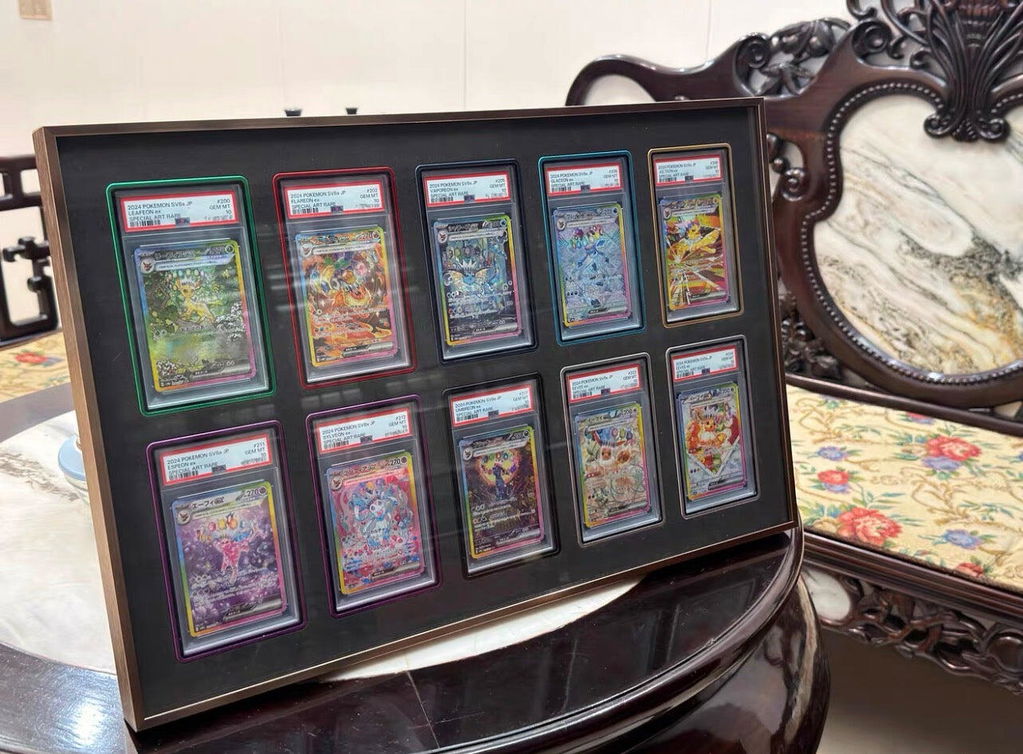
Cards that share similar artwork, colours or visual treatments can work together even when their market values are very different.
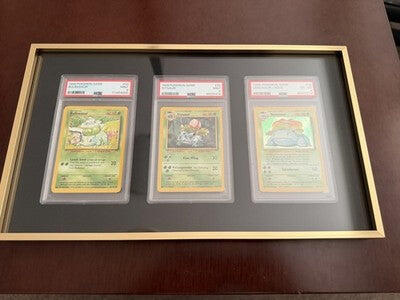
Graded Cards in the Same Holder Format
Using the same slab format creates consistent external dimensions across every card position.
This is particularly useful for purpose-built PSA, CGC or BGS wall displays.
Your Current Collecting Focus
The cards on display do not need to remain there permanently.
A display can represent the part of the collection currently receiving the most attention and change as the collection changes.
How Many Trading Cards Should You Display?
There is no ideal number.
The right capacity depends on the collection, available wall space and whether the collector wants to display one focused group or a much larger set.
1 to 4 Cards
Small displays work well when the objective is to isolate a very specific group or individual card.
6 to 16 Cards
This range provides enough capacity to build a clear group without requiring a particularly large section of wall.
It can suit character collections, small sets, player groups and selected graded cards.
18 to 36 Cards
At this scale, the display begins to represent a substantial section of the collection rather than only a few individual cards.
Layout becomes more important because horizontal and multi-row formations can create very different external proportions.
45 Cards and Above
Large-capacity displays can suit completed groups, extensive graded collections and collectors who specifically want a large section of the collection visible at once.
At these sizes, wall dimensions should be checked carefully before selecting the layout.
Choosing the Right Grid Layout for a Curated Collection
The number of cards is only one part of choosing a display.
The arrangement matters as well.
A 24-card collection arranged 12 across × 2 down creates a very different frame from 24 cards arranged 6 across × 4 down.
The collection itself can help determine which formation makes sense.
A sequence that naturally reads from left to right may suit a wider display.
A collection containing several smaller groups may work better across multiple rows.
Before choosing the frame, establish:
- The exact cards being displayed.
- The holder format.
- The total number of cards.
- The preferred card order.
- The available wall dimensions.
- The Grid formation that best accommodates those requirements.
This is much more reliable than choosing a frame first and trying to force the collection into it afterwards.
Should You Arrange Trading Cards by Value?
You can, but it is rarely the only useful way to arrange a collection.
Market value can determine which cards receive additional protection or security, but it does not necessarily create the strongest visual arrangement.
Other approaches include arranging cards by:
- Set number.
- Release date.
- Character or player.
- Card colour.
- Artwork.
- Rarity.
- Grade.
- Team.
- Era.
- A custom sequence chosen by the collector.
A collection can also combine approaches.
For example, cards might first be grouped by player and then ordered chronologically within each group.
Should Every Card in a Display Have the Same Grade?
No.
A consistent grade can be part of a collecting goal, but it is not a requirement for a coherent display.
A PSA collection containing grades 8, 9 and 10 will still use the same physical slab format where compatible.
What matters visually is often the consistency of the holder dimensions and Grid alignment rather than the number printed on every grading label.
If collecting one specific grade is part of the objective, then matching grades may matter more.
That is a collecting decision rather than a display requirement.
Should You Display Your Most Expensive Trading Cards?
Not automatically.
Value should be considered alongside security, environmental exposure, insurance arrangements and the collector's own risk tolerance.
A valuable card may be better kept elsewhere if displaying it creates unnecessary concern.
At the same time, there is no rule that a display should contain only inexpensive cards.
The decision should be based on the actual card, the holder, the room and the conditions in which it will be displayed.
For wall displays, prolonged direct sunlight should still be avoided even where UV-resistant glazing is used.
Using a Trading Card Display Frame as Part of the Curation Process
A purpose-built trading card display frame can provide a useful physical limit when deciding which cards belong in a particular group.
A 9 Grid display requires nine cards.
An 18 Grid display requires a decision about which 18 cards belong together.
A 36 Grid display creates enough capacity for a much larger collection while still requiring a defined selection.
This can be useful for collectors whose stored collection has become too large to view as one group.
Instead of attempting to display everything, the collector can build individual displays around specific sections of the collection.
For example:
- A PSA display for one Pokémon.
- A BGS display for a sports-card collection.
- A One Touch display for ungraded cards from one set.
- A larger graded display for a completed collection.
- Separate displays for different teams, characters, sets or eras.
The physical frame then reflects the way the collection has already been organised rather than determining what the collector is allowed to collect.
Choosing a Display for PSA, CGC, BGS or One Touch Collections
Once the cards have been selected, holder compatibility comes before colour, layout or frame finish.
The Card Collective® aluminium display range includes purpose-built configurations for supported:
- PSA graded slabs.
- CGC graded slabs.
- BGS / Beckett graded slabs.
- One Touch magnetic card holders.
The card franchise does not determine the physical fit.
The holder does.
A Pokémon card in a PSA slab requires a PSA-compatible display. A sports card in the same supported PSA slab format requires the same physical compatibility.
Once the holder type, capacity and Grid formation have been selected, choices such as aluminium frame colour and Black or White EVA Foam can be used to configure the presentation around the collection.
Black or White EVA Foam for a Curated Trading Card Display
EVA Foam Colour can substantially change the finished appearance of the same card selection.
Black EVA Foam
Black EVA creates a darker internal field around the holders.
This can work well with mixed collections where the cards already contain substantial colour and the collector wants the surrounding insert to remain restrained.
White EVA Foam
White EVA creates a brighter internal field and stronger visual separation between individual holder positions.
This can make the Grid itself more apparent, particularly across larger multi-card displays.
Neither colour changes which cards belong in the collection.
It simply changes how the selected group presents once it is on the wall.
Should Your Frame Colour Match the Cards?
Not necessarily.
Trying to match every card can become impractical as soon as the collection contains varied artwork.
A neutral aluminium finish such as Black, Silver, Titanium or another restrained finish can provide consistency around cards that already contain many colours.
A stronger aluminium colour can instead be used when the collector deliberately wants the outer frame to contribute colour.
The frame can therefore be selected around:
- The cards.
- The wall.
- The surrounding room.
- The EVA Foam Colour.
- Another frame already being displayed nearby.
- A particular colour used throughout the collection.
Literal colour matching is only one option.
Can You Change the Cards in a Curated Display Later?
A curated collection is not permanent.
New cards are released.
Collectors change focus.
A missing card may finally be acquired.
A raw card may be replaced by a graded copy.
A better-condition example may replace an existing one.
One section of a collection may eventually become more important than another.
That means the cards selected for display can change as well.
It is often more useful to think of the display as representing the collection at a particular point in time rather than assuming the same cards must remain there indefinitely.
When Has a Trading Card Collection Become Too Large?
There is no numerical point at which a collection becomes too large.
The more useful question is whether the collector can still manage it.
A collection may need reorganising when:
- You no longer know what you own.
- You repeatedly buy duplicates unintentionally.
- Cards intended for sale become mixed with permanent cards.
- Storage locations are inconsistent.
- Important cards are difficult to find.
- You have stopped working toward any particular collecting goal.
- The amount of bulk makes the main collection difficult to identify.
At that point, the solution does not necessarily need to be selling half the collection.
Separating the collection into defined groups may be enough.
How Often Should You Review a Trading Card Collection?
There is no required schedule.
A review is most useful when the collection has changed significantly.
That might happen after completing a set, buying a large group of cards, changing collecting focus, receiving graded submissions back or simply accumulating enough cards that the existing organisation no longer works.
The objective is not constant optimisation.
If the collection is organised and the collector knows what they are building, there is no need to repeatedly restructure it.
Common Trading Card Collection Curation Mistakes
Buying Cards Because They Are Popular
Popularity can be useful market information, but it does not automatically make a card relevant to your collection.
If a card does not fit any collecting goal and you would not otherwise want it, popularity alone may be a weak reason to add it.
Keeping Every Duplicate Without a Reason
Duplicates can be useful, but allowing them to accumulate indefinitely can make the permanent collection harder to manage.
Grading Everything
Professional grading can be useful, but the cost and purpose should make sense for the individual card and collection.
Displaying Everything
A large collection does not require every card to be visible simultaneously.
Storage and display serve different purposes.
Choosing a Display Before Choosing the Cards
Decide what will actually go into the display first. Then choose the holder-compatible capacity and Grid formation.
Focusing Only on Market Value
A curated collection can contain expensive cards, inexpensive cards or both.
Price is one characteristic of a card, not a requirement for whether it belongs in a collection.
A Simple Process for Curating a Trading Card Collection
If the collection feels difficult to organise, the process can be reduced to a few practical steps.
- Review what you currently own.
- Identify the cards or groups you are actively collecting.
- Separate duplicates, bulk and cards intended for sale or trade.
- Decide which raw cards, graded slabs and protected cards belong in the permanent collection.
- Record important missing cards on a wishlist.
- Organise stored cards so they can be located easily.
- Select a smaller group for display if desired.
- Choose the correct holder-compatible display and Grid capacity for that group.
- Review the collection again when your collecting focus materially changes.
The process does not need to be complicated.
The goal is simply to know what you own, why you own it and which part of the collection you are actively building.
Frequently Asked Questions About Curating a Trading Card Collection
What does it mean to curate a trading card collection?
Curating a trading card collection means deliberately deciding which cards belong in the collection, how they are grouped and which cards should be kept, stored, graded, sold, traded or displayed.
Does a trading card collection need a theme?
No. A collection can contain several different collecting focuses. Themes simply make it easier to organise cards into meaningful groups.
How do I make my trading card collection more organised?
Start by separating the core collection from duplicates, bulk, trade stock and cards intended for sale. Then organise the permanent collection by a system that suits the cards, such as set, character, player, team, era, grade or another collecting goal.
How do I decide which trading cards to keep?
Consider whether the card still fits your collecting goals, completes a set, belongs to a specific group or is something you would still actively choose to own. Cards that no longer fit can be stored separately, traded or sold.
What should I do with duplicate trading cards?
Duplicates can be kept, traded, sold or used to upgrade the condition of an existing copy. If two cards serve exactly the same purpose, keeping the better-condition example is one simple approach.
Should I sell cards that no longer fit my collection?
That depends on whether you still want to own them. Selling cards that no longer fit the collection can release money for other cards, but there is no requirement to sell something simply because your collecting focus has changed.
Should I grade the most valuable cards in my collection?
Not automatically. Consider condition, authentication, grading cost, the intended use of the card and whether professional grading fits the way you collect.
Should every card in my collection be graded?
No. Raw cards, professionally graded slabs and cards in One Touch magnetic holders can all coexist in the same collection.
Can I collect PSA, CGC and BGS slabs together?
Yes. A collection can contain multiple grading companies. When displaying them, remember that different slab formats may require different holder-compatible display configurations.
How many cards should be in a trading card collection?
There is no minimum or maximum. A focused collection of 20 cards can be just as deliberate as a collection containing thousands.
When is a trading card collection too big?
A collection may have become difficult to manage when you no longer know what you own, regularly buy accidental duplicates, cannot find important cards or have difficulty separating the permanent collection from bulk and trade stock.
Should I display my entire trading card collection?
Not necessarily. Many collections are too large for that to be practical. A smaller selected group can be displayed while the remainder stays organised in storage.
How do I choose which trading cards to display?
Select cards that form a useful group. This might be a set, player, character, team, artist, era, grading format or simply the section of the collection you currently want visible.
Should I display my most expensive trading cards?
Not automatically. Consider the card's value alongside security, environmental conditions and your own risk tolerance before deciding where it should be kept.
How many trading cards look good in a display?
There is no universal number. Small displays can isolate one focused group, while larger Grid capacities can present complete sets or substantial graded collections. Available wall space and the physical holder format should also be considered.
Should trading cards be arranged by value?
They can be, but other arrangements may make more sense. Cards can be ordered by set number, release date, character, player, team, artwork, rarity, grade, colour or another system.
Should all cards in a display have the same grade?
No. Matching grades can be part of a collecting objective, but consistent holder dimensions and alignment are usually more relevant to the physical display.
Can PSA and One Touch cards go in the same display frame?
Do not assume so. PSA slabs and One Touch magnetic holders have different physical dimensions and should use displays designed around the relevant holder format.
Can Pokémon and sports cards use the same display frame?
Yes, where the cards use the same supported physical holder format. The franchise does not determine compatibility. The holder does.
Should I organise trading cards by set or character?
Either can work. Choose the system that reflects how you actually collect. A large collection can also use several organisational systems for different groups.
Should I keep low-value cards in my collection?
If you want them, yes. A card does not need a high market value to justify its place in a collection.
Should I only buy cards that fit my collection?
No rule requires this, but having a defined collecting focus can reduce impulse purchases and make it easier to allocate a collecting budget.
Can a curated collection still be large?
Yes. Curation refers to deliberate selection and organisation, not necessarily reducing the number of cards.
Can I have several different collections at once?
Yes. One collector might simultaneously build a Pokémon character collection, a complete set, a sports-card collection and a graded-card collection.
How often should I change the cards in my display?
As often or as rarely as suits the collection. Cards can be changed when new additions arrive, a set is completed or the collector wants to display a different group.
Should my frame colour match my trading cards?
Not necessarily. Neutral aluminium finishes can provide consistency around varied artwork, while stronger colours can be used deliberately when the frame itself is intended to contribute colour.
Is Black or White EVA Foam better for a curated display?
Neither is objectively better. Black creates a darker surrounding field, while White creates a brighter Grid with stronger separation between card positions.
What is the best way to display a graded card collection?
Start with the actual slab format, then choose a compatible display capacity and Grid formation. After compatibility is established, frame finish and EVA Foam Colour can be selected around the collection and room.
Can I build a display around one Pokémon or player?
Yes. A focused character, athlete or team collection is one of the simplest ways to create a defined group for display.
What should I do when my trading card collection gets too big?
Separate the permanent collection from bulk, duplicates and cards intended for sale or trade. Then divide the permanent collection into smaller groups and decide which cards need storage and which, if any, you want to display.
Can displaying cards help organise a collection?
It can help create a defined group because the display has a fixed capacity. The remainder of the collection can then stay organised separately rather than trying to place every card on the wall.
Does a good trading card collection need expensive cards?
No. A collection is defined by what the collector is trying to build, not by a minimum market value.
What makes a trading card collection feel organised?
Clear groupings, consistent storage, a record of important cards and knowing which cards belong to the permanent collection all help. The exact organisational system can vary between collectors.
Final Thoughts: Build the Collection First, Then Decide How to Present It
Curating a trading card collection does not mean reducing everything to a small number of expensive cards.
It means understanding what you are actually collecting.
Some cards may form the core collection.
Others may complete sets or smaller side collections.
Duplicates can become trade stock.
Cards that no longer fit can be sold or stored separately.
Some cards may be worth grading.
Others may remain raw or in One Touch magnetic holders.
And only a portion of the collection may need to be displayed at any one time.
Once that structure exists, choosing a display becomes considerably easier.
You know the holder format.
You know the number of cards.
You know which cards belong together.
You can choose the Grid formation around that group rather than trying to build the collection around a frame afterwards.
For collectors who want that selected group on the wall, The Card Collective® aluminium display range provides holder-specific configurations for supported PSA, CGC, BGS and One Touch collections across small individual displays through to large multi-card Grid layouts.
The rest of the collection can stay exactly where it belongs.
Organised, protected and ready when the displayed selection changes.
Continue Exploring
If you are organising, protecting or displaying a trading card collection, these guides and collections can help with the next step.
📚 Collector Guides
-
How to Choose the Right Trading Card Display Frame Size: The Complete Collector Guide
Compare display capacities and Grid formations after deciding which cards you want to display. -
The Ultimate Trading Card Display Guide: Ideas, Frames, Shelves & Display Solutions for Every Collector
Compare different ways to store and display selected parts of a trading card collection. -
Why Premium Aluminium Trading Card Display Frames Are Worth It: The Complete Collector Guide
Explore the construction and materials used in purpose-built aluminium trading card displays.
🛒 Shop Display Collections
-
Aluminium Trading Card Wall Display Frames
Explore aluminium displays across multiple Grid capacities, layouts, holder formats, frame colours and supported Black or White EVA Foam configurations. -
PSA, CGC & BGS Graded Slab Wall Display Frames
Purpose-built wall displays for supported professionally graded slab formats. -
One Touch Wall Display Frames
Wall display frames designed around compatible One Touch magnetic trading card holders.


0 comments