


How to Document a Trading Card Collection: Photos, Records, Receipts & Grading Details
A trading card collection can become surprisingly difficult to document once it grows beyond a handful of cards.
Cards may be spread across binders, storage boxes, graded slabs, One Touch holders, display frames and grading submissions. Some may have purchase receipts. Others may have been bought years ago, traded with another collector or acquired as part of a larger collection.
Documenting a trading card collection creates a record of what you own and the information associated with it.
That record can be useful for everyday organisation, tracking significant purchases, recording grading information, identifying where cards are stored and keeping photographs of important cards.
It can also complement a collection catalogue. A catalogue tells you what you own. Documentation adds supporting information such as photographs, receipts, certification numbers and other records.
This guide covers practical ways to document a trading card collection without turning the process into a second hobby.
What Does It Mean to Document a Trading Card Collection?
Documenting a collection means keeping useful records relating to the cards you own.
Depending on the collection, this might include:
- Photographs of individual cards.
- Photographs of graded slabs.
- Grading certification numbers.
- Purchase receipts.
- Marketplace order confirmations.
- Purchase dates.
- Purchase prices.
- Card condition notes.
- Serial numbers.
- Autograph information.
- Storage locations.
- Display locations.
- Grading submission records.
- Sale and trade records.
You do not necessarily need all of this information for every card.
The amount of documentation should reflect the collection and what you actually want the records to achieve.
Why Document a Trading Card Collection?
Collectors usually begin documenting their collections for practical reasons.
As the number of cards grows, it becomes harder to remember where every card came from, what was paid for it and where it is currently stored.
Documentation creates a reference point.
Instead of relying entirely on memory, you can check your records.
This becomes particularly useful for:
- Higher-value cards.
- Large collections.
- Graded collections.
- Autographed cards.
- Serial-numbered cards.
- Collections spread across several storage locations.
- Cards regularly bought, sold or traded.
- Collections containing several grading companies or holder formats.
Documentation and Cataloguing Are Not Exactly the Same
Cataloguing and documenting a trading card collection overlap, but they solve slightly different problems.
A catalogue is primarily an inventory.
It might tell you:
- Card name.
- Set.
- Card number.
- Grade.
- Storage location.
- Collection status.
Documentation can support those entries with additional evidence and information.
For example, a catalogue entry might say that you own a particular PSA 10 card.
The supporting documentation could contain:
- A photograph of the slab.
- The PSA certification number.
- The purchase receipt.
- The purchase date.
- The original marketplace order.
The two systems can therefore work together.
Do You Need to Document Every Trading Card?
No.
Trying to photograph and document every inexpensive common card in a collection of thousands may create an enormous amount of work without providing much practical benefit.
A better approach is often to document cards according to importance.
Individual Documentation
This may make sense for:
- Higher-value cards.
- Graded cards.
- Rare cards.
- Autographs.
- Serial-numbered cards.
- Important vintage cards.
- Significant personal collection pieces.
Group Documentation
Less significant cards can often be documented as groups.
For example:
- Complete set stored in Binder 1.
- Approximately 1,000 Pokémon bulk cards in Storage Box 3.
- Duplicate sports cards in Trade Box A.
- Modern set bulk stored in labelled card boxes.
This provides useful information without requiring an individual record for every card.
Start With the Most Important Cards
If you already have a large collection, do not try to document everything in one session.
Start with the cards where documentation provides the greatest benefit.
A practical order might be:
- Higher-value graded cards.
- Higher-value raw cards.
- Autographs and serial-numbered cards.
- Cards currently away for grading.
- Cards currently displayed.
- Complete or important sets.
- Lower-value collection groups.
- Bulk only where useful.
This creates a useful record quickly without requiring weeks of data entry and photography.
How to Photograph Trading Cards for Your Records
Collection photographs do not need to look like professional product photography.
The objective is usually identification and documentation.
A clear photograph should make it possible to recognise the card and any important characteristics.
For significant cards, consider photographing:
- The front of the card.
- The back of the card.
- The grading label where applicable.
- The certification number.
- Serial numbering.
- Autographs.
- Condition details worth recording.
Use consistent lighting where possible and avoid reflections that make important information difficult to read.
Should You Photograph the Front and Back of Every Card?
Not necessarily.
For inexpensive collection cards, a front photograph may be enough or photography may not be necessary at all.
For more significant raw cards, front and back photographs can provide a more complete record of the card's condition at a particular point in time.
This can be useful if the card is later:
- Sent for grading.
- Sold.
- Traded.
- Moved into a different holder.
- Compared with another copy.
How to Photograph Graded Cards
Graded cards already contain useful identification information on the grading label.
A clear photograph of the front of the slab can therefore record several details at once.
Depending on the grading company, the label may show:
- Card identification.
- Set information.
- Card number.
- Grade.
- Certification number.
For particularly important slabs, photographing the reverse can provide an additional record of the holder and card.
Record Grading Certification Numbers
Certification numbers are particularly useful when documenting graded collections.
Two collectors may own the same card in the same grade, but the certification number identifies the individual graded example.
A graded-card record can therefore include:
- Card name.
- Set.
- Card number.
- Grading company.
- Grade.
- Certification number.
- Purchase price.
- Purchase date.
- Current storage or display location.
This becomes especially useful in larger PSA, CGC or BGS collections containing multiple examples of similar cards.
How to Document PSA Graded Cards
For PSA slabs, record the underlying card details alongside the grade and certification number.
You may also want a clear photograph of the slab label and card.
If your PSA collection is spread across storage boxes and displays, add a physical location field so the individual slab can be found quickly.
For example:
Location: PSA Display 02, Position 7
or:
Location: Graded Storage Box B
How to Document CGC Graded Cards
CGC cards can be documented using the same basic structure.
Record:
- Card information.
- CGC grade.
- Certification information.
- Purchase information where available.
- Photographs.
- Physical location.
Keeping grading company as its own field also allows a larger mixed collection to be filtered by holder format.
How to Document BGS Graded Cards
BGS slabs should likewise have their grading information recorded separately from the basic card details.
If the slab contains additional grading information such as subgrades, you can choose whether those details are useful enough to include in your records.
The objective is not to record every possible piece of information.
Record what you expect to use later.
How to Document Raw Trading Cards
Raw cards do not have the structured label information found on graded slabs.
That means your own documentation may need to contain more identifying information.
Useful fields can include:
- Card name.
- Set.
- Card number.
- Year.
- Language.
- Parallel or variation.
- Estimated condition.
- Current holder.
- Purchase information.
- Storage location.
For cards with multiple similar versions, accurate set and variation information becomes particularly important.
How to Document Cards in One Touch Holders
A card stored in a One Touch magnetic holder is still a raw card, but recording the holder type can be useful.
This is particularly relevant if you organise or display cards according to physical holder format.
A record might show:
Holder: One Touch Magnetic Holder
Location: One Touch Display 01
This makes it easy to identify cards that are already prepared for a particular storage or display system.
Should You Keep Trading Card Receipts?
For significant purchases, keeping the receipt or order confirmation can be useful.
It creates a record of:
- Where the card was purchased.
- When it was purchased.
- What was paid.
- Which specific item was purchased.
For inexpensive cards, keeping every receipt may be unnecessary.
For higher-value purchases, the information becomes considerably more useful.
What Counts as a Purchase Record?
A purchase record does not necessarily need to be a traditional paper receipt.
Depending on how the card was purchased, useful records might include:
- Retail receipts.
- Online marketplace order confirmations.
- Invoices.
- Email confirmations.
- Payment records.
- Auction results.
- Dealer receipts.
Where possible, keep enough information to connect the record to the actual card.
How to Store Digital Trading Card Receipts
Digital records can quickly become difficult to find if they remain scattered across email accounts, marketplace histories and download folders.
A simple folder structure can make them easier to manage.
For example:
- Trading Card Collection
- Purchase Records
- 2025
- 2026
- Grading Records
- Card Photographs
You could also organise documents by collection type, player, character or grading company.
The best system is whichever one you will continue using.
Use Consistent File Names
Hundreds of photographs named IMG_4821, IMG_4822 and IMG_4823 are not particularly useful several years later.
Consider a consistent naming structure.
For example:
Pokemon-Charizard-Set-CardNumber-PSA10-CertNumber.jpg
or:
Player-Year-Set-CardNumber-BGS9.5.jpg
The exact structure is less important than consistency.
A searchable filename can make finding a particular image much faster.
Document Purchase Price Separately From Current Value
Purchase price and current estimated value are different pieces of information.
Purchase price records what actually happened.
Estimated value is an opinion based on current market information and can change.
Keeping them in separate fields avoids confusion.
For example:
- Purchase Price: $180
- Purchase Date: March 2026
- Estimated Current Value: $240
The first two are historical records.
The third may need to be reviewed periodically.
Do You Need to Track Current Trading Card Values?
No.
If your purpose is simply to document ownership and organise the collection, current value may not be necessary.
Constantly updating market values across hundreds or thousands of cards can become time-consuming.
Some collectors only track current estimates for their most significant cards.
Others update values when they are considering selling, trading or reviewing the collection.
Document Cards Before Sending Them for Grading
Before sending significant raw cards to a grading company, it can be useful to photograph and record them.
This creates a record of the card before it leaves your possession.
You might record:
- Front photograph.
- Back photograph.
- Card details.
- Estimated condition.
- Date submitted.
- Grading company.
- Submission number.
When the card returns, the record can then be updated with the final grade and certification number.
How to Document a Grading Submission
If you regularly submit cards for grading, create a separate grading status within your collection records.
Possible statuses include:
- Considering Grading.
- Preparing Submission.
- Submitted.
- At Grading Company.
- Grades Available.
- Returned.
This prevents cards that are temporarily outside your physical collection from becoming difficult to track.
Document Autographed Trading Cards
Autographed cards can benefit from additional documentation.
Depending on the card, you may want to retain:
- Purchase information.
- Authentication information.
- Certification numbers.
- Clear photographs of the autograph.
- Any supporting documentation supplied with the card.
Keep original supporting documentation rather than relying only on your own notes.
Document Serial-Numbered Cards
Serial-numbered cards are particularly easy to identify individually.
Record the exact numbering shown on the card.
For example:
Serial Number: 17/99
For valuable numbered cards, a photograph showing the serial number can also be useful.
This distinguishes your specific copy from other examples of the same card.
How to Document a Large Pokémon Card Collection
Large Pokémon collections can contain several different types of material at once.
For example:
- Complete sets.
- Character collections.
- Graded slabs.
- Vintage cards.
- Modern singles.
- Promotional cards.
- Sealed products.
- Bulk.
Do not assume every category needs the same level of documentation.
Important graded cards might be documented individually, while a complete binder can be documented as a collection group.
This keeps the workload proportional to the importance of the material.
How to Document a Sports Card Collection
Sports collections may require additional fields because the same player can appear across many manufacturers, years, teams and parallels.
Useful information can include:
- Player.
- Sport.
- Team.
- Year.
- Manufacturer.
- Set.
- Parallel.
- Serial number.
- Rookie status.
- Autograph information.
- Grading information.
Photographs can be particularly useful for parallels that are difficult to distinguish by name alone.
How to Document MTG, Yu-Gi-Oh!, One Piece and Other TCG Collections
Different trading card games may require slightly different information.
Useful fields can include:
- Set.
- Card number.
- Language.
- Rarity.
- Printing.
- Edition.
- Condition.
- Grading information.
The documentation system should adapt to the collection rather than forcing every trading card into exactly the same structure.
Document Where Your Cards Are Stored
One of the simplest pieces of information can also be one of the most useful.
Record where the card actually is.
For example:
- Binder 01.
- Binder 04.
- PSA Storage Box A.
- BGS Storage Box 02.
- Trade Box.
- Display Frame 01.
- Display Frame 04.
This becomes increasingly useful when a collection is spread across multiple storage and display systems.
Document Cards That Are on Display
A displayed card is still part of your collection inventory.
Instead of removing it from your records, change its location.
For example:
Status: Displayed
Location: 18 Grid PSA Display, Position 12
This can be useful if you have several wall displays or regularly rotate the cards inside them.
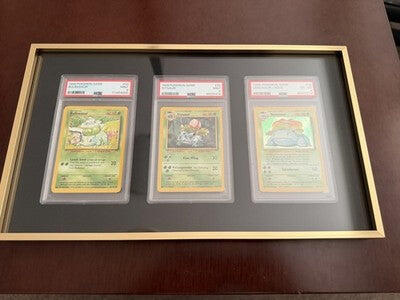
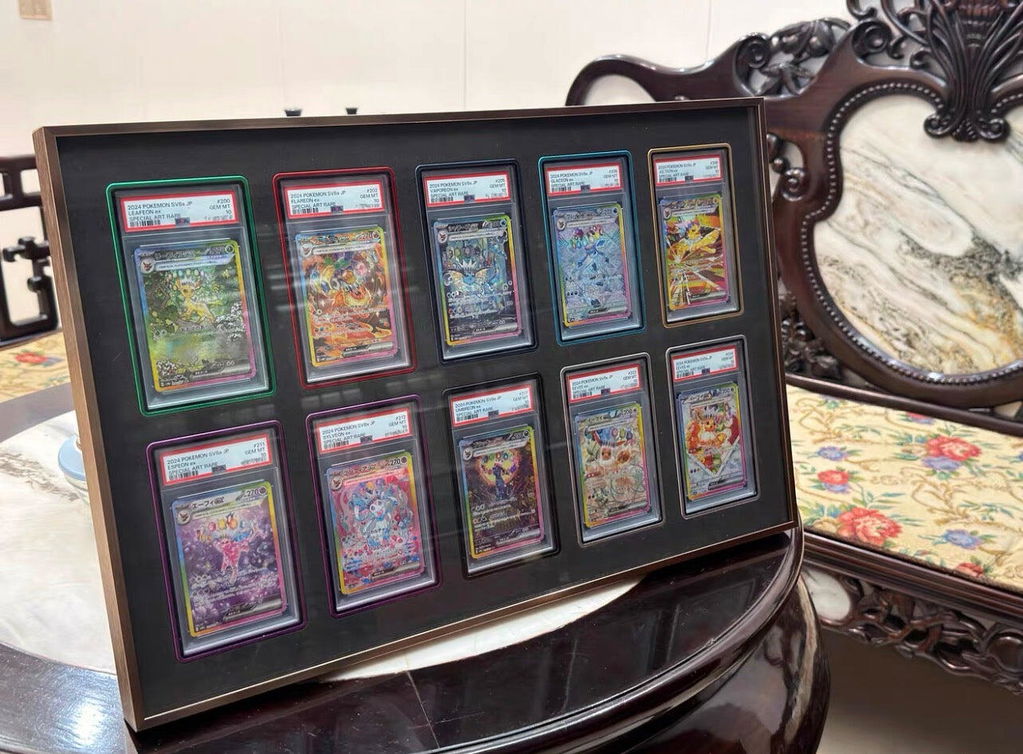
Photograph Complete Trading Card Displays
Individual card photographs are useful, but photographs of complete display groups can provide another type of record.
If you have arranged a set, player collection or character collection in a particular grid, take a photograph of the finished arrangement.
This can help you recreate the same layout later if the cards are temporarily removed or rotated.
It can also provide a quick visual reference for which cards were displayed together.
How Documentation Can Help Plan a Display
Once a collection is documented, it becomes easier to identify groups that could work together visually.
You can review your records by:
- Character.
- Player.
- Set.
- Grade.
- Grading company.
- Holder type.
- Year.
- Team.
A documented collection might reveal that you already own nine PSA slabs from one set, eighteen cards from one player or a complete group of One Touch-protected cards.
Those groups can then be considered for display.
Match the Display to the Holder Format
Once you have identified the cards you want to display, confirm their physical holder format.
PSA, CGC, BGS and One Touch holders are not all physically identical.
A display designed around one holder format should not automatically be assumed to fit another.
This is particularly important for larger grid displays because small dimensional differences repeat across every card position.
The Card Collective® aluminium trading card display range includes dedicated configurations for supported PSA, CGC, BGS and One Touch formats across multiple grid capacities.
Documenting a Collection Before Moving House
Moving is one situation where having current collection records becomes particularly useful.
Before packing significant cards, consider updating:
- Photographs.
- Storage locations.
- Box numbers.
- Grading certification details.
- High-priority card records.
As boxes are packed, their location can be updated in the catalogue.
For example:
Location: Moving Box TC-03
This makes unpacking and checking the collection considerably easier.
Documenting Cards Before Selling or Trading
Before selling or trading an important card, make sure your records accurately identify the card being transferred.
For graded cards, this can include the certification number.
For raw cards, current front and back photographs can provide a record of the card's condition before it leaves your possession.
Once the transaction is complete, update the collection status rather than leaving the card recorded as something you still own.
Should You Keep Records of Cards You Have Sold?
You can.
Instead of deleting sold cards entirely, some collectors change the status to Sold and retain:
- Original purchase price.
- Sale price.
- Purchase date.
- Sale date.
- Certification number.
This creates a historical record of how the collection has changed over time.
Other collectors prefer to remove sold cards from the active collection entirely.
Either approach can work.
Backing Up Your Trading Card Collection Records
If your collection records matter to you, avoid keeping the only copy on one device.
A failed computer or lost phone should not destroy years of documentation.
Depending on your preferred system, backups could include:
- Cloud storage.
- An external drive.
- A second computer.
- Exported copies of collection databases.
Photographs and purchase documents should be included in the backup where appropriate.
How Often Should You Update Collection Documentation?
You do not need to repeatedly rebuild the entire record.
Update it when something meaningful changes.
For example:
- A significant new card is purchased.
- A card is sold.
- A card is traded.
- A raw card is graded.
- A card moves into or out of a display.
- A card changes storage location.
- A new grading submission is sent.
Small updates made at the time of the change are much easier than trying to reconstruct everything months later.
Common Trading Card Documentation Mistakes
Trying to Record Everything
Documenting thousands of low-value cards individually can make the system so time-consuming that you stop using it.
Taking Photographs Without Useful File Names
A folder containing thousands of randomly numbered images becomes difficult to search.
Not Recording Physical Location
Knowing you own a card is less useful if you cannot remember which binder or box contains it.
Mixing Purchase Price With Estimated Value
Keep historical transaction information separate from changing market estimates.
Not Updating Sold Cards
A collection record should reflect what you currently own.
Keeping Only One Copy of Important Records
Back up documentation that would be difficult to recreate.
A Simple Trading Card Documentation System
If you want to keep the process straightforward, start with a small number of fields.
For individually documented cards:
- Card.
- Set and card number.
- Raw or holder type.
- Grade and certification number where applicable.
- Purchase date.
- Purchase price.
- Current location.
- Status.
- Photograph.
That is enough to create a useful record for most collections.
Additional information can always be added later.
Frequently Asked Questions About Documenting Trading Card Collections
How should I document my trading card collection?
Create a simple inventory and add supporting information such as photographs, grading certification numbers, purchase records and storage locations where useful.
Do I need to photograph every trading card I own?
No. Many collectors photograph only significant, valuable, graded or condition-sensitive cards while documenting inexpensive bulk as larger groups.
Should I photograph the front and back of trading cards?
For significant raw cards, photographing both sides can provide a more complete record of condition. For inexpensive cards, this may not be necessary.
Should I photograph graded cards?
It can be useful. A clear photograph can document the card, grading label, grade and certification number in a single image.
Should I record PSA certification numbers?
Yes, particularly for important graded cards. The certification number identifies the individual graded example.
Should I record CGC certification numbers?
Recording certification information can make individual CGC slabs easier to identify within a larger collection.
Should I record BGS certification information?
Yes where useful, particularly for higher-value or individually tracked BGS slabs.
Should I keep receipts for trading cards?
Keeping receipts or order confirmations can be useful for significant purchases because they record where and when the card was purchased and what was paid.
Do I need to keep receipts for inexpensive cards?
Not necessarily. The amount of documentation should be proportionate to the usefulness of the information.
What counts as proof of buying a trading card?
Purchase documentation might include a receipt, invoice, marketplace order confirmation, auction record, dealer receipt or other transaction record.
Should I record what I paid for my trading cards?
For significant cards, purchase price is a useful historical record and does not require the constant updating associated with estimated market values.
Should I track the current value of my trading cards?
You can, but it is optional. Some collectors track current estimates only for significant cards rather than trying to maintain live values across an entire collection.
How do I document cards before grading?
Record the card details and take clear front and back photographs before submission. You can then add the submission information, final grade and certification number later.
How do I track cards currently at PSA or another grading company?
Use a status such as At Grading and record the grading company, submission date and submission information until the card returns.
How should I document autographed trading cards?
Keep clear photographs, purchase information and any original authentication or certification documentation supplied with the card.
How should I document serial-numbered cards?
Record the exact serial number and consider keeping a photograph clearly showing the numbering.
How do I document a large Pokémon card collection?
Document important cards individually while recording lower-priority cards, sets and bulk as larger groups. This keeps the system manageable.
How do I document a sports card collection?
Useful fields can include player, team, year, manufacturer, set, parallel, serial number, autograph information, grade and storage location.
How do I document where my cards are stored?
Give each binder, storage box and display a simple name or number and record that location against the relevant card or collection group.
Should cards on display remain in my collection inventory?
Yes. Change their location to the relevant display rather than removing them from your records.
How do I document a trading card display?
You can photograph the complete display and record which cards occupy each position. This is particularly useful if you regularly rotate the collection.
Can documenting my collection help me decide what to display?
Yes. Filtering records by set, player, character, grade or holder format can reveal groups of cards that naturally work together in a display.
Should I document my collection before moving house?
Updating photographs, box locations and important card records before packing can make the collection easier to account for and organise during the move.
Should I photograph a card before selling it?
For significant cards, current photographs can provide a useful record of the exact card and its condition before it leaves your possession.
Should I delete sold cards from my collection records?
You can either remove them or change their status to Sold if you want to retain a historical record of the collection.
How should I back up my trading card collection records?
Keep another copy somewhere separate from the primary device, such as cloud storage, an external drive or an exported backup of the collection database.
How often should I update my trading card records?
Update them when meaningful changes occur, such as purchases, sales, grading submissions or changes in storage and display location.
What is the easiest way to start documenting a large collection?
Begin with graded and higher-value cards. Once those are documented, work through important sets and other collection groups gradually.
Is documenting a trading card collection worth the effort?
For larger or more significant collections, even a basic record can make organisation, grading, storage, selling and display considerably easier.
Final Thoughts
Documenting a trading card collection does not need to mean creating a complicated database containing every detail about every card.
The purpose is to create useful records.
For one collector, that might mean photographing every graded slab and recording certification numbers.
For another, it might mean keeping purchase receipts for significant cards and recording which binder contains each set.
A large collection might combine both approaches.
Start with the cards that matter most.
Record enough information to identify them.
Keep useful purchase and grading records.
Photograph important cards.
Record where they are stored.
Update the documentation when something meaningful changes.
Over time, those records make it considerably easier to understand the collection as a whole.
They can also reveal groups within the collection that are suitable for display.
Once a group has been selected, the physical holder format and number of cards can determine the appropriate display configuration.
The Card Collective® aluminium trading card display range includes dedicated configurations for supported PSA, CGC, BGS and One Touch holders across multiple grid capacities, while custom display enquiries can accommodate collections that do not suit an existing configuration.
Continue Exploring
If you are planning a premium trading card wall display, these guides and collections can help with the next step.
📚 Collector Guides
-
How to Choose the Right Trading Card Display Frame Size: The Complete Collector Guide
Compare display capacities and Grid layouts before choosing the colour configuration for your collection. -
Why Premium Aluminium Trading Card Display Frames Are Worth It: The Complete Collector Guide
Explore aluminium construction, display design and the role of premium materials in a purpose-built trading card wall display. -
The Ultimate Trading Card Display Guide: Ideas, Frames, Shelves & Display Solutions for Every Collector
Compare wall frames, stands, shelves, cabinets and other ways to display trading cards across different budgets and collection types.
🛒 Shop Display Collections
-
Aluminium Trading Card Wall Display Frames
Premium aluminium trading card display frames with multiple Grid layouts, holder-specific configurations, aluminium Frame Colours and supported Black or White EVA Foam options. -
PSA, CGC & BGS Graded Slab Wall Display Frames
Purpose-built graded card display frames for compatible PSA, CGC and BGS slab configurations. -
One Touch Wall Display Frames
Premium wall display frames designed around compatible One Touch magnetic trading card holders.


0 comments