


How to Organise a Graded Card Collection: PSA, CGC & BGS Slabs
A graded card collection can become difficult to organise much faster than a raw card collection.
Slabs take up considerably more physical space than individual cards, different grading companies use different holder formats, and a collection can quickly spread across storage boxes, shelves, cabinets and wall displays.
What begins as five or ten graded cards can eventually become fifty, one hundred or several hundred slabs.
At that point, simply remembering where everything is becomes increasingly difficult.
A good organisation system should make it easy to answer three basic questions:
- Which graded cards do I own?
- Where is each slab located?
- Which part of the collection does each card belong to?
This guide covers practical ways to organise PSA, CGC and BGS graded cards, including sorting, cataloguing, storage, certification tracking, display planning and managing larger slab collections.
Why Graded Card Collections Need Their Own Organisation System
Graded cards create different organisational challenges from raw cards.
A raw collection might contain hundreds of cards inside a relatively small number of binders or storage boxes.
The same number of graded cards requires substantially more physical space.
You also need to account for information associated with the slab itself, including:
- Grading company.
- Grade.
- Certification number.
- Holder format.
- Storage location.
- Display location.
As the collection grows, these details become increasingly useful.
Start With an Inventory of Your Graded Cards
Before reorganising the physical slabs, work out what you actually own.
Your inventory does not need to be complicated.
A basic graded-card catalogue might contain:
- Card name.
- Set.
- Card number.
- Year.
- Grading company.
- Grade.
- Certification number.
- Purchase price.
- Purchase date.
- Storage or display location.
Additional fields can be added if they are genuinely useful to your collection.
Record the Grading Company Separately
Do not rely on the grade alone to identify a slab.
A PSA 10, CGC 10 and BGS 10 are different graded products housed in different holders.
Keeping grading company as its own field allows you to filter the collection by:
- PSA.
- CGC.
- BGS.
- Other grading companies.
This becomes particularly useful if the physical collection is also organised according to slab format.
Record Certification Numbers
A certification number identifies an individual graded example rather than simply the card and grade.
For important slabs, record the certification number alongside the card information.
This is especially useful when you own:
- Multiple copies of the same card.
- Multiple copies in the same grade.
- Large graded sets.
- Cards regularly moved between storage and display.
A photograph of the slab label can also provide a useful visual record.
Choose How You Want to Sort Your Graded Cards
There is no single correct way to organise slabs.
The best system depends on how you think about your collection.
Common sorting methods include:
- Grading company.
- Set.
- Player.
- Pokémon or character.
- Year.
- Sport.
- Team.
- Grade.
- Value.
- Card number.
- Collection priority.
- Displayed versus stored.
You can also combine several methods.
Organising Graded Cards by Grading Company
Separating PSA, CGC and BGS slabs is one of the simplest physical organisation methods.
It has a practical advantage because the holders are not all identical in size.
You might therefore have:
- PSA Storage Box 1.
- PSA Storage Box 2.
- CGC Storage Box 1.
- BGS Storage Box 1.
Within each box, the cards can then be organised using another category such as set, player or year.
Organising PSA Slabs
A large PSA collection can be divided in several ways.
For example:
- By Pokémon set.
- By character.
- By sports player.
- By team.
- By year.
- By card number.
- By collection priority.
If you own a large number of PSA slabs, give each physical storage location its own identifier.
For example:
PSA-01
PSA-02
PSA-03
Your catalogue can then identify the exact storage box containing each card.
Organising CGC Slabs
CGC collections can use the same general structure.
Keep the grading company recorded in the catalogue and use clearly identified physical storage locations.
For example:
CGC-01: Pokémon Vintage
CGC-02: Pokémon Modern
If the collection is small, a single CGC storage location may be sufficient.
The system only needs to become more detailed as the collection requires it.
Organising BGS Slabs
BGS slabs should be organised around their own physical holder dimensions rather than assumed to fit storage designed tightly around another grading company's slabs.
Within the BGS collection, you can then sort according to:
- Set.
- Player.
- Sport.
- Year.
- Grade.
- Collection group.
If subgrades are important to the way you collect, they can also be recorded in your catalogue.
Should You Mix PSA, CGC and BGS Slabs Together?
You can.
There is no collecting rule that says different grading companies need to remain separate.
A collection built around one player, character or set may make more sense grouped together regardless of grading company.
However, mixed slab formats can create practical differences when choosing tightly fitted storage or display systems.
If you mix grading companies, make sure the physical storage method accommodates the actual holders being used.
Organising Graded Cards by Set
Set-based organisation works particularly well for collectors working toward graded sets.
Cards can be arranged according to their position within the set.
This makes missing cards immediately obvious and provides a clear completion target.
Your catalogue can include a status such as:
- Owned.
- Wanted.
- Upgrade Wanted.
- At Grading.
- Not Yet Acquired.
This turns the catalogue into both an inventory and a collecting checklist.
Organising Pokémon Graded Cards by Character
Character-based organisation works well when the collection focuses on particular Pokémon rather than complete sets.
For example, separate collection groups could be created for:
- Charizard.
- Pikachu.
- Gengar.
- Eeveelutions.
- Legendary Pokémon.
- Favourite artwork groups.
Each group can then be sorted by year, set, grade or personal preference.
This approach also creates natural groups for display.
Organising Sports Card Slabs by Player
Player-based organisation is one of the most practical systems for sports collectors.
A player collection can then be divided by:
- Year.
- Rookie cards.
- Manufacturer.
- Set.
- Parallel.
- Autographs.
- Serial-numbered cards.
- Grade.
For larger player collections, your catalogue can provide much more detail than the physical storage labels need to show.
Organising Sports Cards by Team
Team collecting creates another useful structure.
You might keep all graded cards from one team together and then arrange them chronologically or by player.
This works particularly well for collections built across several generations of players.
It can also create a clear theme if selected cards are later moved into a wall display.
Should You Organise Slabs by Grade?
Some collectors separate cards according to grade.
For example:
- PSA 10.
- PSA 9.
- PSA 8 and below.
This can work if grade is central to the collection.
However, for a set, character or player collection, sorting purely by grade can separate cards that otherwise belong together.
Use grade as the primary organisation method only if it reflects how you actually think about the collection.
Should You Organise Graded Cards by Value?
Value can be useful as a secondary classification, particularly for identifying higher-priority cards.
However, market values change.
That makes value less stable than categories such as player, set or card number.
You might instead use broad categories such as:
- Core Collection.
- Higher Priority.
- Standard Collection.
- Trade or Sell.
This can provide similar practical benefits without constantly reorganising the physical collection when prices change.
Give Every Storage Location a Name
A catalogue becomes considerably more useful when it tells you where the card physically is.
Create simple storage identifiers.
For example:
- PSA-01.
- PSA-02.
- CGC-01.
- BGS-01.
- Display-01.
- Display-02.
You can make these as detailed as necessary.
A very large collection might even record positions within individual boxes.
Do Not Create an Organisation System That Is Too Complicated
An organisation system is only useful if you continue using it.
If adding one new card requires updating ten different records, the system may eventually be abandoned.
Start with the information you genuinely need.
For many collectors, this is enough:
- Card.
- Set.
- Grading company.
- Grade.
- Certification number.
- Location.
Everything else can be added when useful.
Use a Spreadsheet for a Large Graded Collection
A spreadsheet can work well because it allows cards to be filtered and sorted without changing their physical location.
For example, your slabs might physically be organised by grading company while the spreadsheet can instantly show:
- Every Charizard.
- Every PSA 10.
- Every rookie card.
- Every card from one set.
- Every card currently displayed.
- Every card marked for sale.
This means the physical organisation does not need to solve every possible sorting problem.
Physical Organisation and Digital Organisation Can Be Different
This is an important distinction.
Your physical storage system should make cards easy to store and retrieve.
Your digital catalogue can provide the more complicated relationships between them.
For example, all PSA slabs might be stored together physically.
But your catalogue could still group those cards digitally by:
- Set.
- Character.
- Player.
- Year.
- Value.
- Display group.
You do not need to physically rearrange hundreds of slabs every time you want to look at the collection differently.
Photograph Important Graded Cards
For significant slabs, keep a clear photograph alongside the catalogue record.
A front photograph can capture:
- The card.
- Grading company.
- Grade.
- Certification information.
You may also photograph the reverse for particularly important cards.
This creates a visual record without requiring you to physically locate the slab every time you want to reference it.
Track Cards That Are Away for Grading
A card does not disappear from the collection simply because it is currently at a grading company.
Use a status such as:
- Preparing for Grading.
- Submitted.
- At PSA.
- At CGC.
- At BGS.
- Grades Available.
- Returned.
When the card returns, update the record with its final grade, certification number and physical storage location.
Track Grade Upgrades
Some collectors replace an existing slab with a higher-grade example.
If you upgrade from a PSA 9 to a PSA 10, decide what will happen to the original card.
It might be:
- Kept.
- Sold.
- Traded.
- Moved into a secondary collection.
Updating the catalogue at the time of the change prevents both slabs from accidentally remaining recorded as part of the primary collection.
Manage Duplicate Graded Cards
Duplicates can accumulate even in slab collections.
You might own:
- Two grades of the same card.
- Multiple copies submitted together.
- Different grading-company versions.
- Duplicates acquired through larger purchases.
Decide whether each duplicate has a purpose.
If it does not, mark it clearly as available for sale or trade rather than letting duplicate slabs consume storage indefinitely.
Create a Sell or Trade Section
Keeping cards you intend to sell mixed throughout the permanent collection can create confusion.
A separate physical or digital category makes the distinction clear.
For example:
- Core Collection.
- Display Collection.
- Upgrade Candidates.
- Sell.
- Trade.
This also makes periodic collection curation easier.
How to Store a Large Graded Card Collection
Large slab collections require more physical space than many collectors initially expect.
Suitable storage will depend on the size of the collection and how frequently you access it.
Options can include:
- Dedicated slab boxes.
- Drawers.
- Cabinets.
- Shelving.
- Protective cases.
- Display frames for selected cards.
Whatever system you use, avoid packing slabs so tightly that retrieving one card becomes difficult or risks damaging adjacent holders.
Protect the Slab as Well as the Card
A graded holder protects the card, but the slab itself can still become scratched or damaged.
Some collectors use protective slab sleeves or bags for this reason.
Even when sleeves are used, the physical storage system should prevent slabs from repeatedly rubbing or colliding with one another.
Keep Storage Areas Practical
Do not focus only on fitting the maximum number of slabs into the smallest possible area.
You also need to retrieve and return cards.
A useful storage system should allow you to:
- Find a particular card.
- Remove it without disturbing dozens of others.
- Add new cards.
- Reorganise sections when necessary.
- Identify which box or cabinet contains each group.
Leave Room for the Collection to Grow
If you are actively collecting, completely filling every storage box creates another problem as soon as the next slab arrives.
Leaving some expansion space can make the system easier to maintain.
You might deliberately leave capacity within:
- Each set.
- Each player group.
- Each character group.
- Each grading-company section.
This reduces the need to reorganise the entire collection every time something new is added.
How to Organise 100 Graded Cards
At around 100 slabs, a basic structure becomes increasingly useful.
For example:
- Catalogue every slab.
- Record grading company and certification number.
- Separate major collection groups.
- Number physical storage locations.
- Identify cards currently displayed.
- Create a separate sell or trade category.
You do not need an elaborate database.
You simply need enough organisation that every slab can be found.
How to Organise 500 or More Graded Cards
At several hundred slabs, relying on memory becomes increasingly impractical.
A larger collection benefits from:
- A searchable digital catalogue.
- Consistent storage identifiers.
- Clear collection categories.
- Certification tracking.
- Separate sale and trade inventory.
- Defined display groups.
The physical collection and digital inventory should work together.
If your catalogue says a card is in PSA-07, you should be able to go directly to that location and find it.
How to Organise 1,000 Graded Cards
A collection of 1,000 graded cards is no longer something most collectors can efficiently manage through memory alone.
At that scale, treat the collection more like a structured inventory.
That does not mean removing the enjoyment from collecting.
It simply means creating enough structure that the size of the collection does not become a problem.
Consider:
- Unique storage-location codes.
- Searchable card records.
- Consistent naming.
- Grading-company fields.
- Certification numbers.
- Collection categories.
- Purchase records for significant cards.
- Display locations.
- Sell and trade statuses.
Separate Stored Cards From Displayed Cards
Displaying a slab should not remove it from your collection records.
Instead, change its location.
For example:
Status: Displayed
Location: PSA Display 03, Position 8
This becomes especially useful when several displays are used around a room.
How to Choose Which Graded Cards to Display
You do not need to display the most valuable cards simply because they are valuable.
A display works best when the cards make sense together.
Possible display groups include:
- One Pokémon.
- One player.
- One set.
- Rookie cards.
- Autographs.
- A particular year.
- Favourite artwork.
- A complete graded subset.
- Personal favourites.
Your catalogue can help identify these groups without physically sorting through every storage box.
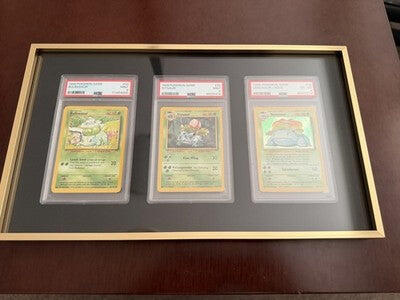
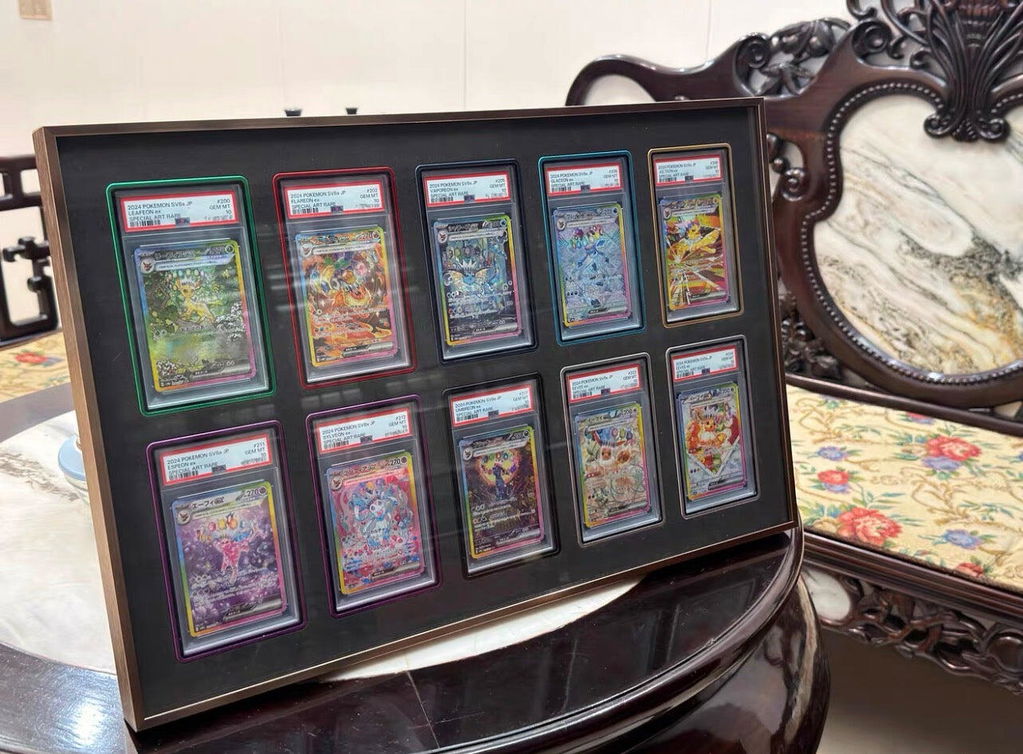
Plan a Graded Card Display by Card Count
Once you have selected a display group, count the cards.
A group of nine cards might suit a 3 × 3 arrangement.
Eighteen cards could suit several possible grid orientations.
A much larger graded collection might be divided across multiple displays or arranged into one large-format configuration.
The correct layout depends on:
- Number of cards.
- Holder format.
- Available wall space.
- Preferred orientation.
- How the cards relate visually.
PSA, CGC and BGS Holder Dimensions Matter for Display
Graded holders are not universally interchangeable.
PSA, CGC and BGS slabs have different physical dimensions.
This matters when a display uses precision-cut openings designed around the holder.
A fitted BGS configuration should not automatically be assumed to fit PSA, and the reverse is also true.
The larger the grid, the more important accurate holder dimensions become because the spacing repeats across the entire display.
Dedicated Graded Card Display Configurations
The Card Collective® aluminium trading card display range uses dedicated configurations for supported graded holder formats rather than treating every slab as identical.
Configurations are available across multiple card capacities for supported:
- PSA slabs.
- CGC slabs.
- BGS slabs.
- One Touch holders.
This allows the internal layout to be designed around the physical holder format being displayed.
Use Display Groups Inside a Much Larger Collection
You do not need a display large enough for every graded card you own.
A collector with 500 slabs might choose only nine, eighteen, thirty-six or another selected group for the wall.
The remainder can stay organised in storage.
This creates two layers within the collection:
Stored Collection
and
Displayed Collection
The cards can move between those groups whenever you want to change the display.
Rotate Graded Cards on Display
Rotation can make a large collection easier to enjoy without requiring enormous amounts of wall space.
You might rotate according to:
- Set.
- Season.
- Player.
- Character.
- New acquisitions.
- Favourite artwork.
If the catalogue records display positions, updating the arrangement becomes considerably easier.
Organising a Mixed Raw and Graded Collection
Many collections contain both raw and graded cards.
Do not force them into the same physical storage system.
Instead, the catalogue can connect them digitally.
For example, a Charizard collection might contain:
- Raw cards in Binder 03.
- PSA slabs in PSA-02.
- BGS slabs in BGS-01.
- Nine favourite slabs in Display-01.
They remain one collection even though they occupy several physical locations.
Organising Graded Cards When Moving House
A move is much easier when every slab already has a documented location.
Before packing, temporarily replace storage locations with moving-box identifiers.
For example:
Old Location: PSA-04
Moving Location: TC-07
After unpacking, update the card to its new permanent location.
This allows the existing collection catalogue to double as a moving inventory.
Review the Collection Regularly
Organisation is not something you do once and never revisit.
As the collection grows, periodically review:
- Cards you no longer want.
- Duplicates.
- Grade upgrades.
- Storage capacity.
- Cards awaiting grading.
- Cards currently displayed.
- New collection groups.
Small adjustments prevent the system from becoming unmanageable later.
Common Mistakes When Organising Graded Cards
Relying Entirely on Memory
This becomes increasingly unreliable as the collection grows.
Not Recording Certification Numbers
The certification number helps distinguish individual graded examples.
Using One Storage Solution for Every Slab Format
PSA, CGC and BGS holders have different physical dimensions.
Creating Too Many Categories
An overly complicated system can become harder to maintain than the collection itself.
Not Recording Physical Locations
A catalogue that tells you what you own but not where it is solves only half the problem.
Mixing Sell Cards Into the Permanent Collection
Keep cards intended for sale or trade clearly identified.
Completely Filling Every Storage Box
Leave some room for new additions where practical.
Forgetting Cards That Are Displayed
Displayed slabs remain part of the inventory and should have a recorded location.
Reorganising Physically Every Time You Want a Different View
Use the digital catalogue to filter cards instead of constantly rearranging hundreds of slabs.
A Simple Graded Card Organisation System
If you want to start without making the process complicated, use this structure.
Step 1: Catalogue every graded card.
Step 2: Record grading company, grade and certification number.
Step 3: Give every physical storage location a code.
Step 4: Organise physically using one primary category.
Step 5: Use the digital catalogue for additional filtering.
Step 6: Separate cards intended for sale or trade.
Step 7: Record displayed cards as separate locations.
Step 8: Update the catalogue whenever cards move.
That system can scale from a few dozen slabs to a much larger collection.
Frequently Asked Questions About Organising Graded Cards
What is the best way to organise graded trading cards?
Catalogue the slabs digitally, give physical storage locations simple identifiers and choose one primary sorting method such as grading company, set, player or character.
How do I organise PSA cards?
PSA slabs can be organised by set, player, character, year, card number or another collection category. Number larger physical storage locations so individual slabs remain easy to find.
How do I organise CGC cards?
Keep CGC recorded as its own grading-company field and organise the physical slabs according to the structure of your collection, such as set, character or year.
How do I organise BGS slabs?
Use storage suitable for BGS holder dimensions and sort the collection by player, set, year, sport, grade or another category that reflects how you collect.
Should PSA, CGC and BGS cards be stored separately?
They do not have to be, but separating them can simplify physical storage because the holder dimensions differ.
Can I mix PSA and CGC cards in one collection?
Yes. A collection can contain several grading companies. Record the grading company so the different holder formats remain easy to identify.
Should I organise graded cards by grade?
You can, particularly if grade is central to your collecting strategy. For set or player collections, another primary sorting method may be more useful.
Should I organise slabs by value?
Value can be useful as a secondary classification, but market values change. Stable categories such as set, player or character may work better for physical organisation.
Should I record graded card certification numbers?
Yes, particularly for important slabs. Certification numbers identify individual graded examples and are useful when you own multiple copies.
How do I keep track of hundreds of graded cards?
Use a searchable catalogue combined with clearly numbered physical storage locations.
How do I organise 100 PSA slabs?
Catalogue every slab, divide the physical collection into logical groups, number storage locations and record where each slab is kept.
How do I organise 500 graded cards?
Use a digital inventory, consistent storage identifiers, defined collection categories and separate statuses for displayed, stored, selling and grading cards.
How do I organise 1,000 graded cards?
At that scale, use structured inventory management with searchable records, certification numbers, storage-location codes and consistent collection categories.
What information should I record for a graded card?
Useful fields include card name, set, card number, grading company, grade, certification number, purchase information and physical location.
Should I photograph my graded cards?
Photographs can provide a useful visual record of significant slabs and their grading labels.
How should I organise duplicate graded cards?
Decide whether each duplicate belongs in the permanent collection, represents a grade upgrade or should be marked for sale or trade.
How do I organise graded Pokémon cards?
Pokémon slabs can be organised by set, Pokémon, era, card number, artwork or grading company depending on the focus of the collection.
How should I organise graded sports cards?
Sports slabs can be grouped by player, team, year, rookie status, manufacturer, set, autograph or serial-numbered category.
How should I store PSA slabs?
Use storage that supports the holders, prevents unnecessary movement and allows individual slabs to be retrieved without excessive pressure on surrounding cards.
Do graded cards need protective sleeves?
Some collectors use slab sleeves to protect the holder surface from scratches. Whether they are necessary depends on your storage and handling preferences.
Should I leave empty space in slab storage boxes?
Leaving some expansion capacity can make it easier to add new cards without reorganising the entire collection.
How do I track cards currently at PSA?
Keep the card in your inventory and change its status to something such as At PSA until it returns.
How do I track grade upgrades?
Update the primary card record and decide whether the previous graded copy will be kept, sold, traded or moved into another collection group.
Should displayed graded cards remain in my inventory?
Yes. Change their physical location to the relevant display rather than removing them from the catalogue.
How do I choose which graded cards to display?
Select cards that create a coherent group, such as one set, character, player, team, year, artwork style or personal favourite collection.
Can I display only part of my graded collection?
Yes. A large collection can remain primarily in storage while selected groups are displayed and rotated over time.
Can PSA and BGS slabs use the same fitted display frame?
Not automatically. Their physical holder dimensions differ, so precision-fitted displays should be designed around the intended holder format.
How do I organise graded cards when moving?
Use your existing catalogue as a moving inventory and temporarily assign slabs to numbered moving boxes before updating their locations after unpacking.
What is the easiest graded-card organisation system?
Record every slab digitally, organise physical storage using one main category and give every box or cabinet a simple location code.
When should I start organising my graded cards?
Starting while the collection is still small is easier than trying to catalogue and organise hundreds of slabs later.
What is the biggest mistake when organising graded cards?
Building a system so complicated that you stop maintaining it. The best organisation system is one you can consistently update as the collection grows.
Final Thoughts
A graded card collection does not need an elaborate organisation system.
It needs a consistent one.
Know which slabs you own.
Record the grading company.
Record the grade and certification number.
Give physical storage locations simple identifiers.
Use a catalogue to connect cards that are physically stored in different places.
Separate permanent collection cards from slabs intended for sale or trade.
Keep cards away for grading recorded.
And treat displayed cards as another location within the same collection.
As the collection becomes larger, that structure becomes increasingly valuable.
It also makes it much easier to identify groups of cards that belong together visually.
A set, character collection, player collection or other group can be selected from the catalogue and moved from storage into a dedicated display without losing track of the wider collection.
The Card Collective® aluminium trading card display range includes dedicated configurations for supported PSA, CGC and BGS graded holders across multiple grid capacities, alongside One Touch configurations for selected raw cards.
For larger or unusual graded collections, custom display enquiries can also be planned around the holder format, number of cards, grid arrangement, orientation and preferred finish.
Continue Exploring
If you are planning a premium trading card wall display, these guides and collections can help with the next step.
📚 Collector Guides
-
How to Choose the Right Trading Card Display Frame Size: The Complete Collector Guide
Compare display capacities and Grid layouts before choosing the colour configuration for your collection. -
Why Premium Aluminium Trading Card Display Frames Are Worth It: The Complete Collector Guide
Explore aluminium construction, display design and the role of premium materials in a purpose-built trading card wall display. -
The Ultimate Trading Card Display Guide: Ideas, Frames, Shelves & Display Solutions for Every Collector
Compare wall frames, stands, shelves, cabinets and other ways to display trading cards across different budgets and collection types.
🛒 Shop Display Collections
-
Aluminium Trading Card Wall Display Frames
Premium aluminium trading card display frames with multiple Grid layouts, holder-specific configurations, aluminium Frame Colours and supported Black or White EVA Foam options. -
PSA, CGC & BGS Graded Slab Wall Display Frames
Purpose-built graded card display frames for compatible PSA, CGC and BGS slab configurations. -
One Touch Wall Display Frames
Premium wall display frames designed around compatible One Touch magnetic trading card holders.


0 comments