


How to Plan a Trading Card Collection Before You Start Buying
Starting a trading card collection is easy.
Building one that still makes sense several years later takes a little more thought.
Without some kind of direction, collectors can quickly accumulate cards from different sets, players, characters, grading companies and products without being particularly sure what the collection is supposed to become.
That is not necessarily a problem. Collecting can be completely spontaneous.
But if you want to build a collection around a particular idea, planning before buying can help you spend more deliberately, avoid unnecessary duplicates and create a collection that is easier to organise, store and display as it grows.
This guide covers practical ways to plan a trading card collection before you start buying heavily, whether you collect Pokémon, sports cards, MTG, Yu-Gi-Oh!, One Piece or another trading card category.
Do You Actually Need a Plan for a Trading Card Collection?
No.
There is nothing wrong with simply buying cards you like.
However, a basic plan becomes useful when you start spending more money or accumulating larger quantities of cards.
It can help answer questions such as:
- What am I actually collecting?
- Which cards fit my collection?
- How much do I want to spend?
- Do I want raw or graded cards?
- Am I collecting complete sets?
- Do I want sealed products?
- How will I store everything?
- Which cards do I eventually want to display?
You do not need to answer every question immediately.
The objective is simply to create enough direction that each purchase contributes to the collection you want to build.
Start by Deciding What You Actually Want to Collect
“Trading cards” is an enormous category.
Even narrowing the collection to Pokémon or sports cards still leaves thousands of possible directions.
A collection can be built around:
- A particular Pokémon or character.
- A sports player.
- A sports team.
- A trading card set.
- A particular year.
- A card artist.
- A card type.
- A particular rarity.
- Rookie cards.
- Autographs.
- Serial-numbered cards.
- Vintage cards.
- Modern cards.
- Graded cards.
- Sealed products.
- A combination of several categories.
Having a focus does not mean you can never buy anything outside it.
It simply gives the main collection some structure.
Collection Goals Can Be Broad or Extremely Specific
There is no correct level of specificity.
One collector might decide:
“I collect Charizard cards.”
Another might decide:
“I want every English Charizard card from a particular era.”
A sports collector might collect one player across their entire career.
Another might collect rookie cards from an entire team.
Both approaches can work.
The important part is understanding what counts as part of your main collection.
Write a Simple Collection Goal
You do not need a complicated collecting manifesto.
One sentence can be enough.
For example:
- Collect my favourite Pokémon artwork in PSA slabs.
- Build a collection of rookie cards from my favourite basketball players.
- Complete one vintage Pokémon set in a binder.
- Collect graded cards featuring one character.
- Build a nine-card display around one player.
- Collect autographed cards from one team.
This gives you something to compare future purchases against.
Choose Between Set Collecting and Individual Card Collecting
One of the earliest decisions is whether you want to complete sets or select individual cards.
Set Collecting
Set collecting gives the collection a defined target.
You know which cards belong and can track progress toward completion.
However, completing a set can also mean purchasing cards you would not necessarily have chosen individually.
Individual Card Collecting
Buying individual cards gives you more freedom.
You can focus entirely on artwork, players, characters, rarity or personal preference.
The trade-off is that the collection has no automatic endpoint.
Neither approach is better. They simply create different types of collections.
Consider Whether You Want Raw or Graded Cards
Raw and graded cards create very different collecting experiences.
Raw cards are generally easier to store compactly and can work particularly well for binders and complete sets.
Graded cards provide an independently assigned grade and sealed holder, but the slabs require considerably more physical space.
Before buying heavily, think about whether your collection will primarily contain:
- Raw cards.
- Graded cards.
- Cards in One Touch holders.
- A combination of formats.
This decision affects storage, organisation and eventually display.
You Do Not Need to Grade Everything
A collection containing graded cards does not require every card to be graded.
You might choose to grade only:
- Your favourite cards.
- Higher-value cards.
- Cards intended for a graded set.
- Cards intended for display.
- Cards where the grade itself matters to your collection.
Other cards can remain raw.
This can prevent grading from becoming the automatic destination for every card you acquire.
Decide Whether the Grade Matters to Your Collection
Some collectors want the highest grade they can reasonably obtain.
Others care more about owning the card than the number on the label.
Before paying significantly more for a higher grade, ask whether that difference actually matters to your collection.
For example, you might prefer:
- PSA 10 only.
- PSA 9 or better.
- Any professionally graded example.
- The best-looking raw copy within budget.
Defining this early can make purchasing decisions much easier.
PSA, CGC or BGS?
If you intend to build a graded collection, you may also want to decide whether grading-company consistency matters to you.
Some collectors prefer one grading company across an entire collection.
Others are comfortable mixing PSA, CGC and BGS slabs.
There is no requirement to choose only one.
However, holder format becomes relevant for physical organisation and display because PSA, CGC and BGS slabs do not all have identical dimensions.
Think About One Touch Holders as Another Option
Not every card needs to be raw in a binder or professionally graded.
One Touch magnetic holders provide another way to individually protect and present selected raw cards.
They can work particularly well for cards that you want to keep accessible without sending them for grading.
If One Touch holders will form a significant part of the collection, account for their physical size when planning storage and display.
Set a Trading Card Budget Before Buying Heavily
A collection can absorb almost any budget you give it.
Setting a rough limit makes purchasing more deliberate.
Your budget could be:
- A monthly amount.
- An annual amount.
- A maximum price per card.
- A budget for completing a particular set.
- A separate budget for grading.
The exact number matters less than having some boundary around spending.
Separate the Card Budget From the Grading Budget
If you plan to grade cards, remember that purchasing the card is only one part of the cost.
Grading may involve:
- Grading fees.
- Shipping.
- Insurance or declared-value charges where applicable.
- Submission services.
- Protective materials.
A collection plan that assumes every raw purchase will eventually be graded should account for those additional costs.
Do Not Spend the Entire Budget Immediately
One of the easiest mistakes when starting a collection is buying too much too quickly.
Early in the hobby, your preferences may still be developing.
A card that seems essential during the first month may be completely outside your collecting focus six months later.
Leaving some budget available gives you room to learn what you actually enjoy collecting.
Build a Wishlist Before Buying
A wishlist can turn random browsing into more deliberate collecting.
It does not need to be complicated.
You might record:
- Card.
- Set.
- Preferred condition.
- Preferred grade.
- Maximum price.
- Priority.
Then when you find a card for sale, you can compare it against the list rather than making every decision in the moment.
Use Priority Levels
Not every wanted card needs to have the same importance.
A simple system could be:
- High Priority.
- Medium Priority.
- Low Priority.
High-priority cards might define the collection.
Low-priority cards might simply be nice additions if the right opportunity appears.
This can help when several cards become available at once.
Research Cards Before Buying
Before spending significant money, understand exactly which card you are looking at.
Depending on the category, check details such as:
- Set.
- Card number.
- Year.
- Language.
- Edition.
- Parallel.
- Rarity.
- Grading company.
- Grade.
- Certification number where applicable.
Trading cards can have multiple versions that look extremely similar.
Correct identification should come before price comparison.
Compare Recent Sales Rather Than One Asking Price
An asking price tells you what a seller wants.
It does not necessarily tell you what buyers have recently paid.
For more significant purchases, look at multiple relevant sales where available.
Make sure you are comparing the same:
- Card.
- Edition.
- Parallel.
- Condition.
- Grade.
- Grading company.
A PSA 10 and raw copy of the same card are not directly comparable simply because the artwork is identical.
Decide How Much Condition Matters
Condition can dramatically affect both price and how easy it is to find a suitable copy.
If you are building a binder collection, minor imperfections may not matter to you.
If you are building a high-grade collection, condition may be central to the entire project.
Decide what level of condition is acceptable before shopping rather than changing the standard for every card.
Be Careful Buying Cards Just Because They Are Cheap
A low price does not automatically make a card a good addition to your collection.
Ten inexpensive cards you do not particularly want can cost more than one card that genuinely belongs in the collection.
Before buying something simply because it looks cheap, ask:
Would I still want this card if it were not discounted?
If the answer is no, the price may be driving the purchase rather than the collection itself.
Plan for Duplicates
Duplicates are almost inevitable in many trading card collections.
They can come from:
- Opening packs.
- Buying collections.
- Upgrading condition.
- Upgrading grades.
- Buying lots.
- Accidentally purchasing the same card twice.
Decide what duplicates are for.
You might:
- Keep them.
- Trade them.
- Sell them.
- Use them in another collection.
- Keep the best copy and move the others on.
Having a duplicate policy sounds excessive until you own boxes full of them.
Plan How You Will Store the Collection
Storage should not be an afterthought.
A collection of 50 raw cards requires very little space.
A collection of 500 graded slabs is a completely different physical object.
Before expanding heavily, consider where the collection will actually live.
Possible storage systems include:
- Binders.
- Card storage boxes.
- Slab storage boxes.
- Drawers.
- Cabinets.
- Shelving.
- Display frames.
Estimate How Large the Collection Could Become
You do not need to predict the exact final number of cards.
But understanding the potential scale can influence how you organise it from the beginning.
If you intend to collect one nine-card set, the storage problem is small.
If your goal involves hundreds of graded cards, it makes sense to create a system capable of expanding.
This is particularly important for physical storage, cataloguing and display.
Think About Display Before the Collection Is Finished
Display does not need to wait until the collection is complete.
In fact, thinking about it early can help shape what you collect.
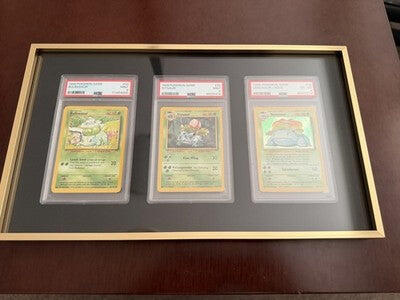
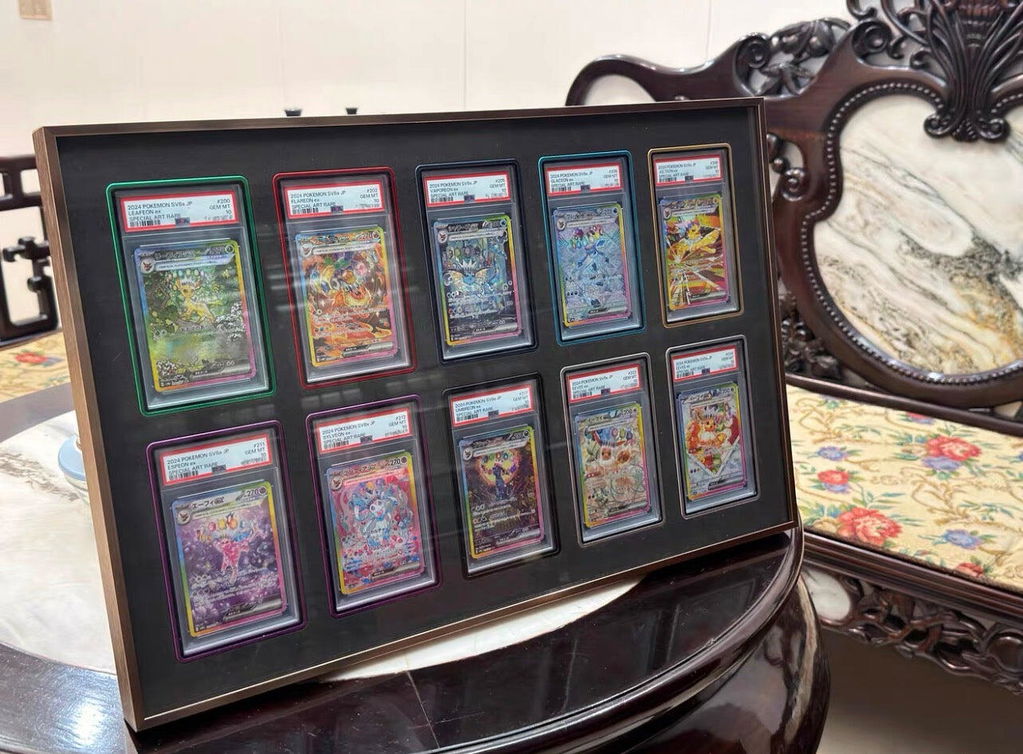
If you know you eventually want a nine-card display, you can deliberately build a nine-card group.
If you want an eighteen-card player collection, you can work toward eighteen cards that visually belong together.
If you want a large graded set on the wall, you can consider the final card count and holder format while acquiring cards.
Build Collection Groups That Can Eventually Be Displayed
A large collection does not need to be displayed all at once.
Instead, think in groups.
For example:
- Nine cards from one set.
- Six cards featuring one Pokémon.
- Eighteen cards from one player.
- Twelve rookie cards.
- A complete character evolution.
- A group of autographed cards.
- A graded subset from a larger collection.
These groups can remain part of a much larger collection while still creating coherent displays.
Plan Around the Actual Holder Format
If display is part of the collection plan, the holder format matters.
PSA, CGC, BGS and One Touch holders have different dimensions.
A display designed specifically around one format should not automatically be assumed to fit another.
This becomes increasingly important as the number of cards grows because small dimensional differences repeat across the entire grid.
The Card Collective® aluminium trading card display range includes dedicated configurations for supported PSA, CGC, BGS and One Touch formats across multiple grid capacities.
Think About Orientation and Available Wall Space
If you already know where the collection may eventually be displayed, measure the available wall.
Consider:
- Width.
- Height.
- Furniture.
- Doors.
- Windows.
- Orientation.
- Number of cards.
This can influence whether a long horizontal collection, vertical arrangement, square grid or several smaller displays make more sense.
Plan for Collection Rotation
You do not need enough wall space to display every card you will ever own.
A larger collection can be rotated.
You might display one set for several months and then replace it with another.
Or keep permanent favourites on display while rotating secondary groups.
This allows the stored collection and displayed collection to serve different purposes.
Should You Collect Sealed Products?
Sealed collecting is another distinct branch of the hobby.
Before buying heavily, consider whether sealed products actually belong in your collection goal.
They can require considerably more storage space than individual cards.
A shelf of booster boxes, tins or collection products creates a different storage problem from a binder or slab box.
If sealed products are not central to your collection, do not feel obligated to buy them simply because they are part of the same hobby.
Packs or Singles?
Opening packs and buying singles solve different collecting goals.
Packs provide uncertainty and the possibility of pulling cards you were not specifically targeting.
Singles let you buy the exact card you want.
If your collection has a very specific objective, buying singles can provide much greater control over what enters it.
If opening products is part of what you enjoy, allocate part of the budget to packs without expecting every pack to advance the collection efficiently.
Do Not Confuse Collecting With Investing
A card can be enjoyable to own without becoming more valuable.
If your main objective is collecting, choose cards that make sense for the collection rather than assuming every purchase must produce a financial return.
If potential value is important to you, treat that as a separate consideration and research accordingly.
There is no guarantee that a particular trading card, set or category will increase in value.
Plan a Pokémon Card Collection
Pokémon offers an enormous number of possible collecting directions.
You could build around:
- One Pokémon.
- One evolution line.
- One artist.
- One era.
- Complete sets.
- Promotional cards.
- Vintage cards.
- Modern illustration cards.
- Graded cards.
- Specific rarities.
Trying to collect everything can quickly become overwhelming.
Choosing one or two primary directions makes the collection easier to manage while still leaving room for unrelated cards you simply enjoy.
Plan a Sports Card Collection
Sports collectors can narrow their focus using several different dimensions.
For example:
- Player.
- Team.
- Season.
- Rookie cards.
- Autographs.
- Serial-numbered cards.
- One manufacturer.
- One set.
- Championship teams.
- Hall of Fame players.
A clear focus can be particularly useful in sports cards because one player may have hundreds or thousands of different cards.
Plan an MTG, Yu-Gi-Oh! or One Piece Collection
Other trading card games can also be approached through a collecting goal rather than simply accumulating cards.
Depending on the game, you might collect:
- A character.
- A card type.
- A rarity.
- A particular set.
- Alternative artwork.
- Promotional cards.
- Vintage releases.
- Graded examples.
The exact system should reflect what interests you about that particular game.
Start Cataloguing Earlier Than You Think You Need To
A catalogue seems unnecessary when you own twenty cards.
It becomes considerably more useful when you own hundreds.
Starting early means you do not need to reconstruct years of purchases later.
At minimum, consider recording:
- Card.
- Set.
- Card number.
- Raw or graded.
- Grade where applicable.
- Purchase price.
- Purchase date.
- Storage location.
The system can become more detailed as the collection grows.
Document Important Purchases From the Beginning
For significant cards, retain useful purchase records and photographs.
This can include:
- Receipts.
- Marketplace orders.
- Purchase dates.
- Purchase prices.
- Grading certification numbers.
- Front and back photographs.
Doing this at the time of purchase is much easier than trying to reconstruct the information years later.
Review the Collection Periodically
Your original collecting goal does not need to remain permanent.
Interests change.
You might discover a different set, player, character or era that interests you more.
Every few months, ask:
- Do I still enjoy collecting this?
- Which cards do I care about most?
- What am I buying that does not really fit?
- Are there duplicates I no longer need?
- Has my budget changed?
- Has the collection become difficult to store?
- Which cards do I actually want to display?
The plan should serve the collection, not trap you inside decisions you made years earlier.
Know When the Collection Is Getting Too Big
There is no universal number of cards that makes a collection too large.
The warning signs are practical.
The collection may need attention when:
- You regularly buy duplicates accidentally.
- You cannot find cards you know you own.
- Bulk has no organisation.
- Storage is overflowing.
- You have stopped cataloguing purchases.
- You are buying cards simply because they are available.
- You no longer know which part of the collection matters most.
At that point, curation becomes as important as acquisition.
Plan for Selling and Trading
A collection does not need to grow forever in one direction.
Selling and trading can help refine it.
Cards that no longer fit your focus can be moved on and the funds redirected toward cards that do.
This can be particularly useful when:
- You have duplicates.
- You upgrade to a better condition copy.
- You upgrade a graded card.
- Your collecting focus changes.
- You buy a larger collection containing cards you do not want.
Build a Collection That Is Easy to Understand
A well-planned collection does not necessarily need to be small.
It simply needs enough structure that you understand what you own and why it belongs.
A collection containing 2,000 cards can be highly organised.
A collection containing 100 cards can be completely chaotic.
Size is not the deciding factor.
Structure is.
Common Mistakes When Planning a Trading Card Collection
Trying to Collect Everything
The trading card hobby is too large for most collectors to own everything that interests them. A primary focus makes decisions easier.
Buying Too Quickly
Your preferences may change substantially during your first months collecting.
Buying Because Something Is Cheap
A bargain that does not fit the collection is still money spent.
Ignoring Storage
Large graded and sealed collections require considerably more physical space than many new collectors expect.
Grading Everything Automatically
Decide which cards actually benefit your collection by being graded.
Ignoring Holder Formats
Different graded slabs and magnetic holders require different storage and display dimensions.
Not Tracking Purchases
It becomes much harder to reconstruct purchase prices, dates and card details years later.
Having No Plan for Duplicates
Duplicates accumulate surprisingly quickly, particularly when opening products.
Never Reviewing the Collection
Your interests will probably change. The collection should be allowed to change with them.
A Simple Trading Card Collection Plan
If you want a straightforward starting point, answer these questions:
- What do I primarily want to collect?
- Do I want sets or individual cards?
- Do I prefer raw, graded or One Touch cards?
- If graded, does grading company matter?
- What condition or grade am I targeting?
- What is my collecting budget?
- Which cards are currently highest priority?
- How will the collection be stored?
- How large could the collection realistically become?
- Which cards or groups do I eventually want to display?
- How will I track what I own?
- What will I do with duplicates?
You do not need perfect answers.
Even rough answers create considerably more direction than buying without any plan at all.
Frequently Asked Questions About Planning a Trading Card Collection
How do I start a trading card collection?
Choose a category that genuinely interests you, decide what type of cards you want to focus on and start with a manageable number of deliberate purchases rather than trying to collect everything immediately.
Do I need a plan before collecting trading cards?
No, but a basic plan can help control spending, reduce unnecessary purchases and make the collection easier to organise as it grows.
What should I collect first?
Start with cards connected to the reason you became interested in collecting, such as a favourite Pokémon, player, team, set, artist or era.
Should I collect complete sets or individual cards?
Set collecting provides a defined completion goal, while individual-card collecting provides more freedom. Choose whichever structure better matches what you enjoy.
Should I collect raw or graded cards?
Raw cards are compact and work well in binders, while graded cards provide an assigned grade and rigid holder but require more space. Many collections contain both.
Should I grade all my cards?
No. You can reserve grading for cards where the grade, protection or presentation is important to your collection.
What grade should I collect?
There is no required grade. Some collectors target PSA 10s while others prefer lower-cost graded examples or raw cards. Choose a standard that fits your goals and budget.
Should I collect PSA, CGC or BGS?
You can collect one grading company or mix several. If physical consistency or display is important, remember that the holders have different dimensions.
Are One Touch holders good for collections?
They can provide a practical way to individually protect and present selected raw cards without professionally grading them.
How much money should I spend on trading cards?
There is no universal amount. Set a collecting budget that fits your own finances and avoid treating hobby spending as money that is guaranteed to return later.
Should I have a monthly trading card budget?
A monthly limit can make spending easier to control, particularly when you regularly buy cards throughout the year.
Should grading have a separate budget?
It can be useful because grading introduces costs beyond purchasing the cards themselves.
Should I make a trading card wishlist?
Yes. A wishlist can help prioritise cards and reduce impulse purchases that do not fit the main collection.
How do I prioritise cards on my wishlist?
Use simple priority levels such as high, medium and low, or rank cards according to how important they are to the collection.
Should I buy packs or singles?
If you want specific cards, singles provide more control. Packs can still be enjoyable, but they are less predictable as a way to build a targeted collection.
Should I buy cards because they might increase in value?
Potential value can be one consideration, but future prices are uncertain. A collecting plan should not depend on every purchase becoming more valuable.
How do I avoid buying duplicate cards?
Maintain a simple catalogue or checklist and check it before making purchases, particularly once the collection becomes larger.
What should I do with duplicate trading cards?
You can keep, sell or trade them, or retain the best example and move the others on.
How should I store a new trading card collection?
Choose storage appropriate to the card and holder format, such as binders, card boxes, slab storage or suitable displays.
When should I start cataloguing my trading cards?
Earlier than you think. Starting while the collection is small avoids having to reconstruct hundreds of purchases later.
Should I keep receipts for trading cards?
Keeping receipts and purchase records can be useful for significant cards, particularly when you want a historical record of what you paid and where the card came from.
Should I plan how my collection will be displayed?
Yes, if display matters to you. Knowing the eventual card count, holder type and available wall space can help shape the collection from the beginning.
How many cards should I put in a display?
There is no correct number. Build display groups around cards that make sense together and choose a configuration that suits the available space.
Can I display only part of a large collection?
Yes. Many collectors can keep most cards organised in storage while displaying selected groups and rotating them over time.
Can PSA and BGS cards go in the same fitted display?
Not automatically. Their holder dimensions differ, so a fitted display designed for one holder format should not be assumed to fit another.
How do I plan a Pokémon card collection?
Choose a focus such as one Pokémon, set, era, artist, rarity or graded collection rather than assuming you need to collect every type of Pokémon card.
How do I plan a sports card collection?
A sports collection can be structured around a player, team, season, rookies, autographs, serial-numbered cards or a particular set.
How do I know if my trading card collection is getting too big?
If you cannot find cards, regularly buy duplicates, run out of storage or no longer understand what belongs in the collection, it may be time to reorganise and curate it.
Can I change my collecting goal later?
Absolutely. A collection plan is a tool, not a permanent rule. Your interests can change as you learn more about the hobby.
Should I sell cards that no longer fit my collection?
You can. Selling or trading cards that no longer fit your focus can free space and budget for cards that matter more to you.
What is the best trading card collection strategy for beginners?
Start slowly, choose a clear area of interest, set a budget, research significant purchases, track what you own and allow your collecting preferences to develop before committing heavily to one direction.
Final Thoughts
You do not need to remove spontaneity from collecting to have a plan.
The purpose of planning is simply to give the collection direction.
Decide what interests you.
Choose whether you prefer sets or individual cards.
Think about raw cards, grading and holder formats.
Set a reasonable budget.
Build a wishlist.
Research significant purchases.
Plan for duplicates.
Think about storage before the collection becomes difficult to store.
Start cataloguing before you have hundreds or thousands of cards.
And consider which parts of the collection you eventually want to display.
The collection will almost certainly change over time.
That is fine.
A good plan should make those changes easier rather than prevent them.
As the collection grows, you can curate what belongs, catalogue what you own, document important cards and decide which groups deserve a permanent or rotating place on display.
The Card Collective® aluminium trading card display range includes dedicated configurations for supported PSA, CGC, BGS and One Touch holders across multiple grid capacities, with custom display enquiries available for collections that require a different layout or configuration.
Continue Exploring
If you are planning a premium trading card wall display, these guides and collections can help with the next step.
📚 Collector Guides
-
How to Choose the Right Trading Card Display Frame Size: The Complete Collector Guide
Compare display capacities and Grid layouts before choosing the colour configuration for your collection. -
Why Premium Aluminium Trading Card Display Frames Are Worth It: The Complete Collector Guide
Explore aluminium construction, display design and the role of premium materials in a purpose-built trading card wall display. -
The Ultimate Trading Card Display Guide: Ideas, Frames, Shelves & Display Solutions for Every Collector
Compare wall frames, stands, shelves, cabinets and other ways to display trading cards across different budgets and collection types.
🛒 Shop Display Collections
-
Aluminium Trading Card Wall Display Frames
Premium aluminium trading card display frames with multiple Grid layouts, holder-specific configurations, aluminium Frame Colours and supported Black or White EVA Foam options. -
PSA, CGC & BGS Graded Slab Wall Display Frames
Purpose-built graded card display frames for compatible PSA, CGC and BGS slab configurations. -
One Touch Wall Display Frames
Premium wall display frames designed around compatible One Touch magnetic trading card holders.


0 comments