


Trading Card Collecting for Beginners: How to Start, Organise, Protect & Display Your Collection
Starting a trading card collection can be as simple as buying a few cards from a favourite game, opening a booster pack or keeping cards of a particular player, character or team.
It can also become much larger.
Collectors build complete sets, collect individual characters, search for rare cards, grade valuable cards, organise binders, build decks, display favourite cards and collect sealed products.
There is no single correct way to collect trading cards.
A Pokémon collector trying to complete a set may approach the hobby very differently from a sports card collector searching for rookie cards. A Magic: The Gathering player may collect cards for decks as well as display, while a Yu-Gi-Oh! collector may focus entirely on one monster, rarity or era.
The most useful starting point is deciding what interests you before spending heavily on cards, storage, grading or display products.
For a beginner, that means understanding several basic questions.
- What trading cards do you want to collect?
- Should you buy booster packs, boxes or individual cards?
- How do you know which cards are valuable?
- What are card rarities?
- Should cards be sleeved?
- What is the difference between a top loader and a One Touch holder?
- When is card grading worthwhile?
- How should a collection be organised?
- How should valuable cards be stored?
- How can favourite cards be displayed?
- How much should a beginner spend?
- How can a collection grow without becoming disorganised?
This guide covers the fundamentals of trading card collecting for beginners.
It explains how to start collecting Pokémon cards, sports cards, Magic: The Gathering, Yu-Gi-Oh!, One Piece, Disney Lorcana, Dragon Ball, Digimon, Flesh and Blood, Star Wars Unlimited and other trading card games.
It also covers booster packs, singles, rarity, card condition, sleeves, binders, top loaders, One Touch magnetic holders, graded cards, PSA, CGC and BGS slabs, storage, organisation, displaying cards and planning a collection as it grows.
The aim is not to tell every collector to buy the same cards.
It is to provide a practical starting point for understanding the hobby and building a collection around the cards you actually want to own.
What Is Trading Card Collecting?
Trading card collecting is the process of acquiring, organising and keeping cards based on a particular collecting goal or personal interest.
Some trading cards are designed primarily around games.
Others are centred on sports, entertainment, characters, artwork or memorabilia.
Many modern card hobbies combine several of these elements.
A collector might buy cards because of:
- The artwork.
- A favourite Pokémon or character.
- A favourite athlete or sports team.
- The rarity.
- The card's history.
- A particular trading card set.
- The condition or grade.
- An autograph.
- A piece of memorabilia.
- A tournament achievement.
- A specific artist.
- A complete collection goal.
- The card's use within a game.
These approaches can overlap.
A card can be valuable to a collector because it is rare, useful in a deck, difficult to find, visually interesting or connected to a favourite character.
Not every card in a collection needs to be expensive.
Large collections often contain inexpensive cards alongside a much smaller number of premium pieces.
A collection does not need to begin with rare or expensive cards. Starting with a clearly defined theme usually makes it easier to decide what to buy, what to ignore and how to organise the cards as the collection grows.
Why Do People Collect Trading Cards?
Trading cards support several different types of collecting.
Understanding which part of the hobby interests you can prevent unnecessary purchases early on.
Collecting Favourite Characters
Character collecting is common across Pokémon, Yu-Gi-Oh!, One Piece, Disney Lorcana, Dragon Ball and many entertainment card games.
A collector may focus entirely on:
- Charizard.
- Pikachu.
- Gengar.
- Eeveelutions.
- Blue-Eyes White Dragon.
- Dark Magician.
- Monkey D. Luffy.
- Roronoa Zoro.
- Elsa.
- Goku.
- One particular character from an anime or franchise.
This can be easier to manage than attempting to collect every card released for an entire game.
Collecting Complete Sets
Set collectors attempt to obtain every card within a particular release.
Depending on the game, this may include:
- The numbered base set.
- Secret rares.
- Alternate artworks.
- Parallel versions.
- Promotional cards.
- Stamped cards.
- Master-set variations.
Before beginning a complete set, decide what “complete” means for that collection.
A standard numbered set can be significantly easier and less expensive to complete than a master set containing every variation.
Collecting Sports Players
Sports collectors may focus on one athlete throughout an entire career.
The collection might include:
- Rookie cards.
- Base cards.
- Parallels.
- Numbered cards.
- Autographs.
- Patch cards.
- Championship cards.
- Graded examples.
Collecting Teams
Team collecting allows cards from many players and eras to sit within one broader theme.
This can include:
- Current players.
- Historic players.
- Rookies.
- Championship teams.
- Hall of Fame players.
- Autographs and memorabilia cards.
Collecting Artwork
Some collectors choose cards primarily because of their artwork.
This is particularly common with:
- Pokémon Illustration Rares.
- Pokémon Special Illustration Rares.
- Magic: The Gathering showcase treatments.
- Secret Lair cards.
- One Piece alternate-art cards.
- Disney Lorcana Enchanted cards.
- Yu-Gi-Oh! premium rarities.
- Anime trading cards.
Collecting Graded Cards
Some collections are built around professionally graded cards rather than raw cards.
A collector might focus on:
- PSA 10 cards.
- CGC 10 cards.
- BGS 9.5 or 10 cards.
- Vintage graded cards.
- Graded rookie cards.
- Graded Pokémon sets.
- One graded example of each favourite card.
Collecting Sealed Products
Not every trading card collection consists entirely of individual cards.
Collectors may also keep:
- Booster packs.
- Booster boxes.
- Elite Trainer Boxes.
- Collection boxes.
- Starter decks.
- Structure decks.
- Commander decks.
- Collector tins.
Sealed collecting requires considerably more storage space than individual cards, so available room should be considered before buying large quantities.
How to Start a Trading Card Collection
The easiest way to start is to define a small collecting goal.
A beginner does not need to understand every set, rarity, grading company and card value before purchasing the first cards.
However, having some direction makes it easier to avoid accumulating products that do not fit the collection later.
Step 1: Choose What You Want to Collect
Start with one game, sport, player, character, set or theme.
Examples include:
- Pokémon cards.
- Charizard cards.
- One Pokémon set.
- Vintage Pokémon.
- NBA rookie cards.
- One football team.
- One baseball player.
- Magic Commander cards.
- Blue-Eyes White Dragon cards.
- One Piece manga and alternate-art cards.
- Lorcana Enchanted cards.
The goal can always expand later.
Step 2: Decide Whether You Want to Play, Collect or Both
Trading card games such as Pokémon, Magic, Yu-Gi-Oh!, One Piece and Lorcana can be collected independently of playing the game.
Players may need multiple copies of useful cards and regular access to their decks.
Collectors may care more about condition, artwork, rarity and presentation.
Someone doing both should usually separate active deck cards from cards intended for long-term collection.
Step 3: Set an Initial Budget
A budget provides a limit while you are still learning how the market works.
This is particularly useful when opening sealed products because individual packs do not guarantee that the card you want will be inside.
A beginner budget can be divided between:
- Cards.
- Booster products.
- Sleeves.
- Binders.
- Top loaders.
- Storage boxes.
- Display products.
Step 4: Learn the Set You Are Buying
Before buying large quantities of packs, look at the card checklist for the set.
Identify:
- The cards you actually want.
- The available rarities.
- The approximate set size.
- Whether there are secret or alternate-art cards.
- Whether singles are readily available.
- Whether the product is still being printed.
Step 5: Buy a Small Amount First
There is little reason for a beginner to immediately purchase large quantities of one product.
A few packs, a starter deck, a small group of singles or an inexpensive binder collection can provide enough experience to decide whether the set or game is worth pursuing further.
Step 6: Protect Cards as You Acquire Them
Basic sleeves and storage should be available before opening large quantities of cards.
This prevents valuable pulls from sitting unprotected while suitable holders are purchased later.
Step 7: Create an Organisation System Early
Even a collection of fifty cards is easier to organise before it becomes a collection of five thousand.
Decide whether cards will be sorted by:
- Set number.
- Character.
- Rarity.
- Colour.
- Player.
- Team.
- Year.
- Game.
- Value.
- Holder type.
Should Beginners Buy Booster Packs or Individual Cards?
This is one of the first decisions most new collectors encounter.
Booster packs and individual cards serve different purposes.
Buying Booster Packs
Booster packs contain a selection of cards from a particular set.
They are useful for:
- Seeing a broad range of cards from a set.
- Starting a binder collection.
- Obtaining common and uncommon cards.
- Building an initial card pool for some games.
- Collectors who specifically enjoy opening sealed products.
The main limitation is uncertainty.
Opening more packs does not guarantee a particular rare card.
Buying Individual Cards
Individual cards, commonly called singles, allow the collector to choose the exact card required.
Singles are particularly useful when:
- Only a few cards from a set are wanted.
- A set is nearly complete.
- The desired card is difficult to pull.
- The collector wants a particular condition.
- The collector wants a specific graded card.
- The card is needed for a deck.
Using Both Approaches
Many collectors combine the two.
They may open a limited number of packs when a set releases, keep the cards they want and then purchase missing cards individually.
This can prevent a collecting goal from turning into repeated purchases of sealed products containing mostly duplicates.
If the objective is to obtain one specific card, buying that card directly usually provides more certainty than repeatedly opening packs. Booster products are better treated as a way to obtain a random selection of cards rather than a guaranteed route to a particular pull.
Understanding Trading Card Sets
Most trading cards are released as part of identifiable sets, expansions, series or product years.
Understanding the set structure makes organising and buying cards considerably easier.
Set Numbers
Many trading cards include a number showing their position within the set.
A card marked 25/100, for example, generally indicates card 25 within a numbered set of 100 cards.
Some games also include cards numbered beyond the stated base-set total.
These may represent secret rares or other special cards depending on the game and release.
Set Symbols and Codes
Cards may include a symbol or code identifying the expansion they belong to.
This becomes useful when:
- Sorting cards.
- Checking values.
- Buying replacements.
- Completing sets.
- Identifying similar artworks from different releases.
Base Sets and Special Sets
Some releases form part of the normal expansion cycle, while others are special products with different pack structures, card lists or availability.
Beginners should check how a particular set is distributed before assuming every product can be purchased in the same format.
Reprints
The same card or artwork may appear in multiple products.
Two cards that look similar can have different:
- Set codes.
- Release years.
- Rarity symbols.
- Foil treatments.
- Promotional markings.
- Market values.
Identifying the exact printing is therefore important when cataloguing or pricing a collection.
Understanding Trading Card Rarity
Rarity describes how a card is classified within a particular product or set.
The terminology varies substantially between trading card games.
A rarity name used in Pokémon does not necessarily have the same meaning as a rarity used in Yu-Gi-Oh!, One Piece or Magic.
Common Cards
Common cards generally appear frequently within sealed products.
They often make up a large portion of a set.
Uncommon Cards
Uncommons usually appear less frequently than commons but remain relatively accessible.
Rare Cards
Rare cards appear less frequently and may use different symbols, foil treatments or card designs.
Ultra-Rare and Premium Treatments
Modern trading card games use many different premium rarity systems.
Depending on the game, these can include:
- Illustration Rares.
- Special Illustration Rares.
- Secret Rares.
- Alternate Arts.
- Manga Rares.
- Enchanted cards.
- Ghost Rares.
- Starlight-style rarities.
- Serialized cards.
- Cold Foils.
- Showcase treatments.
- Parallel cards.
- Refractors.
Promotional Cards
Promo cards may be distributed through:
- Events.
- Tournaments.
- Special boxes.
- Retail promotions.
- Magazine releases.
- Pre-orders.
- Membership programs.
A promotional card is not automatically valuable simply because it was distributed differently.
Supply, demand, condition and collector interest still matter.
Does Rarity Mean a Trading Card Is Valuable?
No.
Rarity and value are related in some cases, but they are not interchangeable.
A card can be difficult to pull and still have relatively limited demand.
An older card that was not exceptionally rare when released may become highly desirable because of its character, player, condition or historical significance.
Card value can be influenced by:
- Supply.
- Collector demand.
- Character popularity.
- Player popularity.
- Set popularity.
- Condition.
- Age.
- Print quantity.
- Artwork.
- Competitive usefulness.
- Autographs or memorabilia.
- Professional grade.
- Recent sales.
This is why rarity symbols should not be used as the only method for deciding which cards deserve additional protection.
How to Find Out What a Trading Card Is Worth
Card prices change over time.
A beginner should therefore focus on recent market evidence rather than assuming an old asking price represents current value.
Identify the Exact Card
Before comparing prices, confirm:
- The card name.
- The set.
- The card number.
- The release year.
- The language.
- The rarity or parallel.
- Whether it is first edition, unlimited or another printing where relevant.
- Whether the card is raw or graded.
Compare the Same Condition
A heavily played raw card should not be valued against a professionally graded high-grade example.
Condition can create a substantial price difference.
Look at Recent Completed Sales
Recent completed transactions generally provide more useful market information than unsold listings with ambitious asking prices.
Where possible, compare several recent sales rather than relying on one transaction.
Account for Grading
A PSA 10, PSA 9, CGC 10, BGS 9.5 and raw copy of the same card may all trade at different prices.
Do not apply the price of one grade automatically to another.
Check the Currency
Collectors buying internationally should check whether prices are listed in:
- Australian dollars.
- US dollars.
- Canadian dollars.
- British pounds.
- Euros.
- Japanese yen.
Shipping, marketplace fees, taxes and import costs can also affect the actual amount required to acquire a card.
Understanding Trading Card Condition
Condition is one of the most important concepts for a new collector to understand.
Two copies of the same card can have very different values if one is significantly better preserved.
Condition terminology varies between marketplaces and card categories, but collectors generally examine several physical areas.
Card Corners
Look for:
- Whitening.
- Rounding.
- Dents.
- Compression.
- Peeling.
Card Edges
Edges may show:
- Whitening.
- Chipping.
- Wear.
- Small dents.
- Foil separation.
Card Surface
Surface issues can include:
- Scratches.
- Print lines.
- Indentations.
- Stains.
- Scuffing.
- Fingerprints.
- Foil damage.
Card Centering
Centering refers to how evenly the printed card design sits within the card's borders.
It is particularly important when cards are being considered for professional grading.
Creases and Bends
A crease generally has a much greater effect on condition than minor edge wear.
Cards should be handled carefully even when they are immediately going into sleeves.
Common Trading Card Condition Terms
Marketplace terminology is not perfectly standardised, but collectors frequently encounter terms such as:
- Mint.
- Near Mint.
- Lightly Played.
- Moderately Played.
- Heavily Played.
- Damaged.
These terms should be treated as descriptions rather than exact universal grades.
When purchasing an expensive raw card, examine clear images of the front, back, corners and surface rather than relying entirely on the written condition label.
How to Handle Trading Cards Properly
Good handling habits are inexpensive and can prevent unnecessary damage.
Use Clean, Dry Hands
Hands should be clean and dry before handling cards.
Food residue, moisture and oils can transfer to card surfaces.
Hold Cards by the Edges
Avoid pressing fingers across foil or glossy surfaces where possible.
Prepare the Sleeve First
Have the sleeve or holder ready before removing a valuable card from another form of protection.
Do Not Force Cards Into Tight Sleeves
If a sleeve is too tight, forcing the card can damage corners or edges.
Keep Food and Drinks Away
Cards being sorted, opened or catalogued should be kept away from drinks and food.
Use a Clean Sorting Surface
A clean playmat or other smooth surface can reduce contact with rough tables and small debris.
Trading Card Sleeves for Beginners
Sleeves provide the first layer of protection for many raw cards.
Different sleeve types serve different purposes.
Penny Sleeves
Penny sleeves are inexpensive soft plastic sleeves commonly used for basic card protection.
They are useful for:
- Cards going into top loaders.
- Binder storage.
- Sorting valuable pulls.
- Temporary storage.
- Cards being prepared for sale.
Perfect-Fit Sleeves
Perfect-fit or inner sleeves sit more closely around the card.
They are commonly used as part of double-sleeving systems.
Deck Sleeves
Deck sleeves are designed for cards that will be handled during play.
They usually have a coloured or printed back and provide more durability than a thin penny sleeve.
Graded Card Sleeves
Outer sleeves are also available for PSA, CGC, BGS and other graded slabs.
These can reduce scratches and fingerprints on the slab itself.
What Is a Top Loader?
A top loader is a rigid plastic card holder with an opening at the top.
It is one of the most common protection methods used by trading card collectors.
A card is generally placed inside a soft sleeve before being inserted into the top loader.
Top loaders are useful for:
- Valuable raw cards.
- Shipping cards.
- Storage boxes.
- Card stands.
- Picture ledges.
- Wall displays.
Why Use a Sleeve Inside a Top Loader?
The soft sleeve creates a barrier between the card surface and the harder plastic holder.
Placing an unsleeved card directly into a top loader can increase the chance of surface contact and scratching.
Different Top Loader Thicknesses
Not every trading card has the same thickness.
Standard cards, patch cards, memorabilia cards and other thick sports cards may require different top loader sizes.
Confirm the card thickness before forcing a thick card into a standard holder.
What Is a Card Saver?
Card savers are semi-rigid holders commonly used when submitting cards to grading companies.
They provide more flexibility than a top loader while still supporting the card.
Collectors commonly use them for:
- Grading submissions.
- Temporary storage.
- Card transport.
- Cards being prepared for professional assessment.
They are generally less visually structured than top loaders or magnetic holders for permanent display.
What Is a One Touch Magnetic Card Holder?
A One Touch holder is a rigid card holder that uses a magnetic closure.
It provides a cleaner presentation than a standard top loader and allows a raw card to be displayed without professional grading.
One Touch holders are commonly used for:
- Premium Pokémon cards.
- Sports cards.
- Autographs.
- Patch cards.
- Alternate-art cards.
- Illustration Rares.
- Display collections.
- Cards that may be changed regularly.
Choosing the Correct One Touch Thickness
Magnetic holders are produced in different thicknesses.
This is particularly important for sports cards containing patches, jersey material or other thicker components.
The holder should match the card rather than forcing the card into a cavity that is too shallow.
Top Loader vs One Touch
Top loaders are inexpensive and practical for storage.
One Touch holders generally provide a more structured presentation and are commonly selected for individual display cards.
Neither option is automatically correct for every collection.
Trading Card Binders for Beginners
Binders are one of the most efficient ways to organise a large number of raw cards.
They are particularly useful for complete sets and character collections.
Side-Loading Binders
Side-loading pockets help prevent cards from sliding upward when pages are turned or the binder is carried.
Zipper Binders
A zipper can help keep the binder closed and reduce the amount of dust entering the pages.
Ring Binders
Traditional ring binders allow pages to be added and removed easily.
Care should be taken to prevent cards from being pressed against the rings when the binder is full.
Fixed-Page Binders
Fixed-page binders avoid exposed metal rings and provide a consistent number of card positions.
They work particularly well for complete sets.
How to Organise a Set Binder
A set binder can be arranged by card number.
Collectors may leave empty positions for missing cards so the final set remains in the correct sequence.
Some collectors also reserve positions for:
- Reverse holos.
- Parallel cards.
- Secret rares.
- Promotional cards.
- Alternate versions.
How to Organise a Trading Card Collection
An organisation system should make it easy to locate a card without searching through the entire collection.
The correct system depends on what is being collected.
Organising by Set
This works particularly well for trading card games.
Each set can have its own:
- Binder.
- Storage box.
- Divider.
- Spreadsheet section.
- Digital collection list.
Organising by Card Number
Number order is useful for complete sets because missing cards become immediately visible.
Organising by Character
Character collectors may dedicate separate binder sections to:
- Pikachu.
- Charizard.
- Gengar.
- Blue-Eyes White Dragon.
- Dark Magician.
- Luffy.
- Other favourite characters.
Organising Sports Cards by Player
Player collections can then be subdivided by:
- Year.
- Manufacturer.
- Set.
- Rookie cards.
- Parallels.
- Autographs.
- Graded cards.
Organising Sports Cards by Team
Team collections may be divided by season, player, position or era.
Organising by Value
Some collectors separate higher-value cards from bulk cards so that additional protection and security can be applied where appropriate.
Organising by Holder Type
Large collections may have separate areas for:
- Binder cards.
- Top-loaded cards.
- One Touch cards.
- Graded slabs.
- Sealed products.
The best organisation system is one you can maintain. A highly detailed catalogue is useful only if new cards continue to be added to it. Begin with a simple structure and add more information as the collection becomes larger or more valuable.
How to Store Trading Cards
Cards that are not being displayed should be stored in a way that limits unnecessary handling, dust, moisture and physical pressure.
Trading Card Storage Boxes
Card boxes provide efficient storage for bulk cards and organised sets.
Dividers can separate:
- Sets.
- Games.
- Players.
- Teams.
- Rarities.
- Duplicates.
Top Loader Storage Boxes
Top-loaded cards require larger compartments than loose or sleeved cards.
Purpose-built top loader boxes can keep these cards upright and organised.
Graded Slab Storage
Graded cards can be kept in:
- Slab boxes.
- Graded-card cases.
- Drawers.
- Cabinets.
- Display frames.
- Secure storage for higher-value collections.
Binder Storage
Binders should be kept in a clean, dry environment where they are not crushed beneath heavy objects.
Sealed Product Storage
Booster boxes and other sealed products require significantly more room.
They should be stored away from damp areas and locations where boxes may be compressed, punctured or exposed to prolonged direct sunlight.
Where Should Trading Cards Be Stored?
A stable indoor environment is generally preferable.
Avoid locations exposed to:
- Prolonged direct sunlight.
- Water leaks.
- High humidity.
- Rapid temperature changes.
- Excessive heat.
- Dust and dirt.
- Frequent accidental handling.
Garages, sheds, roof spaces and damp basements can experience larger environmental changes than ordinary living areas.
The suitability of any storage area depends on the actual conditions within that space.
Should You Grade Trading Cards?
Professional grading is optional.
A card does not need to be graded to form part of a serious collection.
Grading may be considered when a collector wants:
- An independent condition assessment.
- A sealed protective holder.
- A standardised labelled presentation.
- Easier comparison with other graded examples.
- A graded-card collection.
- Potentially improved marketability for certain cards.
However, grading also involves cost, turnaround time and the possibility that the card receives a lower grade than expected.
Cards That May Be Considered for Grading
Collectors often consider grading:
- Valuable cards.
- Vintage cards in strong condition.
- Important rookie cards.
- Rare Pokémon cards.
- Autographs.
- Low-population cards.
- Favourite cards intended for permanent collection.
Cards That May Not Need Grading
Grading may be unnecessary when:
- The card has little financial value.
- The collector prefers binders.
- The card is used for play.
- The collector prefers One Touch holders.
- The grading fee is disproportionate to the card's value.
- The collector simply does not want graded slabs.
What Is PSA Grading?
PSA is one of the grading companies commonly encountered in trading card collecting.
Cards submitted for grading are encapsulated inside a labelled rigid slab after assessment.
PSA-graded cards are common across:
- Pokémon.
- Baseball.
- Basketball.
- American football.
- Soccer.
- Yu-Gi-Oh!.
- Magic: The Gathering.
- One Piece.
- Other collectible cards.
Collectors should remember that the grade applies to the specific card assessed and does not mean every copy of that card has the same value.
What Is CGC Grading?
CGC is another grading company used for trading cards.
Its slabs have different external dimensions from PSA holders.
This becomes important when purchasing:
- Storage boxes.
- Slab stands.
- Wall mounts.
- Display frames.
A product designed around PSA dimensions should not automatically be assumed to fit CGC slabs.
What Is BGS Grading?
BGS, or Beckett Grading Services, is widely encountered across sports cards and trading card games.
BGS slabs differ in dimensions and thickness from PSA and CGC holders.
Collectors building a graded-card display should therefore choose products designed for the intended slab format.
Raw Cards vs Graded Cards
Neither format is automatically better.
Advantages of Raw Cards
- Usually cheaper to purchase than equivalent high-grade slabs.
- Easier to store in binders.
- Can be used in decks where appropriate.
- Can be placed in different holder types.
- Can be submitted for grading later.
Advantages of Graded Cards
- Condition has been professionally assessed.
- The card is sealed inside a rigid holder.
- The label identifies the card and grade.
- Slabs provide a consistent external display format.
- They can be easier to catalogue by grade.
Using Both
Many collections contain both.
A collector might keep the complete set raw in a binder while purchasing or grading a small number of favourite cards for a slab display.
How to Start Collecting Pokémon Cards
Pokémon provides several different entry points for new collectors.
A beginner can collect by set, Pokémon, generation, rarity, artwork, language or grading company.
Collecting Pokémon by Set
Choose one expansion and begin filling a binder in card-number order.
This provides a clear start and finish point.
Collecting One Pokémon
Character collections can focus on:
- Pikachu.
- Charizard.
- Gengar.
- Mew.
- Mewtwo.
- Rayquaza.
- Umbreon.
- Eevee and its evolutions.
- Any favourite Pokémon.
Collecting Pokémon by Rarity
A collector may focus on:
- Illustration Rares.
- Special Illustration Rares.
- Full Arts.
- Gold cards.
- Vintage holos.
- Promotional cards.
Collecting Vintage Pokémon
Vintage collections may focus on older sets, original artworks, first editions or specific eras.
Condition becomes increasingly important when comparing older cards.
Collecting Japanese Pokémon Cards
Japanese releases can differ from English products in set structure, card availability, promotional distribution and release timing.
Collectors should identify the exact Japanese set and card number when comparing cards.
Displaying Pokémon Cards
Favourite Pokémon cards can be displayed using:
- Acrylic stands.
- Top loader displays.
- One Touch holders.
- Graded slab stands.
- Picture ledges.
- Wall-mounted trading card frames.
How to Start Collecting Sports Cards
Sports card collecting covers many leagues, manufacturers, sets, players and card types.
A narrow starting goal is particularly useful.
Choose a Sport
Common categories include:
- Baseball cards.
- Basketball cards.
- American football cards.
- Soccer and football cards.
- Hockey cards.
- Formula 1 cards.
- Wrestling cards.
- UFC cards.
Choose a Player or Team
Player collecting provides a defined focus across many different products.
Team collecting provides a broader goal that can continue across seasons.
Learn Sports Card Parallels
Sports card products frequently contain several versions of the same base card.
These may differ through:
- Colour.
- Foil pattern.
- Serial numbering.
- Refractor treatment.
- Autograph.
- Memorabilia.
Understand Numbered Cards
A serial-numbered card is produced in a stated quantity for that particular version.
Examples may include cards numbered to:
- /999.
- /499.
- /199.
- /99.
- /50.
- /25.
- /10.
- /5.
- 1/1.
Lower numbering can reduce supply, but demand for the player and product remains important when determining value.
Understand Rookie Cards
Rookie cards are a major area of sports collecting.
Collectors should identify which cards are recognised as rookie issues within the relevant sport and product rather than assuming every card released early in a player's career has equal significance.
How to Start Collecting Magic: The Gathering Cards
Magic collections often overlap with deck building.
A beginner may collect:
- One set.
- Commander cards.
- Favourite legendary creatures.
- One colour.
- One guild.
- Planeswalkers.
- Specific artists.
- Foils.
- Secret Lair releases.
- Older or Reserved List cards.
Separate Play Cards From Collection Cards
Cards used regularly in decks should remain easy to access.
Higher-value cards kept primarily for collecting may use separate storage or display systems.
Collecting Commanders
Favourite commanders can form a compact collection even when the associated decks change frequently.
They can be stored in binders, magnetic holders or displayed beside their deck boxes.
How to Start Collecting Yu-Gi-Oh! Cards
Yu-Gi-Oh! collectors can focus on monsters, archetypes, rarities, sets or anime eras.
Character and Monster Collections
Popular themes include:
- Blue-Eyes White Dragon.
- Dark Magician.
- Dark Magician Girl.
- Red-Eyes Black Dragon.
- Exodia.
- Egyptian God Cards.
- Cyber Dragon.
- Elemental HERO cards.
Rarity Collections
Yu-Gi-Oh! has used numerous foil and rarity treatments across different releases.
Collectors should identify the exact set, rarity and printing when comparing similar cards.
Anime-Era Collections
Cards can also be grouped around:
- Duel Monsters.
- GX.
- 5D's.
- ZEXAL.
- ARC-V.
- VRAINS.
How to Start Collecting One Piece Cards
The One Piece Card Game provides several straightforward collecting themes.
Collectors may focus on:
- Monkey D. Luffy.
- Roronoa Zoro.
- Nami.
- Sanji.
- Shanks.
- Trafalgar Law.
- Portgas D. Ace.
- Boa Hancock.
- Leader cards.
- Alternate arts.
- Manga rares.
- One particular set.
Collecting by Crew
Cards can also be grouped around:
- Straw Hat Pirates.
- Red-Haired Pirates.
- Heart Pirates.
- Whitebeard Pirates.
- Marines.
- Other factions and crews.
Using one character or crew as the initial collecting goal can keep the collection manageable while learning the card game and its releases.
How to Start Collecting Disney Lorcana Cards
Lorcana collectors may organise cards around:
- Favourite Disney characters.
- Films.
- Ink colours.
- Complete sets.
- Enchanted cards.
- Promotional cards.
- Favourite artwork.
Collecting by Film
A film-focused collection may include cards from:
- Frozen.
- The Lion King.
- Beauty and the Beast.
- Aladdin.
- The Little Mermaid.
- Lilo & Stitch.
Collecting Enchanted Cards
Collectors interested primarily in premium artwork may choose Enchanted cards rather than attempting to complete every card within every release.
How to Start Collecting Dragon Ball Cards
Dragon Ball collections can focus on characters, transformations, battles, series or rarities.
Possible themes include:
- Goku.
- Vegeta.
- Gohan.
- Frieza.
- Broly.
- Fusion characters.
- Transformation sequences.
- Dragon Ball Z.
- Dragon Ball Super.
A transformation sequence can provide a clear collecting goal without requiring every card of one character.
How to Start Collecting Digimon Cards
Digimon collections can be structured around:
- Favourite Digimon.
- Evolution lines.
- Tamers.
- Alternate artworks.
- Royal Knights.
- Sets.
- Colours.
Evolution lines provide a natural binder or display sequence and can be expanded gradually.
How to Start Collecting Flesh and Blood Cards
Flesh and Blood collectors may focus on:
- Heroes.
- Classes.
- Equipment.
- Cold Foils.
- Marvel cards.
- Promotional cards.
- Tournament cards.
- Signed or event-stamped cards.
Players may also keep a separate collection of important cards associated with decks they have used competitively.
How to Start Collecting Star Wars Unlimited Cards
Star Wars Unlimited can be collected by:
- Character.
- Faction.
- Era.
- Set.
- Leader.
- Hyperspace treatment.
- Showcase cards.
Possible themes include Jedi, Sith, the Rebel Alliance, the Galactic Empire, Mandalorians or characters from a particular Star Wars era.
Collecting Other Trading Card Games
The same beginner principles apply to many other card games and entertainment card collections.
These include:
- Weiss Schwarz.
- Union Arena.
- Final Fantasy Trading Card Game.
- Cardfight!! Vanguard.
- Sorcery: Contested Realm.
- Altered.
- KeyForge.
- Grand Archive.
- Force of Will.
- Universus.
- Marvel trading cards.
- DC trading cards.
- Star Trek cards.
- Entertainment trading cards.
Begin by identifying the exact cards or releases that interest you, then learn the rarity and set structure used by that particular product.
How Much Should a Beginner Spend on Trading Cards?
There is no required starting budget.
A collection can begin with inexpensive singles and basic sleeves.
The more important consideration is whether spending remains proportionate to the collecting goal.
Low-Cost Beginner Collection
A small starting budget can focus on:
- Inexpensive singles.
- A few booster packs.
- One binder.
- Penny sleeves.
- A small number of top loaders.
Mid-Range Beginner Collection
A larger budget might include:
- One booster box or equivalent sealed product.
- Selected singles.
- A quality binder.
- Top loaders.
- A few magnetic holders.
- Storage boxes.
Higher-Budget Beginner Collection
Someone entering the hobby with a larger budget should still define the collection before purchasing expensive cards.
Possible purchases include:
- Graded cards.
- Vintage cards.
- Rare singles.
- Premium sealed products.
- Display cases.
- Purpose-built card frames.
Having more money available does not remove the need to learn the market, condition standards and exact card variations.
How to Avoid Overspending When Starting a Collection
Trading card products can be released frequently, particularly across several games at once.
A collector does not need to participate in every release.
Create a Collecting List
Keep a list of cards that fit the collection.
This makes it easier to distinguish a planned purchase from an unrelated card that happens to be available.
Set a Monthly Budget
A fixed amount can prevent one new release from consuming the budget intended for several months of collecting.
Compare Prices
Check several recent sales before purchasing an expensive single.
Do Not Treat Asking Prices as Market Value
A seller can list a card at almost any asking price.
Completed sales provide evidence that buyers have actually paid a particular amount.
Know When to Stop Opening Packs
If only one or two cards remain on the wanted list, buying those singles may be more practical than continuing to open sealed products.
Avoid Buying Every Variation Immediately
A new collector may discover that the same card exists in many languages, rarities, parallels or promotional versions.
Decide which versions actually belong in the collection before attempting to obtain all of them.
How to Catalogue a Trading Card Collection
Cataloguing becomes increasingly useful as a collection grows.
A catalogue can be as simple as a written list or as detailed as a spreadsheet containing every card.
Useful Information to Record
A collection catalogue may include:
- Card name.
- Game or sport.
- Set.
- Card number.
- Year.
- Rarity.
- Language.
- Condition.
- Grade.
- Grading company.
- Purchase price.
- Purchase date.
- Storage location.
- Duplicate quantity.
Using a Spreadsheet
Spreadsheets are useful for large collections because cards can be sorted and filtered by set, player, rarity, grade or storage location.
Using Collection Apps
Digital collection applications may provide card databases, scanning functions and price information.
Collectors should still verify important card variations and market values independently where accuracy matters.
Photographing Valuable Cards
Keeping clear photographs of higher-value cards can assist with cataloguing, condition records and insurance documentation.
What Should You Do With Duplicate Trading Cards?
Duplicates are a normal result of opening booster products and purchasing collections.
They do not all need to remain in the main binder.
Keep Useful Duplicates
Players may require multiple copies for decks.
Create a Trade Binder
Duplicate cards with collector interest can be separated into a dedicated trade binder.
Sell Duplicates
Higher-value duplicates may be sold individually, while lower-value cards may be grouped into lots.
Store Bulk Separately
Common duplicates can be moved into labelled storage boxes rather than occupying the main display or set binder.
Use Duplicates for Different Displays
An inexpensive duplicate can sometimes be used in a desk or wall display while the stronger-condition copy remains in protected storage.
How to Decide Which Trading Cards to Display
Not every card in a collection needs to be visible.
Display works best when a smaller group is selected deliberately.
Cards can be chosen based on:
- Favourite artwork.
- Character.
- Player.
- Team.
- Rarity.
- Grade.
- Set.
- Colour.
- Personal collecting theme.
- Completion of a particular group.
Display Favourites Rather Than Only Expensive Cards
Market value does not need to determine the visible collection.
An inexpensive card with strong artwork may contribute more to a themed display than an unrelated high-value card.
Rotate the Display
Collectors with limited space can keep most cards in binders or storage and change the visible cards periodically.
This works particularly well with:
- Acrylic stands.
- Picture ledges.
- One Touch holders.
- Accessible wall frames.
- Small slab displays.
Trading Card Display Options for Beginners
Display methods range from inexpensive desktop stands to large wall-mounted frames.
The right option depends on the card holder, number of cards and available space.
Acrylic Card Stands
Acrylic stands are useful for individual cards and small collections.
They can support:
- Top loaders.
- One Touch holders.
- PSA slabs.
- CGC slabs.
- BGS slabs.
Picture Ledges
Picture ledges allow several cards to sit in one row and can be changed without remounting every holder.
Floating Shelves
Floating shelves work well when the collection includes cards alongside:
- Booster boxes.
- Deck boxes.
- Figures.
- Collector tins.
- Other memorabilia.
Display Cabinets
Cabinets are useful for larger mixed collections and can provide basic dust protection.
Multi-Card Wall Frames
Purpose-built frames organise several card holders into one consistent layout.
They are useful for:
- Graded-card collections.
- One Touch collections.
- Complete visual sets.
- Character collections.
- Sports card collections.
- Large collector walls.
Displaying Raw Trading Cards
Raw cards should generally remain inside a suitable protective holder when displayed.
Options include:
- Top loaders on stands.
- One Touch magnetic holders.
- Binder rotation.
- Picture ledges.
- Floating shelves.
- Purpose-built raw-card displays.
A penny sleeve alone provides little structural support for an exposed desk or shelf display.
Displaying Graded Trading Cards
PSA, CGC, BGS and other slabs can be displayed using:
- Individual slab stands.
- Picture ledges.
- Acrylic shelves.
- Display cabinets.
- Individual wall mounts.
- Purpose-built multi-slab frames.
Because grading companies use different slab dimensions, confirm compatibility before purchasing fixed holders or frames.
Displaying One Touch Trading Cards
One Touch magnetic holders provide a consistent external format for raw cards.
They work particularly well for collectors who want to display artwork without a grading label.
One Touch collections can use:
- Desktop stands.
- Picture ledges.
- Floating shelves.
- Wall mounts.
- Multi-card display frames.
Cards can remain interchangeable, allowing the visible collection to change as new cards are acquired.
How to Build Your First Trading Card Display
A beginner display does not need to contain the entire collection.
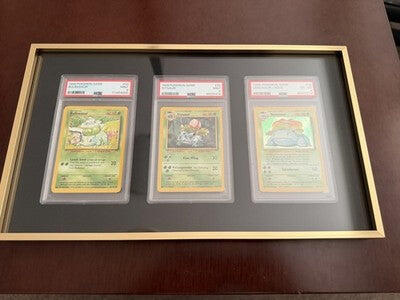
Start With Three Cards
Choose three related cards such as:
- A Pokémon evolution line.
- Three favourite players.
- Three versions of one character.
- Three graded cards.
- Three alternate artworks.
Use matching stands or one small frame.
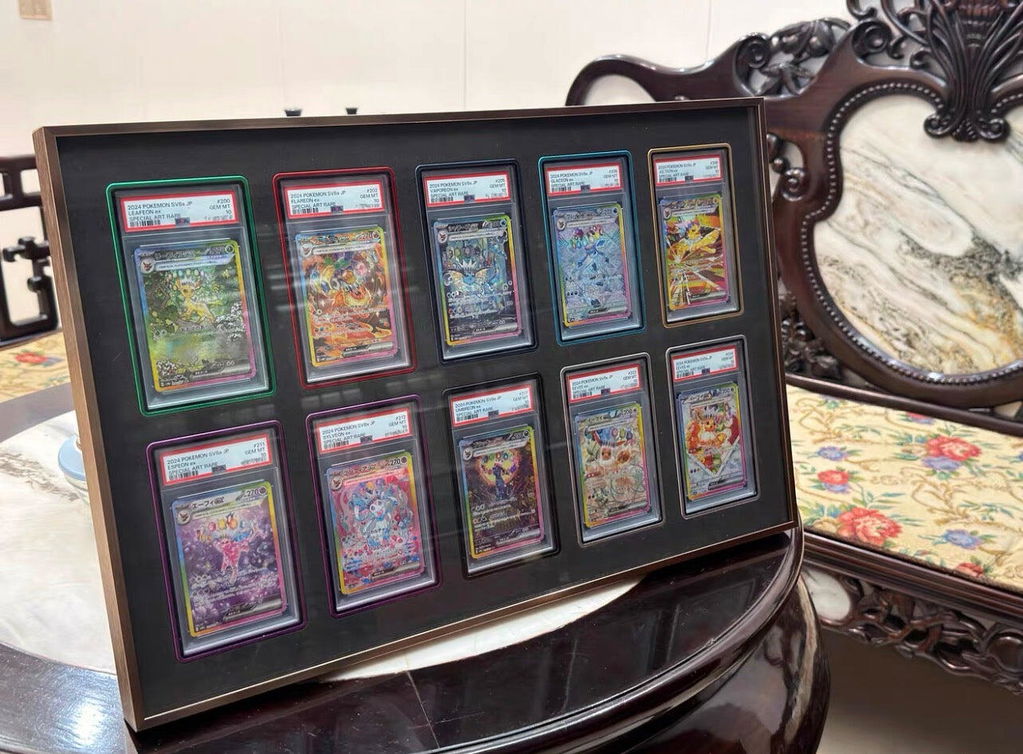
Expand to Nine Cards
A nine-card arrangement provides enough space for a broader theme while remaining relatively compact.
Possible nine-card collections include:
- Eeveelutions.
- Nine favourite Pokémon.
- Nine sports players.
- Nine MTG commanders.
- Nine anime characters.
- Nine graded chase cards.
Add Shelving for Larger Products
Keep booster boxes, figures and deck boxes outside the card grid so the display does not become overcrowded.
Expand Modularly
If the collection continues growing, add matching frames or shelves rather than redesigning the entire wall.
Protecting Trading Cards on Display
Displaying cards introduces different environmental considerations from keeping them inside closed storage.
Avoid Prolonged Direct Sunlight
Cards, slab labels, posters and sealed packaging can be affected by prolonged direct sunlight.
Basic UV-protection acrylic may reduce some exposure, but it does not make a display suitable for continuous direct sunlight.
Reduce Dust
Open stands and shelves require more frequent cleaning than enclosed frames and cabinets.
Use Secure Mounting
Wall frames and shelves should be installed using fixings suitable for the wall construction and completed display weight.
Keep Drinks Away
Desk displays should be positioned away from cups and bottles.
Consider Security
A display product should not be treated as a replacement for a safe, security system or suitable insurance where a collection has substantial value.
Common Trading Card Collecting Mistakes for Beginners
Most early collecting mistakes come from purchasing before deciding what the collection is meant to become.
Buying Everything
Trying to collect every release from several games can become expensive and difficult to organise.
Choose specific sets, characters, players or card types first.
Opening Packs to Find One Specific Card
Booster packs contain random cards.
If only one particular card is wanted, repeatedly opening sealed products can produce large numbers of duplicates without obtaining that card.
Assuming Rare Means Expensive
Rarity does not guarantee high market value.
Demand and condition remain important.
Using Unsold Listings to Value Cards
An asking price only shows what a seller wants.
Recent completed sales provide stronger evidence of actual market activity.
Handling Valuable Cards Without Protection
A valuable pull should be placed into suitable protection rather than left loose on a desk.
Putting Unsleeved Cards Into Hard Holders
Where the holder system calls for a soft inner sleeve, use one to reduce direct contact with harder plastic surfaces.
Forcing Thick Cards Into Standard Holders
Sports memorabilia cards and other thick cards may require deeper holders.
Overfilling Binders
A binder that is packed too tightly can place unnecessary pressure on cards and pages.
Ignoring Card Condition
The same card in different conditions can have substantially different market values.
Grading Every Card
Professional grading has a cost.
Not every card benefits from being graded.
Assuming a Card Will Receive a High Grade
A card that appears clean at first glance may still have centering, surface, corner or edge issues.
Buying Expensive Cards Before Learning the Set
Similar artworks can exist across several printings and rarities.
Identify the exact card before making a substantial purchase.
Failing to Track Purchases
Collectors can accidentally buy duplicates when the collection becomes large enough that every owned card is difficult to remember.
Storing Cards in Poor Environments
Moisture, direct sunlight, heat and unstable storage areas can create avoidable risks.
Displaying Every Card
A display does not need to contain the entire collection.
Bulk cards, duplicates and lower-priority cards usually belong in organised storage.
Buying Storage Too Late
Buying a binder and storage boxes before the collection becomes large is generally easier than organising thousands of unsorted cards later.
Ignoring Future Growth
Leave spare binder positions, storage capacity and display space when the collection is likely to expand.
How to Build a Trading Card Collection in Stages
A collection can develop gradually as knowledge and interests become clearer.
Stage 1: Choose One Theme
Select one set, character, player, team or game.
Stage 2: Buy Basic Protection
Start with:
- Sleeves.
- A binder or storage box.
- A small number of top loaders.
Stage 3: Learn the Cards
Understand the set numbers, rarities, important variations and typical conditions before purchasing expensive examples.
Stage 4: Build the Core Collection
Purchase packs, singles or both according to the collecting goal.
Stage 5: Separate the Collection
Create dedicated areas for:
- Main collection cards.
- Duplicates.
- Trade cards.
- Deck cards.
- Higher-value cards.
Stage 6: Catalogue the Collection
Begin tracking cards once the collection becomes difficult to remember manually.
Stage 7: Consider Grading
Review favourite or valuable cards individually rather than assuming every card should be submitted.
Stage 8: Build a Display
Select a smaller group of cards that represents the collection and choose stands, shelves, cabinets or frames suited to their holders.
Stage 9: Expand Carefully
Add new sets, characters or games only when they fit the available budget, storage and space.
Beginner Pokémon Collection Example
A simple Pokémon collection might begin with:
- One current set binder.
- Penny sleeves.
- A small number of booster packs.
- Selected singles to fill missing positions.
- Top loaders for favourite pulls.
- Three or nine favourite cards selected for display.
As the collection grows, the collector might add a separate character binder, graded cards or a larger wall display.
Beginner Sports Card Collection Example
A sports collection might begin around one favourite athlete.
The collector could acquire:
- Several inexpensive base cards.
- One recognised rookie card.
- One numbered parallel.
- One autograph if the budget allows.
- A binder or card box.
- Top loaders for higher-priority cards.
- One stand for the current favourite.
This provides variety without requiring the collector to understand every product released across the entire sport.
Beginner Trading Card Game Collection Example
A beginner collecting Magic, Yu-Gi-Oh!, One Piece, Lorcana or another trading card game may combine playing and collecting.
A basic setup could include:
- One starter or constructed deck.
- Deck sleeves.
- One binder for collection cards.
- A storage box for bulk cards.
- Top loaders for valuable pulls.
- A small trade section.
- A few favourite cards selected for display.
This keeps playable cards accessible while separating them from cards intended primarily for collection.
Frequently Asked Questions About Trading Card Collecting
How do I start collecting trading cards?
Choose one game, set, player, team, character or theme, set a budget and begin with a small number of cards. Purchase basic sleeves and storage at the same time so the collection can be organised from the beginning.
What trading cards should a beginner collect?
Start with cards connected to a game, sport, player, character or artwork you already want to collect. There is no universal beginner card that everyone needs to own.
Do trading cards have to be valuable to collect?
No. Many collections are based on artwork, characters, sets, teams or personal collecting goals rather than market value.
Should I collect Pokémon cards?
Pokémon offers many collecting approaches including complete sets, individual Pokémon, vintage cards, Illustration Rares, promotional cards and graded cards.
What Pokémon should I collect first?
A favourite Pokémon is often the simplest starting point. Alternatively, choose one current set and collect it in card-number order.
Should I buy Pokémon packs or singles?
Packs provide random cards from a set. Singles are more practical when you want a specific card. Many collectors use both approaches.
How do I start collecting sports cards?
Choose one sport and then narrow the collection to a player, team, rookie class, set or card type.
What is a rookie card?
A rookie card is a card associated with the early professional card releases of an athlete. Exact recognition can vary by sport and product, so the specific card should be researched before purchasing.
What is a parallel card?
A parallel is an alternative version of a base card, often using a different colour, foil treatment, pattern or serial numbering.
What does /99 mean on a sports card?
It generally indicates that the particular card version was produced in a stated run of 99 copies.
Is a 1/1 card rare?
A true 1/1 version has only one copy produced for that specific card variation, although market value still depends on demand for the player, character and product.
What does TCG mean?
TCG commonly stands for Trading Card Game.
What is a trading card set?
A set is a defined group of cards released together as part of an expansion, series, season or product.
What does a card number mean?
The number usually identifies the card's position within its set and helps distinguish it from other printings.
What is a secret rare?
The exact definition varies by game, but the term generally refers to a premium card classification associated with a set's rarity structure.
Does rare mean valuable?
No. A card also needs collector demand, and condition can significantly affect its market value.
How do I know if my trading card is valuable?
Identify the exact set, card number, variation and condition, then compare recent completed sales for the same card.
Where should I check trading card prices?
Use recent marketplace sales and established card-market data relevant to the particular game or sport. Compare multiple transactions where possible.
Should I use sold prices or listed prices?
Completed sales generally provide stronger evidence of current market value because they show transactions that actually occurred.
Why is the same card listed at different prices?
Differences can result from condition, grading, language, set, rarity, printing, seller pricing and market timing.
What does Near Mint mean?
Near Mint is a commonly used condition description for a card with limited visible wear. Exact standards vary between sellers and marketplaces.
What damages trading cards?
Common risks include scratches, bends, creases, moisture, poor handling, excessive pressure, dirt and prolonged direct sunlight.
Should every trading card be sleeved?
Cards being collected, played or stored long term generally benefit from suitable protection, although the level of protection can vary according to the card and how it is used.
What is a penny sleeve?
A penny sleeve is a thin soft plastic sleeve used as basic card protection and commonly placed inside other rigid holders.
What is a top loader?
A top loader is a rigid plastic holder commonly used for storage, shipping and protecting individual cards.
Should a card be sleeved before going into a top loader?
Yes. A soft sleeve is generally used between the card and the rigid top loader.
What is a One Touch card holder?
A One Touch is a rigid magnetic holder used for protecting and presenting individual raw cards.
Is a One Touch better than a top loader?
They serve different purposes. Top loaders are inexpensive and practical for storage, while One Touch holders provide a more structured presentation for individual cards.
Can I put Pokémon cards in One Touch holders?
Yes, provided the holder dimensions and depth are suitable for the card and any sleeve configuration being used.
What is a card saver?
A card saver is a semi-rigid holder commonly used for grading submissions and card transport.
Should I use a binder for trading cards?
Binders are one of the most space-efficient ways to organise raw-card collections and complete sets.
Are zipper binders good for cards?
They can provide organised storage and help keep the binder closed, although the quality and pocket construction still matter.
Should I use a ring binder?
Ring binders can work, but cards should not be allowed to press against the rings when pages are turned or the binder is full.
How should I organise Pokémon cards?
Common systems include set number, Pokémon, rarity, type, generation and value.
How should I organise sports cards?
Sports cards can be organised by player, team, year, manufacturer, set, card type or value.
How should I organise a mixed card collection?
Separate the collection by game or sport first, then apply a second system such as set, player, character or year.
What should I do with duplicate cards?
Duplicates can be traded, sold, stored as bulk, used in decks or kept in a separate trade binder.
Should I catalogue my collection?
Cataloguing becomes useful when the collection is large enough that remembering every card, variation and storage location becomes difficult.
What should I record in a card spreadsheet?
Useful fields include card name, set, number, year, rarity, condition, grade, purchase price and storage location.
How should trading cards be stored?
Use binders, card boxes, top loader boxes, graded-card storage or other suitable systems in a stable indoor environment.
Can I store trading cards in a garage?
Only if environmental conditions are suitable. Garages can experience greater temperature and humidity changes than ordinary indoor rooms.
Should trading cards be kept out of sunlight?
Cards should generally be kept away from prolonged direct sunlight.
Can humidity damage trading cards?
Excessive moisture and unstable environmental conditions can affect paper-based collectibles and should be avoided.
Should I grade my trading cards?
Grading is optional. Consider the card's value, condition, importance to the collection, grading cost and whether you actually prefer graded slabs.
What cards are worth grading?
Collectors commonly consider valuable cards, vintage cards, important rookies, rare cards and personal favourites in strong condition.
Should I grade cheap cards?
There is no rule preventing it, particularly for a personal collection, but the grading cost may exceed the card's market value.
What is PSA?
PSA is a professional grading company commonly used for trading cards and sports cards.
What is CGC?
CGC is another professional grading company used for collectible cards.
What is BGS?
BGS refers to Beckett Grading Services, which is widely encountered in sports and trading card collecting.
Are PSA, CGC and BGS slabs the same size?
No. Their external dimensions differ, which matters when choosing storage and display products.
Is a PSA 10 always valuable?
No. The underlying card still needs collector demand. A high grade does not automatically make every card expensive.
Are graded cards safer than raw cards?
Graded slabs provide rigid encapsulation, but collectors should still protect slabs from drops, scratches, excessive heat, moisture and prolonged direct sunlight.
Can I collect raw and graded cards together?
Yes. Many collectors keep full sets raw while grading or purchasing slabbed versions of selected favourites.
Should I display my trading cards?
That depends on the collection and available space. Favourite cards can be displayed while the majority remain in organised storage.
What is the cheapest way to display trading cards?
Existing shelves, small acrylic stands, mini easels and picture ledges can provide inexpensive display options.
How do I display Pokémon cards?
Pokémon cards can be displayed in top loaders, One Touch holders, graded slabs, acrylic stands, shelves or purpose-built wall frames.
How do I display sports cards?
Sports cards can use stands, magnetic holders, graded slab displays, shelves, shadow boxes and wall frames.
How do I display graded cards?
Use slab stands, ledges, shelves, cabinets, individual wall mounts or multi-card frames designed for the relevant grading format.
Can I display cards without grading them?
Yes. Top loaders and One Touch holders allow raw cards to remain protected while being displayed.
Can I display cards in a bedroom?
Yes. Compact shelves, desk stands, picture ledges and small wall frames work particularly well where floor space is limited.
Can I display cards in a gaming room?
Yes. Gaming rooms can combine card frames, floating shelves, framed playmats, deck storage and display cases.
Can I display cards in a home office?
Yes. Small structured displays, neutral frame finishes and acrylic stands can integrate with a workspace.
How many cards should a beginner display?
There is no required number. Three or nine related cards can provide a manageable first display.
What is a good first Pokémon display?
A three-card evolution line, nine Eeveelutions, a small Charizard collection or nine favourite cards can create a defined starting theme.
How do I protect displayed cards from sunlight?
Position the display away from prolonged direct sunlight. Basic UV-protection acrylic may reduce some exposure but does not make continuous direct sunlight suitable.
How do I keep displayed cards clean?
Use enclosed frames or cabinets where practical and clean open stands, shelves and holders with suitable soft materials.
Do I need expensive card storage?
No. Basic sleeves, a suitable binder and organised card boxes can support a large collection effectively.
When should I upgrade my storage?
Upgrade when the collection's size, value, holder types or organisation requirements exceed the capacity of the existing system.
How quickly should I build my collection?
There is no required pace. Building gradually provides more time to understand sets, card condition, pricing and the types of cards you actually want to keep.
Can trading card collecting be inexpensive?
Yes. Character cards, base sets, lower-rarity cards and inexpensive singles can support large collections without focusing on premium chase cards.
Do I need to collect expensive chase cards?
No. Chase cards are only relevant if they fit the collection you want to build.
Should I collect complete sets?
Complete sets provide a defined collecting goal, but they are not necessary. Character, player, artist, rarity and theme collections can be much smaller.
What is a master set?
The definition varies between collecting communities, but it generally refers to a more comprehensive version of a set that includes additional variants beyond the basic numbered cards.
Should I collect sealed products?
Only if sealed products are part of your collecting goal and you have appropriate storage space.
Should I open my sealed trading card products?
That depends on whether the product was purchased for sealed collecting or for the cards inside. Opening it permanently changes it from a sealed collectible into its individual contents.
How do I know what to collect next?
Review the existing collection and identify the next missing card, set, player, character or group that supports the same collecting goal.
How do I stop my collection becoming disorganised?
Use consistent storage, label boxes and binders, catalogue larger collections and separate duplicates from the main collection.
What should I buy first as a new card collector?
Start with the cards themselves, basic sleeves and a suitable binder or storage box. Additional holders, grading and display products can be added as the collection develops.
Final Thoughts
Trading card collecting can begin with a single booster pack, one favourite player, a Pokémon character, a starter deck or a handful of inexpensive cards.
It does not require an expensive first purchase or a complete understanding of every part of the hobby.
The most useful first step is deciding what the collection is intended to contain.
A clearly defined collecting goal makes almost every later decision easier.
It helps determine which cards to buy, which products to ignore, how much storage is required and whether grading or display is relevant.
Beginners should learn to identify exact card printings, understand basic rarity and condition, compare recent sales and protect cards appropriately as they are acquired.
Sleeves provide basic protection.
Top loaders provide rigid support for individual raw cards.
One Touch magnetic holders provide a more structured presentation format.
Binders efficiently organise complete sets and larger raw-card collections.
Storage boxes keep duplicates and bulk cards separated from the main collection.
Professional grading provides another option for cards that a collector wants independently assessed and encapsulated.
Display can then be treated as a separate decision.
A few favourite cards may sit on acrylic stands. A larger collection may use picture ledges, floating shelves or cabinets. Graded and One Touch collections can also be organised into purpose-built multi-card wall frames.
As the collection grows, the same basic principles continue to apply.
- Know what you are collecting.
- Identify the exact card before buying.
- Understand condition.
- Protect cards appropriately.
- Organise cards before the collection becomes unmanageable.
- Separate bulk, duplicates and active deck cards.
- Catalogue larger collections.
- Grade selectively rather than automatically.
- Display a curated part of the collection.
- Leave room for future growth.
A trading card collection does not need to follow somebody else's definition of complete.
It can contain one character, one team, one set, hundreds of inexpensive cards, a small number of graded cards or several different trading card games.
The important part is building a system that makes the cards easy to identify, protect, organise and view as the collection develops.
Continue Exploring
If you enjoyed this guide, you may also find these collector resources helpful.
📚 Collector Guides
-
The Ultimate Trading Card Display Guide: Ideas, Frames, Shelves & Display Solutions for Every Collector
Explore display ideas, wall layouts, shelving, cabinets, lighting, budgets and display solutions for every major trading card game. -
Why Premium Aluminium Trading Card Display Frames Are Worth It: The Complete Collector Guide
Discover why handmade aluminium display frames have become a premium choice for displaying PSA, CGC, BGS and One Touch trading card collections.
🛒 Shop Display Collections
-
Aluminium Trading Card Wall Display Frames
Premium handmade aluminium wall display frames for Pokémon, MTG, Yu-Gi-Oh!, One Piece and Sports Cards. -
PSA, CGC & BGS Graded Slab Wall Display Frames
Purpose-built wall display frames designed specifically for graded trading card collections. -
One Touch Wall Display Frames
Premium wall display frames designed for One Touch magnetic trading card holders in a range of grid sizes.


0 comments